Publish chess with Typst. staunton goes beyond
board drawings and turns games and positions into publication-quality
diagrams, move notation, and tournament tables — all as referenceable #figures.
A move generator in pure Typst reads FEN and PGN, and everything is
localized to seven languages.
Requires Typst 0.14.2+ with HTML export as the only exception — it builds on compiler features added in 0.15, so it needs 0.15+ whereas paged output (PDF, PNG, SVG) and every other feature work already on 0.14.2.
A game, published-
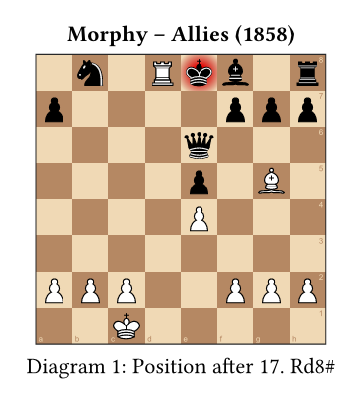
Install the package, parse a PGN, and drop a captioned diagram of any position — the players, the year, and the move just played are filled in automatically:
#import "@preview/staunton:2.0.0": game, diagram, notation, standings-table

#let opera = game(```
[White "Morphy"] [Black "Allies"] [Date "1858"]
1. e4 e5 2. Nf3 d6 3. d4 Bg4 4. dxe5 Bxf3 5. Qxf3 dxe5 6. Bc4 Nf6 7. Qb3 Qe7
8. Nc3 c6 9. Bg5 b5 10. Nxb5 cxb5 11. Bxb5+ Nbd7 12. O-O-O Rd8 13. Rxd7 Rxd7
14. Rd1 Qe6 15. Bxd7+ Nxd7 16. Qb8+ Nxb8 17. Rd8# 1-0
```)

// The final position: roster → info line, last move → caption, check → king glow.
#diagram(opera, at: "17w", check: true)
Move notation
Numbered movetext with figurine glyphs, inline variations, NAGs and comments, localized to the document language — output no board-only package produces:
#let g = game("1. e4 e5 2. Nf3 Nc6 3. Bb5 a6 4. Ba4 Nf6 5. O-O Be7 (5... Nxe4!? 6. d4 b5) 6. Re1 b5 7. Bb3 d6 *")

#notation(g, figurine: true, variations: true, nags: true)

Tournament tables
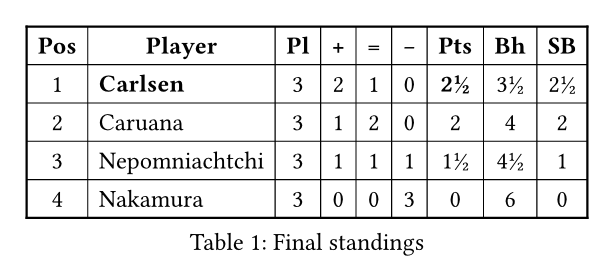
Standings, cross-tables and progress tables straight from the games’ result tags, with Buchholz / Sonneborn-Berger tie-breaks:
#let gs = games(```
[White "Carlsen"][Black "Nakamura"][Result "1-0"][Round "1"] 1-0
[White "Caruana"][Black "Nepomniachtchi"][Result "1/2-1/2"][Round "1"] 1/2-1/2
[White "Carlsen"][Black "Caruana"][Result "1/2-1/2"][Round "2"] 1/2-1/2
[White "Nepomniachtchi"][Black "Nakamura"][Result "1-0"][Round "2"] 1-0
[White "Carlsen"][Black "Nepomniachtchi"][Result "1-0"][Round "3"] 1-0
[White "Nakamura"][Black "Caruana"][Result "0-1"][Round "3"] 0-1
```)

#standings-table(gs, caption: [Final standings])
Annotated diagrams
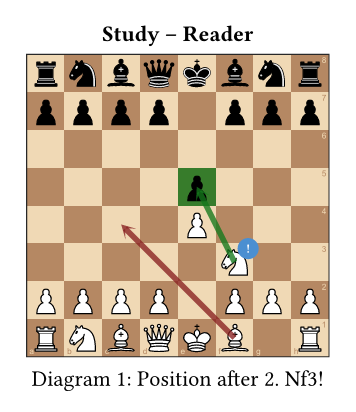
%cal / %csl drawing commands in a move’s comment become arrows and highlights,
and a ! / ? grade becomes a move-quality badge — composited onto the board:
#let g = game("1. e4 e5 2. Nf3! {[%cal Gf3e5,Rf1c4][%csl Ge5]} Nc6 *")

#diagram(g, at: "2w", annotations: true, move-quality: true)
Themed boards
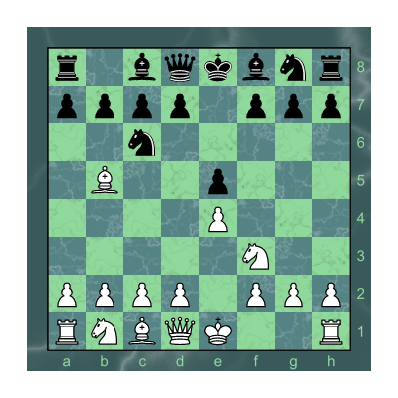
Reusable color-theme / board-theme values — eleven built-ins each — cover
everything from a flat two-color pairing to a full “look”: square patterns
(stripes, marble, wood) and a matching material band around the board:
#board(
  "r1bqkbnr/pppp1ppp/2n5/1B2p3/4P3/5N2/PPPP1PPP/RNBQK2R b KQkq - 3 3",
  label-mode: "border",
  border-theme: "marble",
  color-theme: color-theme(base: "coral", pattern: "marble", brightness: -15%, contrast: 30%),
)
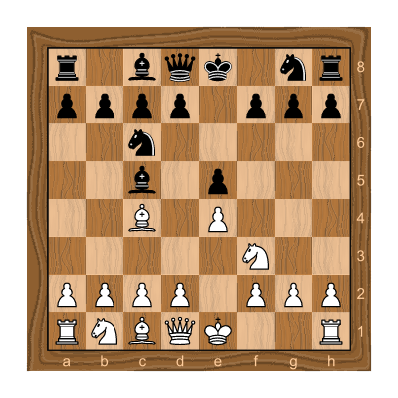
The same machinery in wood — the grain runs across both square colors, so the
board reads as inlaid light and dark timber (set pattern-light: false for the
dark-squares-only look). The textures are monochrome by design: they carry light
and shadow only, so the hue always comes from your color-theme:
#board(
  "r1bqk1nr/pppp1ppp/2n5/2b1p3/2B1P3/5N2/PPPP1PPP/RNBQK2R w KQkq - 4 4",
  label-mode: "border",
  border-theme: "wood",
  color-theme: color-theme(base: "wikipedia", pattern: "wood"),
)
…and the basics
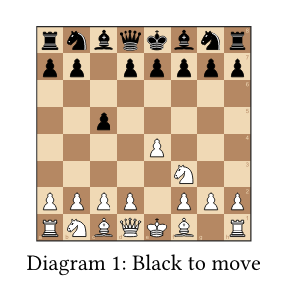
A bare board for an inline or decorative position; diagram
whenever you want it captioned, counted, @-referenceable and listed by an
outline. Sources are the same everywhere — a FEN string, a position(..) object,
or a squares dict:
#diagram("rnbqkbnr/pp1ppppp/8/2p5/4P3/5N2/PPPP1PPP/RNBQKB1R b KQkq - 1 2")
Features
- PGN engine — parse multi-game files, navigate the mainline and (nested) variations by locator, play “what-if” lines, and export FEN, all on a pure-Typst legal-move engine (lazy parsing stays fast on large files). Reads movetext written with Unicode figurines or localized piece letters, so games copied straight out of Informator-style and non-English sources.
- Notation — numbered movetext, inline/indented variations, figurine glyphs, NAGs, comments, and diagrams embedded at markers; localized piece letters.
- Tournament tables — standings, cross-tables and progress (player or team), with Buchholz / Sonneborn-Berger tie-breaks, and a curated set of styling options (rule presets, header / body fills including zebra rows, alignment, winner highlighting) settable per call or document-wide.
- Annotations & markings —
%cal/%cslarrows and highlights from PGN, an in-check glow, move-quality badges, and an optional last-move marking (arrow or squares); add NAGs / comments / variations to a game programmatically, then render it like any parsed one. Every automatic marking comes from the game you pass, so a bare position is never marked. - Styling — reusable
color-theme/board-themevalues (11 built-ins each, derivable from one another), brightness / contrast adjustment, square patterns (stripes, marble, wood), seven"border"-mode band looks including “wood” and “marble” material patterns, six label placements, flip, piece sets, grid; proportional highlights (filled / cross / circle / frame); arrows with a barbed or triangular tip and an optional fade along the shaft; size-adaptive layout. - Bring-your-own & fairy pieces — any downloaded set via a
piece-setloader (named-piece-set/svg-piece-set), plus non-standard kinds and whole variants (define-variant,with-fallback). - Chess960 / Fischer Random — board, engine, PGN pipeline and notation all handle 960 (X-FEN castling, the FRC PGN tags, Scharnagl start numbers).
- Publishing niceties — everything is a
#figure:@labelcross-references, dedicated outlines (lists of diagrams / tables), localization (en, de, es, fr, it, pt, ru), and limited HTML export.
Documentation
- User manual — the complete reference (every function, option, and example),
with each feature shown as the code you type beside the board it produces.
Download the compiled PDF (attached to each release), or build it yourself
from its Typst source,
docs/manual.typ. The manual is part of the repo only — it is not shipped in the package bundle. - Showcase — a runnable capability tour.
Compile the manual and the showcase locally with the package folder as root (the manual’s own styling uses a 0.15 builtin, so building it needs Typst 0.15+ even though using the package does not):
typst compile --root . docs/manual.typ docs/manual.pdf
typst compile --root . docs/examples/showcase.typ showcase.pdf
API at a glance
| area | entry points |
|---|---|
| diagrams | diagram, board |
| positions | position, play, to-fen, starting-fen, chess960-start-fen |
| games (PGN) | game, games, movetext, mainline, move-at, game-start, game-result, game-variant |
| annotate / build | with-nags, with-comments, with-line |
| notation | notation |
| tables | standings-table, crosstable-table, progress-table, games-by-event (+ compute: standings, crosstable, progress) |
| outlines | diagram-outline, table-outline, outlines |
| themes | color-theme, board-theme |
| pieces & variants | define-variant, named-piece-set, svg-piece-set, with-fallback, piece-content, parse-square, is-dark-square |
| engine | legal-moves, apply, in-check, move-to-san |
| defaults | set-chess-defaults, set-board-defaults, set-diagram-defaults, set-table-defaults, set-pgn-defaults, set-lang, set-piece-set |
Pieces & licensing
The code (lib.typ, src/**/*.typ) is MIT. The bundled piece SVGs
are GPLv2+ — two sets ship: cburnett (default, © Colin M.L. Burnett) and
merida (© Armando Hernandez Marroquin), from the
lichess collection. See LICENSE
and LICENSE-PIECES. The package manifest declares
MIT AND GPL-2.0-or-later.
A "unicode" glyph fallback needs no SVGs. To use other art, pass piece-set a
loader (named-piece-set / svg-piece-set, or with-fallback for mixed and
fairy boards) — see the Pieces and fonts and Non-standard pieces sections of
the manual.
(Other popular lichess sets carry non-commercial licenses and are not bundled.)
The manual and tests also embed CC BY-SA 4.0 fairy demo art (under docs/ and
tests/), which is not part of the shipped package — see LICENSE-PIECES.
Repository layout
typst.toml          package manifest          LICENSE / LICENSE-PIECES  MIT / GPLv2+
lib.typ             public API + figure wrapper
src/                engine, FEN/PGN/SAN, notation, tournament, board renderer, i18n
src/assets/         piece-set SVGs (cburnett, merida), square/band pattern SVGs, i18n files
docs/manual.typ     user manual (-> PDF)      docs/examples/  runnable showcase
tests/              test suite (bash tests/run.sh)   scripts/  release bundle build
Tests
bash tests/run.sh        # compiles pass-cases; asserts fail-cases error as expected
bash tests/run.sh -j1    # force serial (default: one worker per CPU)
bash tests/run.sh --system-fonts   # real fonts (slower) — the release gate
Test files are independent compiles, so the runner dispatches them across one
worker per CPU and skips the system-font scan by default (--ignore-system-fonts)
— together a multiple-times-faster suite. Fonts affect only rendered glyphs, never
pass/fail, so the release gate re-runs with --system-fonts for the visual eyeball.
The runner walks every .typ under tests/; a file with a // EXPECT: <substr>
header must error with that message, any other must compile. Files/dirs prefixed
_ (shared fixtures) are skipped; docs/examples/*.typ are compiled too.
Changelog
2.0.0
Breaking. 2.0.0 is a large-scale redesigns of the game / PGN surface around two rules:
-
there is one way to do each thing, and
-
a move is something you pass, not something smuggled inside a value. Every rename below is a hard break — no aliases were kept.
-
Parsing:
parse-pgn(x)becomesgames(x), orgame(x)when you expect exactly one (it errors if the input holds more).parse-fen(x)becomesposition(x), which auto-detects a FEN.chess960-start(n)becomesposition(chess960-start-fen(n)). -
Drawing a move:
diagram-after(g, "17w")becomesdiagram(g, at: "17w"), andboardaccepts the same pair. Previously a position carried a hidden payload describing the move that produced it; it no longer does, so positions are uniform whatever built them. The consequence is the point of the release: the move-quality badge and%cal/%cslannotations are available only when you hand over the game together withat:. A bare position — from a FEN, a squares dict, orapply— has no move behind it and is never badged or annotated. -
position-afteris now internal. It returned a bare position, silently discarding the move, which madediagram(position-after(g, L))quietly lose its badge and annotations. Pass the game withat:instead. -
One positional argument, then named ones. The shape of nearly every function is now
f(subject, setting: .., ..)— the thing being acted on is positional, everything that configures the action is named. The transitional positional locator / payload forms are gone:to-fen(source, at: ..),play(source, moves: ..),with-nags(game, nags: ..),with-comments(game, comments: ..). Calls no longer depend on argument order, and adding an option can never shift the meaning of an existing one.The deliberate exceptions are the places where there is no single subject:
apply(position, move),in-check(position, color)andmove-to-san(position, move)take two co-equal operands of one operation rather than a subject plus a setting;is-dark-square(col, row)andpiece-content(kind, color, size)likewise take an inseparable tuple; andposition(..)stays variadic so a board can be written as one row string per line. -
One move accessor:
move-sanandmove-nodeare removed in favour ofmove-at(game, at: ..), which returns the whole record — SAN, NAGs, comments, variations, and the resolvedfrom/to/piece/capture/promotion. -
Engine moves carry square names:
legal-moves(pos).first()is now(from: "g1", to: "f3", ..)rather than(col, row)tuples.applyandmove-to-sanspeak the same shape. -
with-variationbecomeswith-line, and it now does two jobs:with-line(g, at: "3w", moves: ..)branches a variation as before, whilewith-line(g, moves: ..)continues the mainline — playing out a mate the source game stopped short of, which previously had no API at all. -
Locators honour a game’s own starting move number (a game beginning at move 24 is addressed
"24w", not"1w"), andintois optional in a path hop, defaulting to the first variation. -
Multi-game text: a result token (
1-0,0-1,1/2-1/2,*) now ends a game, so files without a tag roster between games split correctly. Movetext whose move numbers go backwards is rejected rather than silently merged. -
Removed, having been public by accident:
chess-style,style-keys,default-style,style-state— re-exported but documented nowhere.
New in the same release:
- Arrow styling.
arrow-tipcan appear as"triangle"or"hook", a barbed head whose wings sweep back to points;"hook"is the new default, so existing arrows change appearance.arrow-fadefades a shaft toward its tail to a given opacity, relative to the head’s, and both are settable per arrow viatip:/fade:in an arrow entry. last-movemarks the move that produced the drawn position —"arrow"draws it,"squares"marks the two squares — and like every other automatic marking it needs a game plusat:; a bare position gets nothing. Off by default, settable document-wide.- Figurine notation as input.
game/gamesaccept movetext written with Unicode chess figurines (U+2654–U+265F, either colour set), as Chess Informator and many other publications typeset it. Nolang:is needed — figurines are language-neutral, which is why publications use them. - Localized movetext as input:
game(text, lang: "de")reads German, French, Spanish, Italian, Portuguese or Russian piece letters and normalizes them to standard SAN, so the reading language and the printing language are independent.
1.1.0 — GitHub release only
Never published to Typst Universe, which went from 1.0.0 straight to 2.0.0. The tag and the GitHub Release exist; if you install from Universe you will not have seen this version, and its changes reach you as part of 2.0.0.
- Positions remember the move they came from.
position-after(and anything built on it) now folds a small provenance payload — locator, SAN, move quality,%cal/%cslannotations, raw tags, but never the game itself — into the position it returns.board/diagramread that payload at one shared seam, so the move-quality badge and imported annotations render correctly regardless of which function produced the position: badge legitimacy is a property of the value (“this came from a real move”), not of which function was called. No new public API —diagram-afteris a one-line alias fordiagram(position-after(g, l)). - New highlight shape
"frame"— a stroked rounded rectangle hugging the square border, reproducing the square highlight used by ChessBase. Unlike"cross"it carries no empty-square convention: it leaves the centre clear, so it reads over an occupied square. Four new style options, each takingauto/ a ratio of the square / an absolute length:frame-color(green),frame-width(auto→ 10%),frame-margin(auto→ 3%) andframe-radius(auto→ 22%, the outer corner radius). Because PGN%cslentries honourhighlight-shape, settinghighlight-shape: "frame"also renders imported square annotations as frames. - Thinner highlight marks — changes existing documents.
cross-width,circle-widthandframe-widthnow default to 10% of the square instead of 15%. At 15% the non-filled marks read heavy against the pieces. If you relied on the old weight, set it explicitly (circle-width: 15%); an explicit width was never affected.arrow-widthdeliberately stays at 15% — an arrow shaft spans several squares and reads as a hairline at 10% — so arrows now sit visibly heavier than the marks. - Documentation: the Highlights section now says how to color and size a
mark (per-entry
color:, the shape’s own*-colorper call or viaset-board-defaults, or aboard-theme) — previously those options were listed only in the Board Style Options table. - Attribution: the
"frame"shape is credited to ChessBase, and the in-check glow’s profile to Lichess, in the manual and in source.
1.0.0
Breaking. 1.0.0 deliberately narrows scope to western chess — standard play, Chess960, non-standard boards and limited fairy pieces. Other traditions (xiangqi, shogi, …) are out of scope and belong in their own packages.
- Simpler API: with one variant family to serve, the variant-named wrappers
bought nothing, so
chess-board,chess960-board,chess-diagram,chess960-diagramandchess-notationare removed — use the chess-variant-agnosticboard,diagramandnotation, which accept Chess960 and fairy positions just as happily.chess-movesis renamedplay. The outline functions lose their prefix too:chess-diagram-outline,chess-table-outlineandchess-outlinesbecomediagram-outline,table-outlineandoutlines. If a short name collides with something in your document, rename it on import (board as chessboard). Unchanged:set-chess-defaults(there thechess-prefix is a namespace, not a variant marker) andgame-variant, now the way to tell a 960 game from a standard one. - Reworked wood and marble: both materials are redrawn from scratch. The old
textures were pure noise, which cannot produce the structure these materials
have — wood now has real flowing grain with cathedral figure, and marble a
branching, multi-scale vein network. The artwork is monochrome by design: it
carries light and shadow only, so the hue comes from your
color-themeand the same texture reads correctly on any palette. - Wood patterns light squares too — a wood board now reads as inlaid light
and dark timber rather than texture on half the squares. This changes how
existing
pattern: "wood"documents look; setpattern-light: falsefor the previous dark-squares-only behaviour. (The new field works for"marble"too, which always patterned both.) - Material bands follow the theme: the
"wood"and"marble"border-themebands no longer use a fixed espresso / bottle-green. They derive from the board’s own colors — the dark square darkened, with the light square as the label — so the band belongs to whatevercolor-themeis in play instead of clashing with it.
0.3.0
- More border themes:
border-theme(thelabel-mode: "border"band) gains"creme"(creme band, saddle-brown labels) and"light"(light-grey band, charcoal labels — the mirror of"dark"), joining"square","brown"and"dark". - Material border themes:
border-themealso gains"wood"and"marble", the band counterparts of the"wood"/"marble"squarepatterns — a wood-grain or marble-veining texture composited over the band, for matching a wood- or marble-patterned board."wood"reuses"brown"'s exact band and label colors;"marble"is a bottle-green band with creme labels. "brown"border theme retuned: its band is now a lighter espresso brown (was a very dark near-black brown). ⚠️ This changes how existing documents usingborder-theme: "brown"look — the frame is visibly lighter. Set the old color explicitly if you need the previous appearance.- Color and board themes:
color-theme(light:, dark:)bundles a square-color pairing, andboard-theme(..)bundles a full board look (any board style field plus a nested color theme). Both accept a built-in name or a constructor value, and are set via the newcolor-theme/board-themeboard style fields (per-call or document-wide). Eleven built-ins ship:"staunton-default","dutch-gray", and nine themes reproduced from kokopu-react ("scid","wikipedia","xboard","coral","dusk","emerald","marine","sandcastle","wheat"), whose square colors are reproduced from kokopu-react (LGPL-3.0, © Yoann Le Montagner). See the manual for the full catalogue and the precedence rule. - Square patterns:
color-theme(.., pattern: ..)lays a texture over the squares —"stripes"(diagonal hatching on dark squares),"marble"(both squares) or"wood"(dark squares only). The overlay composites over the theme’s own colors and never replaces them, so the result still follows thelight/darkpair you pick. - Brightness and contrast:
color-theme(.., brightness: .., contrast: ..)post-adjusts a square-color pair —brightnessshifts both toward white or black,contrastspreads or compresses the lightness gap between them. Both take signed ratios, are clamped to ±100%, and the pair is always held at least 5% apart in lightness, so an extreme setting cannot collapse or invert the checkerboard. - Tournament-table styling: standings tables, cross-tables and progress
charts gain eight styling options —
grid("complete"/"no-outer"/"header-rule"),header-align,header-fill,body-align,body-fill(including"zebra"rows),table-align,caption-boldandhighlight-winners. Each is settable per call or document-wide via the newset-table-defaults(..), and raw#tablearguments passed straight through still override any preset. Table headers now also repeat when a table breaks across a page boundary. move-to-san: names an engine-generated move from a bare position — the inverse of the SAN parser, with the same disambiguation, check / mate suffix and castling rules. Movetext can now be produced without a pre-existing PGN (puzzle solutions, generated lines, legal-move listings).- Faster board rendering: the checkerboard is memoized, so diagrams sharing geometry and colors build it once instead of per board; square parsing has a fast path, and the in-check probe is gated so it only runs when a glow is actually requested.
- Lower compiler floor — Typst 0.14.2: the manifest previously required
0.15. The library’s only hard 0.15 dependency was the HTML-export path
(
target()/html.frame), which is now guarded onsys.version, so paged output works on 0.14.2. Verified on both compilers: 175/175 on 0.15.1, and on 0.14.2 the only gaps are the two HTML-export tests plus two expected-fail fixtures whose asserted error wording differs between compiler versions — no behavioural difference in the library. ⚠️ HTML export still requires 0.15+.
0.2.2
- Proportional markers: cross / circle / arrow strokes — and the new
cross-margin/circle-margin— scale with the square by default (stroke 15%, cross tip 10% from the corners, circle margin 3%), so marks read the same at any board size. Default arrows are also more opaque now (35% transparency, was 85%), so they no longer look faint. Each is settable per call or document-wide, as a ratio or an absolute length. - Notation spacing: move numbers render spaced by default (“1. e4 e5 2. Nf3”;
a forced Black move as “24… Nf6”). A new
spacedoption (document-settable viaset-pgn-defaults) opts back into the dense “1.e4” / “24…Nf6” form. - Uniform captions: automatic below-captions are consistent — a
diagram-afterreads “Position after 24. Nf3”, and a FENchess-diagramreads “White to move” / “Black to move” (localized).
0.2.1
- i18n: automatic diagram captions (“Position after move …” / “Position at
move N, X to play”) and tournament-table column headers are now localized —
previously they stayed English regardless of
set-lang. The chess language (set-lang) is independent of the document language (#set text(lang: ..)), andset-lang("auto")follows the document language for these too. - docs: the README Quick-Start examples now show their rendered output.
0.2.0
- Chess960 / Fischer Random: variant-named
chess960-board/chess960-diagram; start positions by Scharnagl number (chess960-start,chess960-start-fen, 0–959, 518 = standard); X-FEN castling inparse-fen/to-fen; PGN recognition of[Variant],[SetUp],[FEN]and[FRCPosition]/[Chess960Position](game-variant,game-start). The engine’s castling is generalised, so 960 shares the standard move generator. - Bring-your-own piece art:
piece-setaccepts a loader(color, kind) → bytes(or a bytes dict), so any downloaded or custom set renders. Helpers build one:named-piece-set(filename pattern),svg-piece-set(lichess layout), andwith-fallback(custom pieces over a standard base). Reads live in your document, so it works from an installed package (Typst’s file sandbox). - Non-standard / fairy pieces: define custom piece kinds and whole variants
with
define-variant; the squares-dict and string-form parsers understand the new letters, with a Unicode-glyph fallback for kinds you have no art for. - Move markings: an in-check glow (
check: true, auto-locates the king) and a move-quality badge (move-quality: trueondiagram-after; the!?!!??!??!codes). - Outlines: caption-less diagrams and tables are no longer listed (they stay
referenceable but leave no blank outline row), and
title: nonefully drops an outline title. - Changed:
position.castlingis now the castling rook’s file index (ornone) per side, not a boolean — breaking if you read that field directly.to-fennow emits X-FEN castling whenKQkqis ambiguous and writes en-passant targets strictly (only when a capture is available); standard positions are otherwise unchanged and still round-trip exactly. - Changed:
set-board-defaults/set-chess-defaultsnow reject the position-specific optionshighlight,arrowsandmove-quality-markas document-wide defaults (they apply per call, or viadiagram-afterfor the badge); their styling options stay settable document-wide.
0.1.0
Initial release.
- Boards and diagrams from a FEN string, a
position(..)object, or a squares dict; themes, six label placements, flip, piece sets, grid, highlights, arrows. - Pure-Typst legal-move engine; PGN parsing with mainline and nested variations, locator navigation, “what-if” play, and FEN export.
- Localized move notation with variations, figurine glyphs, NAGs, comments, and embedded diagrams; programmatic NAG / comment / variation builders.
- Tournament tables (standings, cross-tables, progress; player or team) with Buchholz / Sonneborn-Berger tie-breaks.
- Figure-based references and diagram / table outlines; document-wide defaults and localization (en, de, es, fr, it, pt, ru).
- Limited HTML export (notation, tables, outlines and references as native HTML; boards and diagrams as inline SVG).
Acknowledgements
- The boards-n-pieces Typst package was an inspiration for some features.
- Developed with assistance from Claude models by Anthropic.
License
Code: MIT (© 2026 Frank Lippert). Bundled piece images: GPL-2.0-or-later. See LICENSE and LICENSE-PIECES.