Publish chess with Typst. staunton goes beyond
board drawings and turns games and positions into publication-quality
diagrams, move notation, and tournament tables — all referenceable #figures.
A move generator in pure Typst reads FEN and PGN, and everything is
localized to seven languages.
A game, published
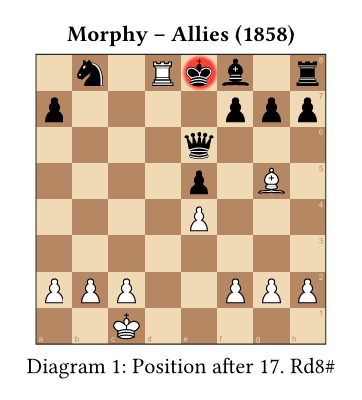
Install the package, parse a PGN, and drop a captioned diagram of any position — the players, the year, and the move just played are filled in automatically:
#import "@preview/staunton:0.2.2": parse-pgn, diagram-after, chess-notation, standings-table

#let opera = parse-pgn(```
[White "Morphy"] [Black "Allies"] [Date "1858"]
1. e4 e5 2. Nf3 d6 3. d4 Bg4 4. dxe5 Bxf3 5. Qxf3 dxe5 6. Bc4 Nf6 7. Qb3 Qe7
8. Nc3 c6 9. Bg5 b5 10. Nxb5 cxb5 11. Bxb5+ Nbd7 12. O-O-O Rd8 13. Rxd7 Rxd7
14. Rd1 Qe6 15. Bxd7+ Nxd7 16. Qb8+ Nxb8 17. Rd8# 1-0
```).first()

// The final position: roster → info line, last move → caption, check → king glow.
#diagram-after(opera, "17w", check: true)
Move notation
Numbered movetext with figurine glyphs, inline variations, NAGs and comments, localized to the document language — output no board-only package produces:
#let g = parse-pgn("1. e4 e5 2. Nf3 Nc6 3. Bb5 a6 4. Ba4 Nf6 5. O-O Be7 (5... Nxe4!? 6. d4 b5) 6. Re1 b5 7. Bb3 d6 *").first()

#chess-notation(g, figurine: true, variations: true, nags: true)

Tournament tables
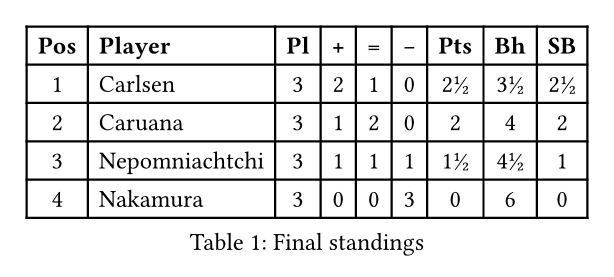
Standings, cross-tables and progress tables straight from the games’ result tags, with Buchholz / Sonneborn-Berger tie-breaks:
#let games = parse-pgn(```
[White "Carlsen"][Black "Nakamura"][Result "1-0"][Round "1"] 1-0
[White "Caruana"][Black "Nepomniachtchi"][Result "1/2-1/2"][Round "1"] 1/2-1/2
[White "Carlsen"][Black "Caruana"][Result "1/2-1/2"][Round "2"] 1/2-1/2
[White "Nepomniachtchi"][Black "Nakamura"][Result "1-0"][Round "2"] 1-0
[White "Carlsen"][Black "Nepomniachtchi"][Result "1-0"][Round "3"] 1-0
[White "Nakamura"][Black "Caruana"][Result "0-1"][Round "3"] 0-1
```)

#standings-table(games, caption: [Final standings])
Annotated diagrams
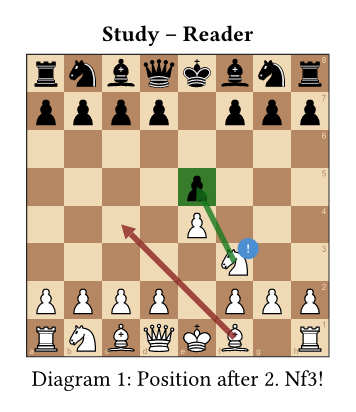
%cal / %csl drawing commands in a move’s comment become arrows and highlights,
and a ! / ? grade becomes a move-quality badge — composited onto the board:
#let g = parse-pgn("1. e4 e5 2. Nf3! {[%cal Gf3e5,Rf1c4][%csl Ge5]} Nc6 *").first()

#diagram-after(g, "2w", annotations: true, move-quality: true)
…and the basics
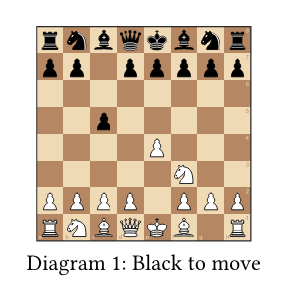
A bare board for an inline or decorative position; a chess-diagram
whenever you want it captioned, counted, @-referenceable and listed by an
outline. Sources are the same everywhere — a FEN string, a position(..) object,
or a squares dict:
#chess-diagram("rnbqkbnr/pp1ppppp/8/2p5/4P3/5N2/PPPP1PPP/RNBQKB1R b KQkq - 1 2")
Features
- PGN engine — parse multi-game files, navigate the mainline and (nested) variations by locator, play “what-if” lines, and export FEN, all on a pure-Typst legal-move engine (lazy parsing stays fast on large files).
- Notation — numbered movetext, inline/indented variations, figurine glyphs, NAGs, comments, and diagrams embedded at markers; localized piece letters.
- Tournament tables — standings, cross-tables and progress (player or team), with Buchholz / Sonneborn-Berger tie-breaks.
- Annotations & markings —
%cal/%cslarrows and highlights from PGN, an in-check glow, and move-quality badges; add NAGs / comments / variations to a game programmatically, then render it like any parsed one. - Styling — themes, six label placements, flip, piece sets, grid; proportional highlights (filled / cross / circle) and arrows; size-adaptive layout.
- Bring-your-own & fairy pieces — any downloaded set via a
piece-setloader (named-piece-set/svg-piece-set), plus non-standard kinds and whole variants (define-variant,with-fallback). - Chess960 / Fischer Random — board, engine, PGN pipeline and notation all handle 960 (X-FEN castling, the FRC PGN tags, Scharnagl start numbers).
- Publishing niceties — everything is a
#figure:@labelcross-references, dedicated outlines (lists of diagrams / tables), localization (en, de, es, fr, it, pt, ru), and limited HTML export.
Documentation
- User manual — the complete reference (every function, option, and example),
with each feature shown as the code you type beside the board it produces.
Download the compiled PDF (attached to each release), or build it yourself
from its Typst source,
docs/manual.typ. The manual is part of the repo only — it is not shipped in the package bundle. - Showcase — a runnable capability tour.
Compile the manual and the showcase locally with the package folder as root:
typst compile --root . docs/manual.typ docs/manual.pdf
typst compile --root . docs/examples/showcase.typ showcase.pdf
API at a glance
| area | entry points |
|---|---|
| diagrams | chess-diagram, diagram, board, chess-board, chess960-board, chess960-diagram |
| positions | position, parse-fen, to-fen, starting-fen, chess960-start, chess960-start-fen |
| games (PGN) | parse-pgn, movetext, mainline, diagram-after, position-after, chess-moves, game-start, game-variant |
| annotate / build | with-nags, with-comments, with-variation |
| notation | chess-notation, notation |
| tables | standings-table, crosstable-table, progress-table, games-by-event (+ compute: standings, crosstable, progress) |
| outlines | chess-diagram-outline, chess-table-outline, chess-outlines |
| defaults | set-chess-defaults, set-board-defaults, set-diagram-defaults, set-table-defaults, set-pgn-defaults, set-lang, set-piece-set |
Pieces & licensing
The code (lib.typ, src/**/*.typ) is MIT. The bundled piece SVGs
are GPLv2+ — two sets ship: cburnett (default, © Colin M.L. Burnett) and
merida (© Armando Hernandez Marroquin), from the
lichess collection. See LICENSE
and LICENSE-PIECES. The package manifest declares
MIT AND GPL-2.0-or-later.
A "unicode" glyph fallback needs no SVGs. To use other art, pass piece-set a
loader (named-piece-set / svg-piece-set, or with-fallback for mixed and
fairy boards) — see the Pieces and fonts and Non-standard pieces sections of
the manual.
(Other popular lichess sets carry non-commercial licenses and are not bundled.)
The manual and tests also embed CC BY-SA 4.0 fairy demo art (under docs/ and
tests/), which is not part of the shipped package — see LICENSE-PIECES.
Repository layout
typst.toml          package manifest          LICENSE / LICENSE-PIECES  MIT / GPLv2+
lib.typ             public API + figure wrapper
src/                engine, FEN/PGN/SAN, notation, tournament, board renderer, i18n
src/assets/         piece-set SVGs (cburnett, merida) + i18n language files
docs/manual.typ     user manual (-> PDF)      docs/examples/  runnable showcase
tests/              test suite (bash tests/run.sh)   scripts/  release bundle build
Tests
bash tests/run.sh # compiles pass-cases; asserts fail-cases error as expected
The runner walks every .typ under tests/; a file with a // EXPECT: <substr>
header must error with that message, any other must compile. Files/dirs prefixed
_ (shared fixtures) are skipped; docs/examples/*.typ are compiled too.
Roadmap
- Tournament tables: read results from non-PGN sources, and richer styling options for the standings / cross / progress tables.
- A move→SAN encoder — name an engine-generated move (
legal-moves/apply) from a bare position; the inverse of the SAN parser, so movetext can be produced without a pre-existing PGN (puzzle solutions, generated lines, legal-move lists). - Engine performance (the narrow
legal-moves/applyseam can swap to WASM). - More chess variants: non-western variants (e.g. xiangqi) are a more distant
goal (0.5.0); the
position/boardpipeline is already variant-aware.
Changelog
0.2.2
- Proportional markers: cross / circle / arrow strokes — and the new
cross-margin/circle-margin— scale with the square by default (stroke 15%, cross tip 10% from the corners, circle margin 3%), so marks read the same at any board size. Default arrows are also more opaque now (35% transparency, was 85%), so they no longer look faint. Each is settable per call or document-wide, as a ratio or an absolute length. - Notation spacing: move numbers render spaced by default (“1. e4 e5 2. Nf3”;
a forced Black move as “24… Nf6”). A new
spacedoption (document-settable viaset-pgn-defaults) opts back into the dense “1.e4” / “24…Nf6” form. - Uniform captions: automatic below-captions are consistent — a
diagram-afterreads “Position after 24. Nf3”, and a FENchess-diagramreads “White to move” / “Black to move” (localized).
0.2.1
- i18n: automatic diagram captions (“Position after move …” / “Position at
move N, X to play”) and tournament-table column headers are now localized —
previously they stayed English regardless of
set-lang. The chess language (set-lang) is independent of the document language (#set text(lang: ..)), andset-lang("auto")follows the document language for these too. - docs: the README Quick-Start examples now show their rendered output.
0.2.0
- Chess960 / Fischer Random: variant-named
chess960-board/chess960-diagram; start positions by Scharnagl number (chess960-start,chess960-start-fen, 0–959, 518 = standard); X-FEN castling inparse-fen/to-fen; PGN recognition of[Variant],[SetUp],[FEN]and[FRCPosition]/[Chess960Position](game-variant,game-start). The engine’s castling is generalised, so 960 shares the standard move generator. - Bring-your-own piece art:
piece-setaccepts a loader(color, kind) → bytes(or a bytes dict), so any downloaded or custom set renders. Helpers build one:named-piece-set(filename pattern),svg-piece-set(lichess layout), andwith-fallback(custom pieces over a standard base). Reads live in your document, so it works from an installed package (Typst’s file sandbox). - Non-standard / fairy pieces: define custom piece kinds and whole variants
with
define-variant; the squares-dict and string-form parsers understand the new letters, with a Unicode-glyph fallback for kinds you have no art for. - Move markings: an in-check glow (
check: true, auto-locates the king) and a move-quality badge (move-quality: trueondiagram-after; the!?!!??!??!codes). - Outlines: caption-less diagrams and tables are no longer listed (they stay
referenceable but leave no blank outline row), and
title: nonefully drops an outline title. - Changed:
position.castlingis now the castling rook’s file index (ornone) per side, not a boolean — breaking if you read that field directly.to-fennow emits X-FEN castling whenKQkqis ambiguous and writes en-passant targets strictly (only when a capture is available); standard positions are otherwise unchanged and still round-trip exactly. - Changed:
set-board-defaults/set-chess-defaultsnow reject the position-specific optionshighlight,arrowsandmove-quality-markas document-wide defaults (they apply per call, or viadiagram-afterfor the badge); their styling options stay settable document-wide.
0.1.0
Initial release.
- Boards and diagrams from a FEN string, a
position(..)object, or a squares dict; themes, six label placements, flip, piece sets, grid, highlights, arrows. - Pure-Typst legal-move engine; PGN parsing with mainline and nested variations, locator navigation, “what-if” play, and FEN export.
- Localized move notation with variations, figurine glyphs, NAGs, comments, and embedded diagrams; programmatic NAG / comment / variation builders.
- Tournament tables (standings, cross-tables, progress; player or team) with Buchholz / Sonneborn-Berger tie-breaks.
- Figure-based references and diagram / table outlines; document-wide defaults and localization (en, de, es, fr, it, pt, ru).
- Limited HTML export (notation, tables, outlines and references as native HTML; boards and diagrams as inline SVG).
Acknowledgements
- The boards-n-pieces Typst package was an inspiration for some features.
- Developed with assistance from Claude (Opus 4.8) by Anthropic.
License
Code: MIT (© 2026 Frank Lippert). Bundled piece images: GPL-2.0-or-later. See LICENSE and LICENSE-PIECES.