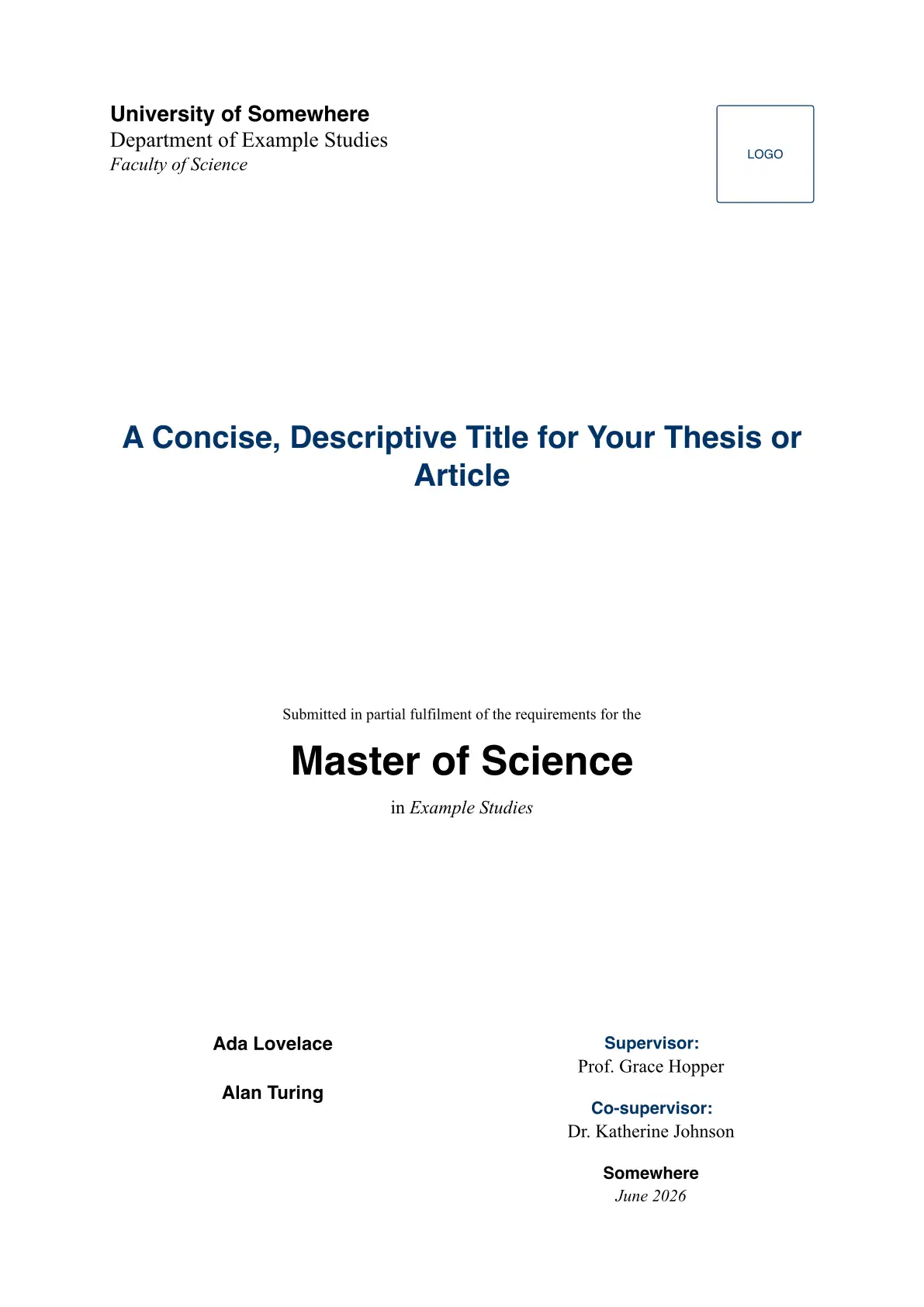
A clean, two-column scientific thesis and article template for Typst, with an optional cover page, a compact title block (abstract, affiliations, supervisors, DOI/dates, license), an automatic table of contents, and themeable colours and fonts.

Quick start
typst init @preview/lambda
cd lambda
typst compile main.typ
This copies the example template/main.typ and
template/refs.bib into a new project. Edit the single
#show: thesis.with(..) call at the top, then write your content below it.
Configuration
Everything is configured through one function call — there is no separate config file to keep in sync. Delete any field you don’t need; optional fields are hidden when omitted.
#import "@preview/lambda:0.1.1": thesis, note-block

#show: thesis.with(
  title: "Your Title",
  authors: ((name: "Ada Lovelace", affils: (1,)),),
  affiliations: ((id: 1, text: "University of Somewhere"),),
  degree: "Master of Science",
  supervisor: "Prof. Grace Hopper",
  abstract: [ ... ],
  keywords: "a, b, c",
)

= Introduction
...
Parameters
| Group | Parameters |
|---|---|
| Metadata | title, authors, affiliations, date |
| Cover | degree, major, department, faculty, university, location, submission-text, supervisor, co-supervisor, logo, birthday, student-id |
| Info bar | email, doi, submitted, defended, accepted, published, license |
| Abstract | abstract, keywords |
| Running head | short-author (auto ⇒ first author’s surname), short-title (auto ⇒ title), foot-info, manuscript-date (auto ⇒ today; none to hide) |
| Toggles | cover, show-abstract, show-outline, header-footer, columns (1 or 2) |
| Theming | accent, theme, labels |
Authors can be plain strings or dictionaries:
(name: "Ada Lovelace", affils: (1, 2)). For a single-author document, set
birthday/student-id at the top level; for multiple authors, put them inside each
author dictionary ((name: .., student-id: .., birthday: ..)).
Theming
Override just the accent colour, or pass a full theme dictionary. Any key omitted
keeps its default (see src/theme.typ):
#show: thesis.with(
  accent: rgb("#8a1538"),
  theme: (
    font-serif: ("Libertinus Serif",),
    font-sans:  ("Libertinus Serif",),
    paper: "us-letter",
    margin: (x: 1.5cm, y: 2cm),
    font-size: 10pt,
  ),
)
Fonts: the defaults are stacks —
Helvetica/Times New Roman/Courierfirst (macOS & Windows), falling back to Typst’s embeddedLibertinus Serif,New Computer Modern, andDejaVu Sans Mono. On the Typst Universe web app the proprietary families are unavailable, so set thethemefonts to bundled families for an identical preview, or compile locally where they are installed.
Localisation
Every visible label is overridable through labels, e.g.
labels: (abstract: "Résumé", supervisors: "Encadrants : "). See
default-cover-labels and default-header-labels in
src/cover.typ and src/article-header.typ.
Custom callout
note-block produces a tinted box that follows the active accent:
#note-block(title: "Note")[ Highlighted aside. ] // title is optional
Project layout
lib.typ            public API (entrypoint)
src/               implementation: theme, cover, article-header, layout, thesis, envs
template/          what `typst init` copies: main.typ, refs.bib
Local development / testing
The shipped template/main.typ imports @preview/lambda:0.1.1, which only resolves
once published. To test changes before publishing, install the package into Typst’s
local package cache and compile the template against it:
# macOS (use ~/.cache/typst on Linux)
DEST=~/Library/Caches/typst/packages/preview/lambda/0.1.0
mkdir -p "$DEST/src" && cp typst.toml lib.typ "$DEST/" && cp src/*.typ "$DEST/src/"
typst compile template/main.typ
Alternatively, point a scratch file at ../lib.typ with a relative import.
Credits
This template is an adaptation of the Rho research-article template by Guillermo Jiménez (MemoJimenez/Rho-class), licensed under CC BY 4.0. The design was ported to Typst and restructured/extended; changes have been made.
License
MIT © 2026 Finn Linus Krauss. This template adapts the Rho template by
Guillermo Jiménez, which is licensed under
CC BY 4.0; that attribution is retained
in LICENSE and in the Credits above. (CC BY 4.0 permits releasing an adaptation under
a different license as long as the original is credited.)