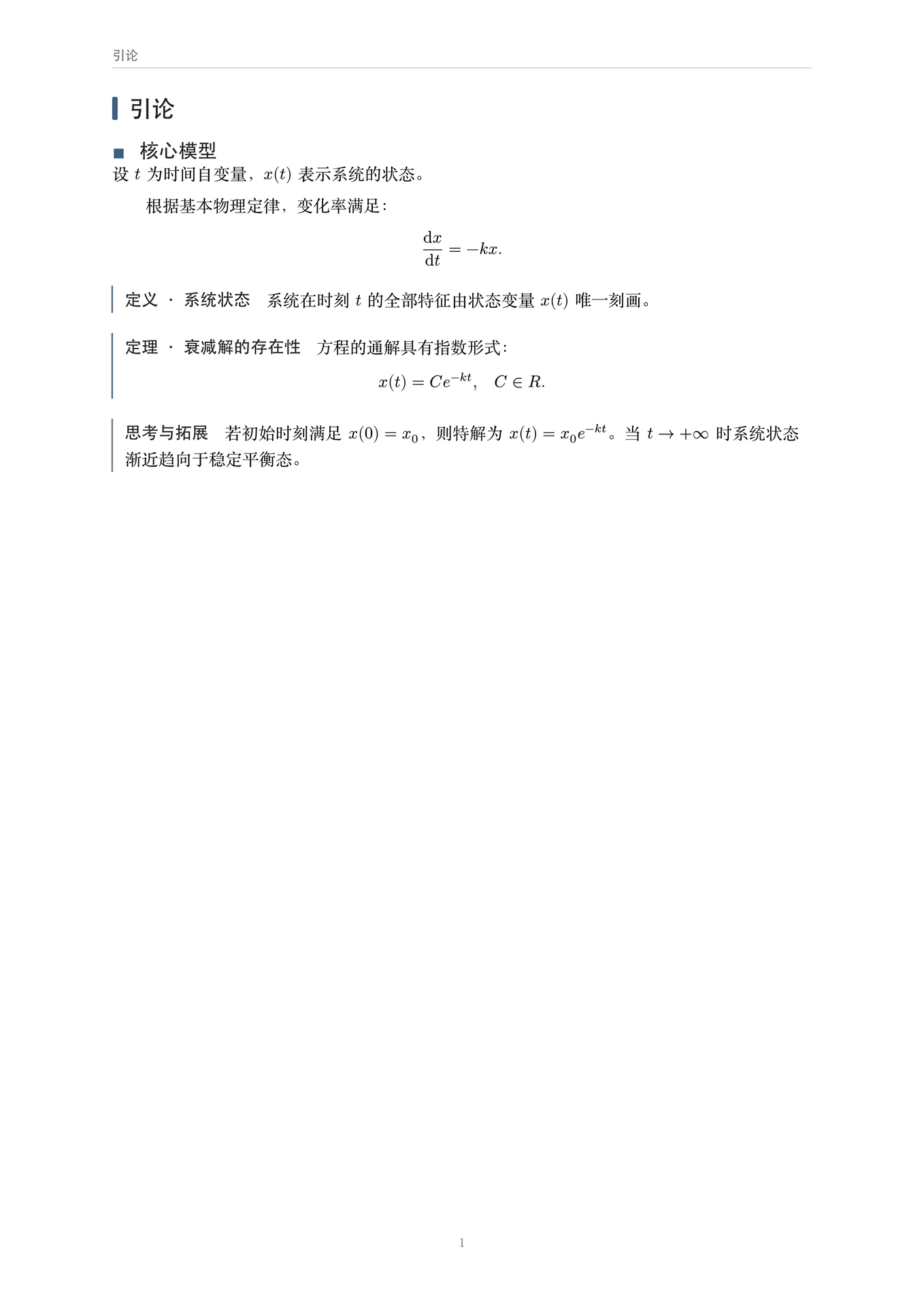
A clean, restrained academic lecture notes and book template for Typst.
专为理工科与数学设计的严肃、克制、优美的 Typst 课程讲义与笔记模板。
English Documentation
zhaji is a minimalist, publication-grade Typst template tailored for mathematics, theoretical science, and engineering courses.
Instead of heavy colored containers and cumbersome multi-level numeric counters (e.g., 1.1.2.1), it embraces classic academic publishing aesthetics:
- Clean Font Hierarchy: Songti SC / SimSun for Chinese text, Heiti SC / SimHei for headings, and New Computer Modern for Latin characters and mathematics.
- Dual-Track Compilation: Compile single lesson notes independently during class with instantaneous preview, or compile the whole book into a unified volume with an auto-generated Table of Contents and clean page numbers.
- Visual Anchor Hierarchy: Headings are distinguished through vertical color accents, subtle geometric glyphs, and calibrated whitespace rather than noisy digits.
- Restrained Callouts: Only 3 intuitive block macros (
#thm,#def,#hint) that eliminate verbose parameter boilerplate. - Dynamic Headers & Footers: Centered footer page numbers, cover pages with zero header/footer noise, and running headers that dynamically track the current section.
Recommended Project Layout
The template is distributed as a package, so there is no template directory to
copy or maintain: import @preview/zhaji:0.1.0 and a course repository only
needs its own material.
my-zhajis/
├── book.typ               # Full book entry point (Cover + Outline + Chapters)
├── notes/                 # Lesson notes (01.typ, 02.typ, ...)
├── figures/               # Vector plots, phase portraits, diagrams
└── out/                   # Exported PDFs (git-ignored)
Quick Start
Import the package with #import "@preview/zhaji:0.1.0": *, or start from the
bundled example with typst init @preview/zhaji:0.1.0 my-notes (the same
template is available in the Typst web app under “Start from template”).
1. Single Lesson Mode (notes/01.typ)
For fast, frictionless classroom note-taking:
#import "@preview/zhaji:0.1.0": *
#show: note

== Introduction

=== Free Fall Model
Consider a point mass $m$ undergoing free fall under gravity...
- Output: Clean A4 document with 2-character Chinese paragraph indent, running header with current section title, and centered page number in the footer.
2. Full Book Mode (book.typ)
Assemble all lectures into a comprehensive course volume:
#import "@preview/zhaji:0.1.0": *
#show: note.with(
  title: "Ordinary Differential Equations",
  subtitle: "Lecture Notes & Compendium",
  author: "Author Name",
  mode: "book",
)

= Chapter 1: Introduction and Elementary Methods

#include "notes/01.typ"
#include "notes/02.typ"

= Chapter 2: Linear Differential Equations

#include "notes/03.typ"
- Output:
- Cover Page: Elegant centered title, subtitle, author, and date without headers, footers, or page numbers.
- Table of Contents: Auto-generated outline (depth 2: chapters and sections only) with leader dots.
- Body Text: Numbering restarts from page 1 in the footer center; running headers track the current chapter/section.
- Collision-Proof: Subfile
#show: notecalls automatically detect the book environment and become transparent, preventing accidental blank page breaks.
Core Syntax and Macros
1. Theorem Block: #thm
Left border: 1.2pt navy/slate blue (#3b5f82). Pure white background.
// With title
#thm[Existence and Uniqueness][
  If $f(t, y)$ is continuous and Lipschitz continuous with respect to $y$,
  then the initial value problem admits a unique solution.
]

// Without title
#thm[
  Every homogeneous linear system of order $n$ has $n$ linearly independent solutions.
]
2. Definition Block: #def
Left border: 1.2pt slate blue.
#def[Ordinary Differential Equation][
  An equation containing derivatives of an unknown function $y(t)$ is called an ODE.
]
3. General Hint / Remark / Case Block: #hint
Left border: 1pt neutral gray (or amber for warnings).
#hint[Physical Model][
  Assume aerodynamic drag is proportional to velocity: $F_d = - gamma v$.
]

#hint(style: "amber")[Caution][
  Check whether stationary solutions $y = y_*$ are lost during separation of variables.
]
Inline Helpers & Accents
- Prominent Emphasis
#emph[...]: Renders key terminology in bold academic crimson (#b02a2a) to stand out naturally from black body text:This set of solutions is called the #emph[general solution]. - Light Gray Tag
#key[...]: Renders a rounded gray inline badge for subtle reminders:Check boundary conditions. #key[Easy to miss] - Q.E.D. Symbol
#qed: Right-aligned hollow square $\square$ marking the end of a proof:This completes the verification. #qed
Heading Hierarchy (Visual Anchors, No Digit Clutter)
| Level | Syntax | Visual Style | Intended Usage |
|---|---|---|---|
| Level 1 | = Chapter Title |
20pt Bold, full-width accent line below | Chapters / Major Course Themes |
| Level 2 | == Section Title |
15pt Bold, 3.5pt left vertical pill, generous top margin | Core Lecture Sections |
| Level 3 | === Model / Topic |
12.5pt Bold, prefixed with solid square ■ |
Concrete physical models, theorems, setups |
| Level 4 | ==== Step / Subcase |
11pt Bold, prefixed with subtle dash – |
Derivation branches, computational steps |
Mathematical Shorthands Table
| Meaning | Template Shortcut | Official Typst Equivalent | Rendered |
|---|---|---|---|
| Differential Operator | $dd x$ |
$dif x$ |
$\mathrm{d}x$ |
| Derivative Fraction | $(dd y)/(dd x)$ |
$(dif y)/(dif x)$ |
$\frac{\mathrm{d}y}{\mathrm{d}x}$ |
| Plus-Minus Sign | $pm$ |
$plus.minus$ or $±$ |
$\pm$ |
| Minus-Plus Sign | $mp$ |
$minus.plus$ |
$\mp$ |
| Number Sets | $R$, $C$, $N$ |
$RR$, $CC$, $NN$ |
$\mathbf{R}, \mathbf{C}, \mathbf{N}$ |
| Constants & Imaginary | $e$, $i$ |
$upright(e)$, $upright(i)$ |
$\mathrm{e}, \mathrm{i}$ |
| Norm & Inner Product | $norm(x)$, $inner(a, b)$ |
$norm(x)$, $angle.l a, b angle.r$ |
$|x|$, $\langle a, b \rangle$ |
中文文档
zhaji 是一个专为数学、物理及理工科理论课程设计的 Typst 讲义与课堂笔记模板。
摒弃繁琐花哨的彩色卡片与多层机械数字编号(如 1.1.2.1),追求严肃、克制、优美的学术出版物风格:
- 经典学术字体排版:正文使用 Songti SC / SimSun 配 New Computer Modern,标题使用 Heiti SC / SimHei,数学公式使用 New Computer Modern Math。
- 单课与全书双轨编译:上课记笔记支持单课毫秒级实时预览;学期末支持一键合订为专著级全本(带纯净封面、自动目录、动态页眉与页脚正中页码)。
- 纯视觉锚点分层:不使用冗长数字点号,利用色标、几何方块与留白级差实现清晰层级。
- 极简语义宏:仅保留
#thm(定理)、#def(定义)、#hint(提示/情形/模型)三个核心块级宏,无繁琐参数。 - 动态页眉页脚体系:页码居中位于页脚,全书目录深度为 2(只收录大章大节,整洁易管理),页眉动态追踪当前翻阅的小节名。
快速上手
用 #import "@preview/zhaji:0.1.0": * 导入本包;也可以执行 typst init @preview/zhaji:0.1.0 my-notes 从自带示例起步(Typst 网页版的 “Start from template” 中同样可以找到 zhaji)。
1. 单课独立笔记(例如 notes/01.typ)
#import "@preview/zhaji:0.1.0": *
#show: note

== 引论

=== 自由落体模型
考虑一个质量为 $m$ 的物体做自由落体运动……
2. 全书讲义合订本(例如 book.typ)
#import "@preview/zhaji:0.1.0": *
#show: note.with(
  title: "常微分方程",
  subtitle: "课堂笔记与讲义",
  author: "你的名字",
  mode: "book",
)

= 第一章 绪论与初等积分法

#include "notes/01.typ"
#include "notes/02.typ"

= 第二章 高阶线性微分方程

#include "notes/03.typ"
核心块级宏与使用示例
1. 定理环境:#thm
左侧 1.2pt 蓝灰细线,自动带有加粗黑体前缀:
#thm[解的存在唯一性][
  若 $f(t, y)$ 在定义域上连续且关于 $y$ 满足 Lipschitz 条件,则初值问题存在唯一解。
]
2. 定义环境:#def
左侧 1.2pt 蓝灰细线,自动带有加粗黑体前缀:
#def[常微分方程][
  形如 $F(t, y(t), y'(t), dots, y^((n))(t)) = 0$ 的方程称为常微分方程。
]
3. 通用提示/情形/模型环境:#hint
左侧 1pt 中灰细线(无底色,保持印刷级黑白质感):
#hint[模型 · 自由落体][
  假设物体只受重力作用,取竖直向下为正方向。
]

#hint(style: "amber")[注][
  定解条件不一定只是初始条件,也可以是两点边值条件。
]
推荐 VS Code 配置(配合 Tinymist 插件)
在笔记项目根目录下的 .vscode/settings.json 中配置:
{
  "tinymist.projectResolution": "singleFile",
  "tinymist.exportPdf": "onSave",
  "tinymist.outputPath": "$root/out/$dir/$name",
  "tinymist.preview.refresh": "onType",
  "tinymist.formatterMode": "typstyle",
  "tinymist.systemFonts": true,
  "[typst]": {
    "editor.formatOnSave": true,
    "editor.wordWrap": "on"
  }
}
License
MIT License © 2026 Boshugege