Horizontal mind map diagrams for Typst, built on CeTZ. Every node is measured before the layout runs, so long labels never overlap — the common failure of fixed-spacing tree drawers.
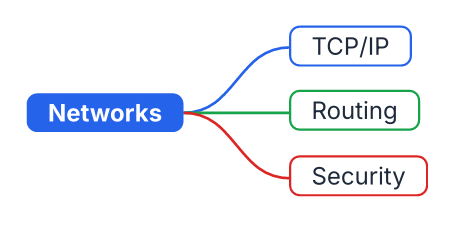
Usage
#import "@preview/tidymind:0.2.0": mindmap, node

#mindmap(node([Root],
  node([Branch A], node([A1]), node([A2])),
  node([Branch B]),
))
node(content, ..children) builds a tree node; content is the label and the
remaining positional arguments are its children (each one another node(...) or
raw content). A raw dictionary (content: .., children: (..)) is also accepted.
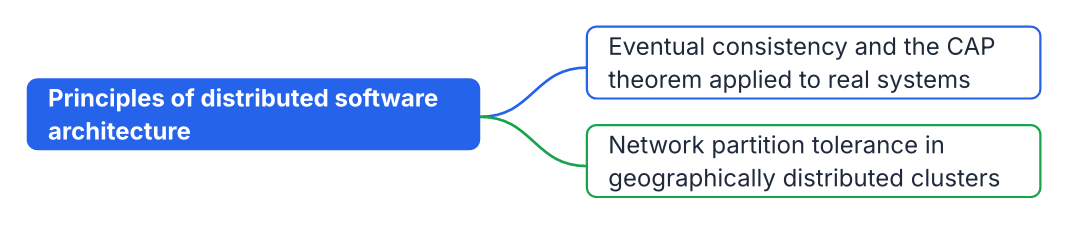
Long labels
This is the case that pushed the package into existence. Node sizes come from
Typst’s measure, so a label that wraps reserves the vertical band it actually
needs — at any depth, with no manual offsets.
Styles
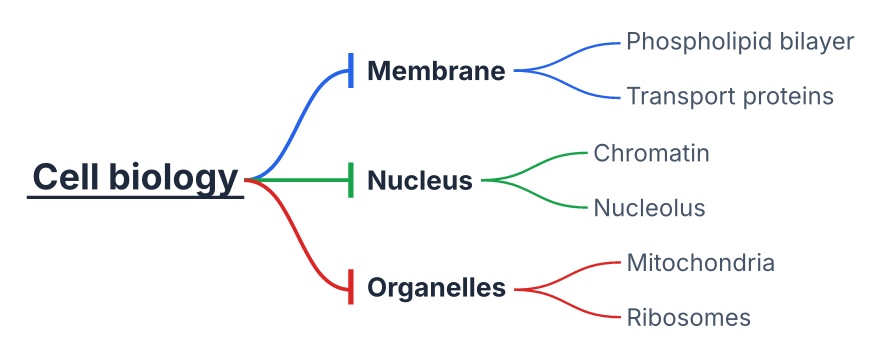
style: "boxed" (the default) draws every node as a rounded box, the root
filled with its branch color.
style: "outline" drops the boxes entirely: the root becomes a heading over a
baseline rule, each first-level branch a label resting on a rule in its own
color, and everything deeper is plain text. Hierarchy comes from size, weight
and color instead of from frames — useful when the map sits inside a document
and boxes would fight with the surrounding text.
Roles and branch colors
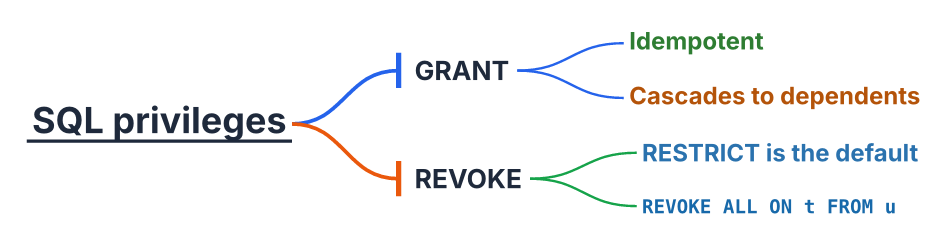
A node can carry an emphasis — its role — and a branch index that overrides
the color it would inherit from its position. Both are given by name: the
document says what a node means, and the package resolves the color.
#mindmap(
  node([SQL privileges],
    node([GRANT],
      node([Idempotent], emphasis: "definition"),
      node([Cascades to dependents], emphasis: "warning"),
    ),
    node([REVOKE], branch: 5,
      node([RESTRICT is the default], emphasis: "highlight"),
    ),
  ),
  style: "outline",
)
Options
| Option | Default | Meaning |
|---|---|---|
style |
"boxed" |
"boxed" or "outline" (see above) |
palette |
6 colors | color per first-level branch, cycled |
font |
"Inter" |
label font, or a fallback list |
text-size |
9pt |
base label size; the root and first level scale up from it |
node-max-width |
6cm |
max width before a label wraps |
max-depth |
6 |
prune nodes deeper than this |
h-gap |
40pt |
horizontal gap between levels |
v-gap |
10pt |
minimum vertical gap between siblings |
ink |
(strong, soft) |
label colors; partial dictionaries merge over the defaults |
emphasis-colors |
4 roles | highlight, warning, definition, example |
Labels take arbitrary Typst content, so markup and emoji work — pass a color
emoji font in the font fallback list to get the second one:
#mindmap(node([Git: #strong[what gets graded]], node([🥇 #strong[Remote sync] (35%)])),
  font: ("Inter", "Noto Color Emoji"))
How it works
The layout is a tidy tree by subtree extent: every subtree reserves a vertical band equal to the sum of its children’s bands (or its own height, if a leaf), and the parent is centered within that band. Because sibling subtrees occupy disjoint bands, nodes never overlap — at any depth. It runs in O(n), in two passes: one up the tree to size the bands, one down to place the nodes.
Node sizes come from Typst’s measure, so a band accounts for the real rendered
size of each (possibly wrapped) label. Measuring and drawing go through a single
description of the node body (src/style.typ), which is what keeps an edge
landing exactly on the node it points at.
Examples
Every file under examples/ compiles on its own. Files named
visual_* produce the images above; files named _assert_* exercise the logic
through #assert, so compiling them is the test suite.
sh examples/render.sh # runs the asserts, then regenerates img/
| Example | What it covers |
|---|---|
visual_shallow |
a root with three leaves |
visual_deep |
several levels of nesting |
visual_many_siblings |
vertical spacing under pressure |
visual_long_labels |
labels wrapping at node-max-width |
visual_outline |
the "outline" style |
visual_emphasis |
roles and branch overrides |
visual_markdown_emoji |
markup and emoji in labels |
visual_single |
a lone root |
visual_empty |
empty labels |
Changelog
0.2.0 — adds style: "outline", the branch and emphasis attributes on
node, and the ink / emphasis-colors options. The default output is
unchanged: style: "boxed" renders exactly what 0.1.1 rendered.
0.1.1 — long labels wrap instead of overflowing their measured width.
License
MIT