Typeset synthetic division (Ruffini’s rule) in Typst — the classic three-row division box and the stacked factorization staircase.
Unlike a sign or variation table, this computes: you pass the coefficients and
the root, and it does the arithmetic and draws it — the products row, the running
sums, the boxed remainder. No more hand-building tables and quietly dropping the
middle row. No dependencies (native table).
Usage
#import "@preview/stair-division:0.1.1": ruffini, ruffini-factor

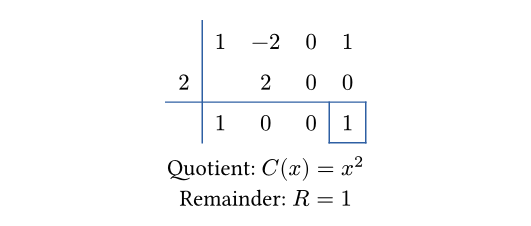
// Divide x³ − 2x² + 1 by (x − 2):
#ruffini((1, -2, 0, 1), 2)
// → three-row tableau; Quotient: C(x) = x²   Remainder: R = 1

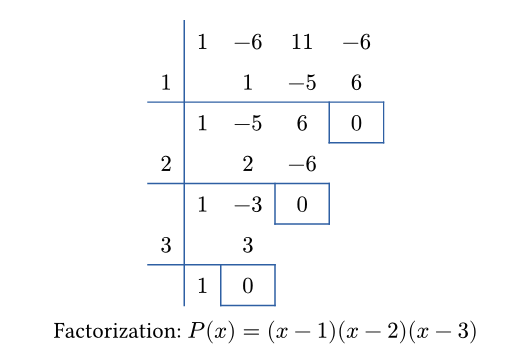
// Factor x³ − 6x² + 11x − 6 using its roots 1, 2, 3:
#ruffini-factor((1, -6, 11, -6), (1, 2, 3))
// → stacked staircase; Factorization: P(x) = (x − 1)(x − 2)(x − 3)
To use a local copy instead, put lib.typ beside your document and import
#import "lib.typ": ruffini, ruffini-factor.
Coefficients go highest degree first and must include zeros for missing
terms: x³ − 2x² + 1 → (1, -2, 0, 1).
Divisor convention: root is the a in (x − a). To divide by (x + 3),
pass -3.
Fractions
After input conversion, arithmetic is exact rational arithmetic, within Typst’s integer limits, and fractions render as fractions. You can write them two ways:
-
As a plain number — integers are exact. A floating-point input is accepted only when a continued-fraction candidate reproduces the received float exactly, with a denominator at most
10000and an absolute numerator at most2^53 - 1:#ruffini((2, -1, -1), 1/2) // root 1/2 → shows ½ #ruffini((1, 0, -3), 1/3) // received float is recovered as ⅓ #ruffini((0.25, 0.5, -1), 0.5) // decimals too → ¼, ½ -
As a string (in quotes) — specifies the rational value exactly, without going through floating-point. This works for
rootandcoefficients:#ruffini(("1/2", "1/4", "-1/4"), "1/2") // fractional coefficients + root
Strings must contain a signed integer or two signed integers separated by exactly
one /, with a nonzero denominator. Whitespace around the value or slash is
allowed (" -2 / -4 " becomes 1/2); whitespace inside an integer and extra
components are rejected ("1 2/3", "1/2/3").
Use strings when the intended rational value matters. Typst evaluates bare fractions before calling the package. Different rationals can produce the same float, so their original value cannot always be recovered. The package uses no approximation tolerance: unsupported floats stop with an error asking for a string, rather than being rounded to zero, an integer, or a nearby fraction.
#ruffini((1, 0), 1/99991)              // error: use a string
#ruffini((1, 0), "1/99991")            // exact
#ruffini((1, 0), 1/10000000000)        // error; not rounded to zero
#ruffini((1, 0), "1/10000000000")      // exact
#ruffini((1, 0), 1.0000000001)         // error; not rounded to one
#ruffini((1, 0), "10000000001/10000000000") // exact
Typst uses 64-bit floating-point numbers. If precision was already lost in an expression before calling the package, input conversion cannot restore it.
Variable. The rendered labels use x by default; pass variable: "t" (or any
letter) to write C(t), P(z), (t − 2), …
ruffini(coefficients, root, ...)
One division P(x) ÷ (x − root), rendered as the three-row tableau
(coefficients · products · results) with the remainder boxed.
| Parameter | Default | Meaning |
|---|---|---|
coefficients |
(required) | Array, highest degree first, zeros included. Numbers, or string fractions for unusual ones (see Fractions). |
root |
(required) | The a in (x − a). A number (-3, 1/2), or a string for unusual fractions ("7/99991"). |
lang |
"en" |
Language of the rendered words: "en" or "es". |
variable |
"x" |
The polynomial’s variable in the rendered labels. |
color |
blue | Accent color of the L-rule and the remainder box. |
show-result |
true |
Append the Quotient / Remainder line. |
highlight-remainder |
true |
Draw the box around the remainder cell. |
trail |
false |
Overlay teaching arrows (see below). |
Explaining the algorithm (trail)
trail: true overlays the arrows that show how synthetic division works —
bring the first coefficient down, multiply by the root (the ×a
diagonals), add the column (the + signs) — so it doubles as a lecture
figure. Drawn natively (no CeTZ). Best with integer coefficients.
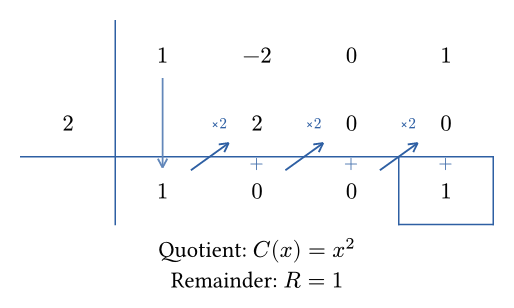
#ruffini((1, -2, 0, 1), 2, trail: true)
ruffini-factor(coefficients, roots, ...)
Applies several roots in turn — each quotient becomes the next dividend — and
draws the stacked staircase. If every division is exact, it appends the
factorization; otherwise it says so.
| Parameter | Default | Meaning |
|---|---|---|
coefficients |
(required) | Array, highest degree first, zeros included. |
roots |
(required) | The successive values a to divide by, in order. Ints or string fractions. |
lang |
"en" |
"en" or "es". |
variable |
"x" |
The polynomial’s variable in the rendered labels. |
color |
blue | Accent color of the rules. |
show-result |
true |
Append the Factorization line. |
highlight-remainder |
true |
Box each division’s remainder cell. |
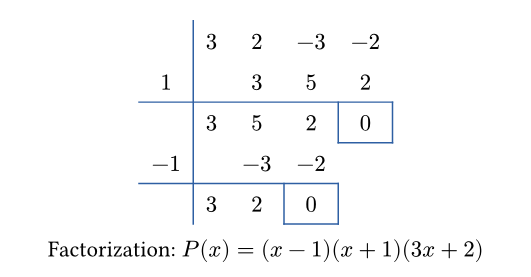
The factorization keeps the leading coefficient correct and, when a nonconstant
quotient remains after the supplied roots, shows it in parentheses — e.g.
P(x) = (x − 1)(x + 1)(3x + 2) or P(x) = (x − 2)(x² + x + 1).
What it handles
| Case | Behavior |
|---|---|
| Exact division | Remainder 0, boxed; quotient shown. |
| Nonzero remainder | Boxed remainder; R = … in the result line. |
| Missing terms | Handled via the explicit zero coefficients you pass. |
| Fractional root / coefficients | Exact rational arithmetic; rendered as fractions. Bare numbers for ordinary fractions, strings for unusual ones. |
| Leading coefficient ≠ 1 | Preserved through the staircase and in the factorization. |
| Repeated zero roots | Rendered as separate factors, e.g. P(x) = x x. |
| Remaining quotient | Shown in parentheses after the factors for the supplied roots. |
| Supplied value is not a root | ruffini-factor reports “not an exact division”. |
Localization
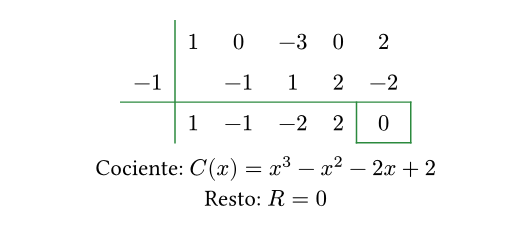
Rendered words default to English. Pass lang: "es" for Spanish
(Cociente / Resto / Factorización). Adding a language is copying one block in the
_i18n dictionary in lib.typ and translating four words — contributions welcome.
Compatibility
- Typst
>= 0.14.0 - No dependencies.
Known limitations
- Roots are supplied by the caller; the package does not search for them or test whether a remaining quotient is irreducible.
- Division is only by linear binomials
(x − a). - Numerators, denominators, and intermediate arithmetic are limited by Typst’s signed 64-bit integers. Large inputs can stop compilation with an overflow error, even when the reduced result would fit; this is not arbitrary-precision arithmetic.
trailis available only for a single division. Its fixed cell sizes are best suited to integer coefficients; tall fractions can crowd the arrows.
Verification
Run python3 tests/run.py from the repository root. It checks arithmetic against
Python’s Fraction, compiles the rendering examples, and verifies expected input
errors. Only Python 3 and Typst are needed; there are no additional test dependencies.
See TESTING.md
for the visual checklist and test sources in the repository.
Changes in 0.1.1
- Repeated zero roots now compile correctly in the factorization line.
- Fraction strings are validated in full; extra components and spaces inside integers are rejected instead of silently changing the input.
- Float conversion requires an exact round trip and rejects nonfinite values. Unsupported floats now request a string instead of rounding to a nearby value.
- Added executable arithmetic and input-error checks; clarified precision and integer-size limits in the documentation.
License
MIT.