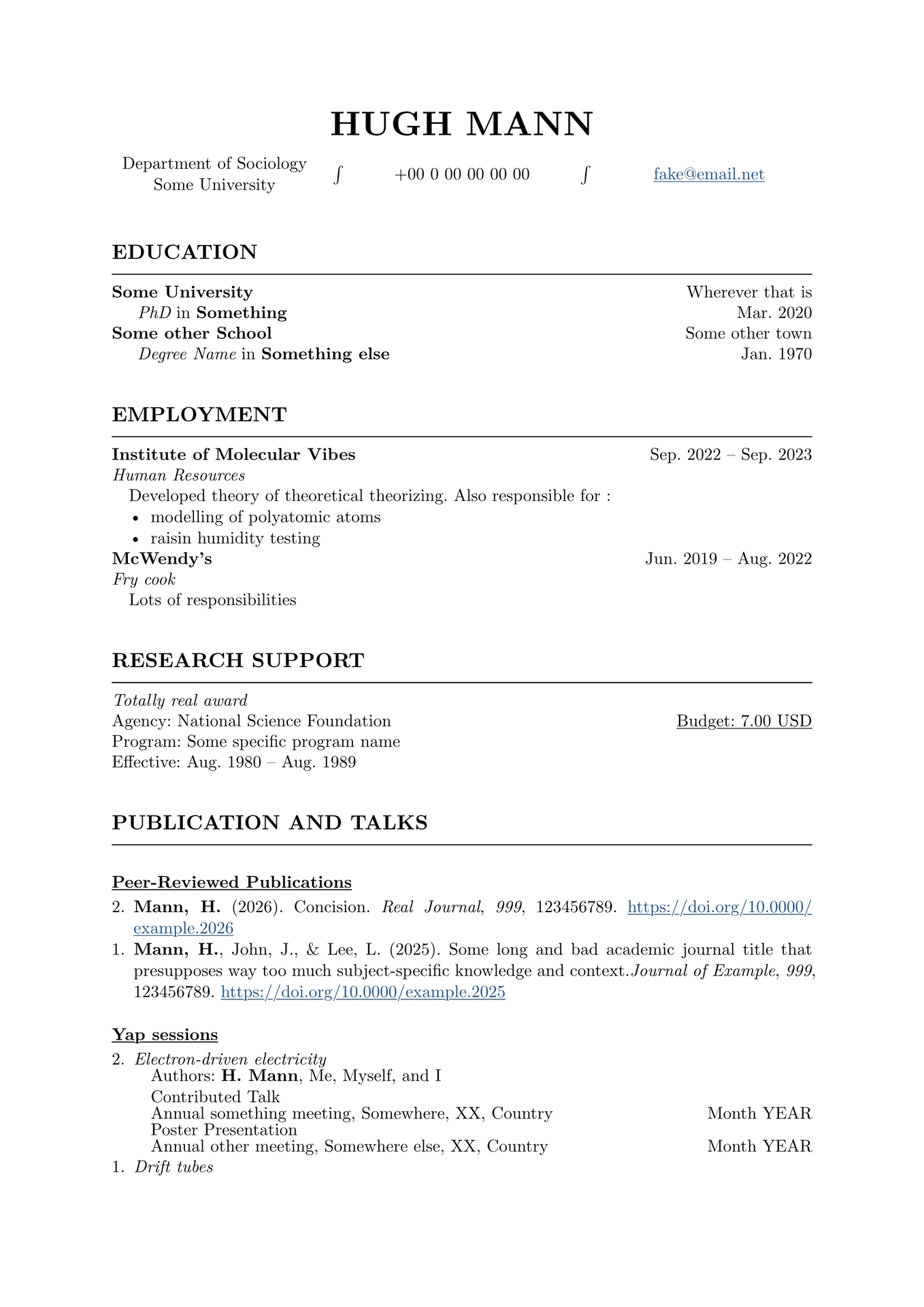
A simple academic CV template.
Sections are whatever you want them to be.
Publications can be cited in place from a .bib file, and your own name can be set in bold wherever it appears.
See example.typ for, well, an example how to use this:
Quickstart
Start a new CV from the template:
typst init @preview/simple-academic-cv:0.1.0 CV
or in an existing file:
#import "@preview/simple-academic-cv:0.1.0": *

#show: cv.with(
    name: "HUGH MANN",
    me: "Mann",
    // me: (first: "Hugh", last: "Mann"),   // also accepted
    header-columns: (
        [Department],
        [#link("mailto:email@email.email")[email\@email.email]],
    ),
    bib: bibliography("example.bib", style: "apa")
)

#section("Education")[
    #entry[*University*][Place]
    #details[_Degree_ in Subject][Month. Year]
]

#section("Publications")[
    #set enum(reversed: true)
    + #cite(<example1>, form: "full")
]
Options for cv
| Option | Default | Function |
|---|---|---|
name |
"" |
Your name, goes up top |
me |
none |
Your last name, or (first: "First", last: "Last") in case someone shares your name; emboldens names matching last name throughout the document |
header-columns |
() |
Any number of content blocks shown beside one another, under your name |
header-columns-separator |
none |
Content that gets placed between each of header-columns |
paper |
"a4" |
Paper size |
margin |
1in |
Paper margins. Takes whatever arguments page(margin: ...) does |
spacing |
1.0 |
Multiplicative vertical whitespace scaling factor |
fonts |
(:) |
Dictionary with any of: body, bold, name, heading. body is for text body and defaults to New Computer Modern; bold names a separate family for bold text and defaults to body; name and heading are fonts for your name and for headings, and default to bold |
font-sizes |
(:) |
Dictionary with any of body,name, section, subsection. body is for text body and defaults to 11pt; the others are derived from body by default |
link-color |
dark blue | The color of links. Seeting this to none will leave them uncolored |
bib |
none |
The bibliography, e.g, bibliography("example.bib", style: "apa") |
bib-show |
false |
Show the bibliography ? Default hidden because the idea is to cite entries in full where they appear |
Everything else is normal, everyday Typst.
You can put set and show rules above the
#show: cv.with(...) line:
#set par(justify: true)
#set text(hyphenate: false, lang: "en")
#set page(numbering: "1 / 1")
#show link: underline

#show: cv.with(...)
Helpers
There exist various small routines to produce different content blocks
The section(title, body) and subsection(title) helpers
These simple helpers give section and subsection headings:
#section("Section Title")[
  #subsection("Section Subtitle")

  Content ...
]
The entry(textleft, ..therest) and details(textleft, ..therest) helpers
#entry[*University*][Somewhere]
#details[_Degree in Subject_][Date]
The job(place, dates, title, ..therest) helper
#job[Institute of Stuff][Date – Range][Position Name][
  What I learned in boating school is:
  - bullet
  - points
  - etc
]
The rows(..rows) helper
Simple collection of rows:
#rows(
  ([Referee], [Some Journal]),
  ([Referee], [Some Other Journal]),
  ([Organizer], [Some Conference], [Dates]),
  ([Person], [At a place], [At a time !]),
)
The talk(title, kind: none, author: none, ..venues) helper
For showing off your talks and posters. Maybe you gave a talk
#talk(
  [Title],
  author: "You !",
  kind: "Contributed Talk",
  ([Some Meeting, Somewhere], [Date]),
)
or poster at several places
#talk(
  [Title],
  author: "You, et al.",
  kind: "Poster",
  ([Some Meeting, Somewhere], [Date]),
  ([Some Other Meeting, Somewhere Else], [Another Date]),
)
or a mix of talks and posters with the same title ?
#talk(
  [Title],
  author: "You, et al.",
  ([Invited Talk], [Meeting, Somewhere], [Date]),
  ("Contributed Talk", [Some Meeting, Somewhere], [Date]),
  ([Poster], [Some Other Meeting, Somewhere Else], [Another Date]),
)
The funding(title, budget: none, ..fields) helper
Maybe you got some money ? Every named argument becomes a Label: value row
in the order that they are supplied
#funding(
  [Award title],
  budget: [000 007 EUR],
  Agency: [Some agency],
  Effective: [Date range],
)
Citations and Publications
Publications are printed where you cite them, i.e.
+ #cite(<example1>, form: "full")
Pick your favorite bibliography style. You can pass whatever bibliography into cv().
If a co-author has the same name as you, consider polluting their name with an invisible unicode character like U+2060 in your bibliography file.
I did not come up with anything smart, sorry.
BibTeX exported from journals will work … unless there’s math, in which case Typst will fail to properly parse your bibliography.
Use the bin/tex2typst script provided by the GitHub repo https://github.com/banana-bred/simple-academic-cv to convert yours if that’s the case and if your shell supports it (needs perl and pandoc):
./bin/tex2typst raw.bib > example.bib
If you have custom commands in your .bib file, it probably won’t work. Oh well.
License
MIT-0. Do whatever you want.
See LICENSE.