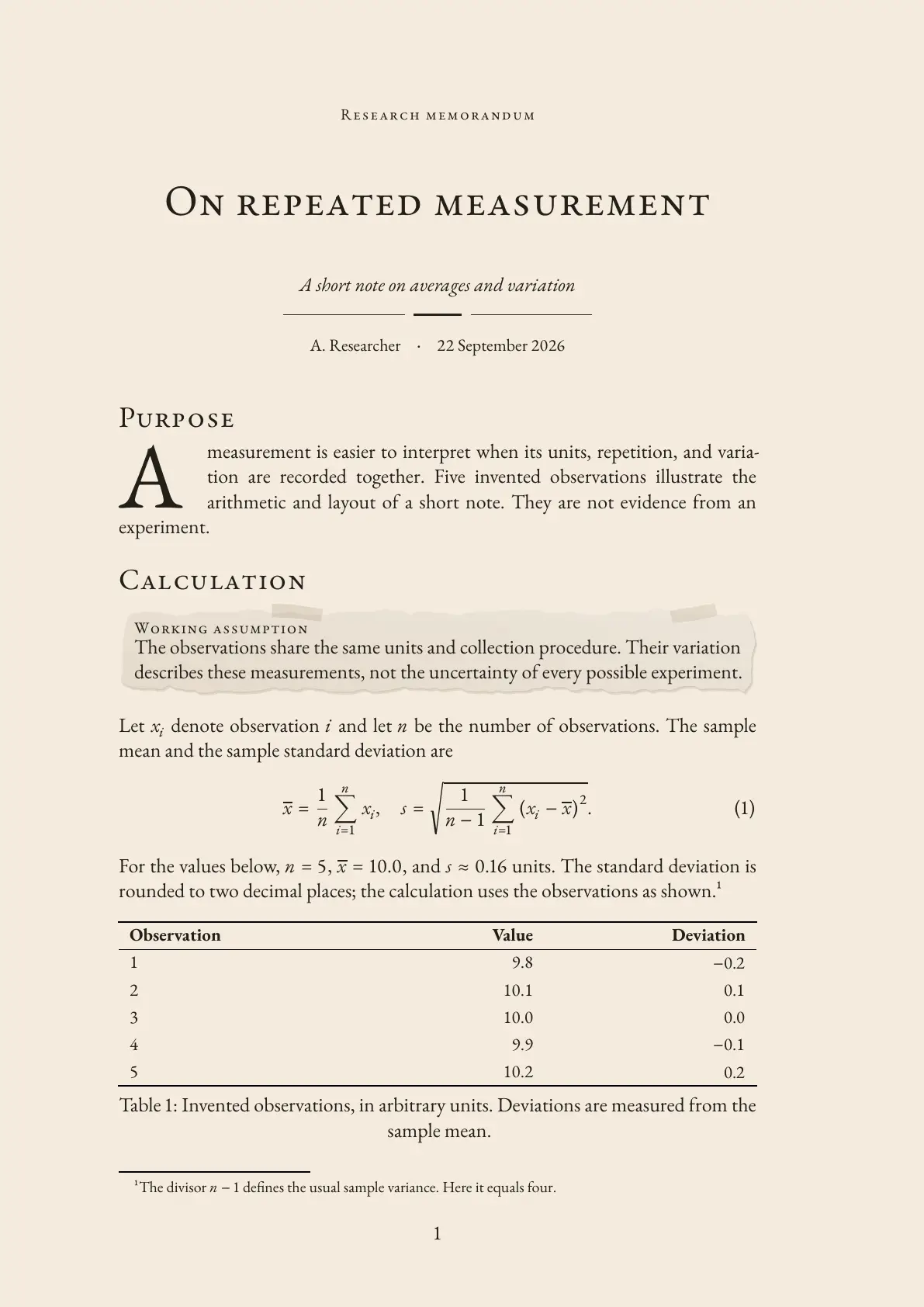
Research memos with cream paper, Garamond text and mathematics, drop capitals, margin notes, and torn-paper emphasis blocks. Requires Typst 0.15.0 or newer.
Available on Typst Universe.
Setup
Install EB Garamond (regular, italic, bold,
and bold italic) and Garamond-Math.
On desktop, install through your font manager and restart the editor/preview;
verify both families with typst fonts. Alternatively pass --font-path /path/to/fonts.
In the Typst web app, upload them to your project if unavailable. Fonts are not
bundled. The starter downloads droplet:0.3.1 on first compilation.
Usage
template/main.typ is the only starter. Edit its metadata and body. The complete example below is the same file; both rendered pages follow.
// SPDX-License-Identifier: MIT-0
// Copyright (c) 2026 Chen Gao
#import "@preview/sepia-memo:0.3.0": memo, memo-note, memo-inset
#import "@preview/droplet:0.3.1": dropcap

#show: memo.with(
  title: [On repeated measurement],
  subtitle: [A short note on averages and variation],
  author: "A. Researcher",
  date: [22 September 2026],
)

// ponytail: One starter; optional fonts use the same memo settings.
#set math.equation(numbering: "(1)")

= Purpose

#dropcap(height: 3, gap: 4pt)[
  A measurement is easier to interpret when its units, repetition, and variation
  are recorded together. Five invented observations illustrate the arithmetic and
  layout of a short note. They are not evidence from an experiment.
]

= Calculation

#memo-inset(title: [Working assumption])[
  The observations share the same units and collection procedure. Their variation
  describes these measurements, not the uncertainty of every possible experiment.
]

Let $x_i$ denote observation $i$ and let $n$ be the number of observations. The
sample mean and the sample standard deviation are

$
  overline(x) = 1/n sum_(i=1)^n x_i,
  quad s = sqrt(1/(n - 1) sum_(i=1)^n (x_i - overline(x))^2).
$ <eq-summary>

For the values below, $n = 5$, $overline(x) = 10.0$, and $s approx 0.16$ units.
The standard deviation is rounded to two decimal places; the calculation uses
the observations as shown.#footnote[The divisor $n - 1$ defines the usual sample
  variance. Here it equals four.]

#block(breakable: false)[
#figure(
  table(
    columns: (1fr, 1fr, 1fr),
    align: (left, right, right),
    table.hline(stroke: 0.6pt),
    table.header([*Observation*], [*Value*], [*Deviation*]),
    table.hline(stroke: 0.3pt),
    [1], [9.8], [$-0.2$],
    [2], [10.1], [$0.1$],
    [3], [10.0], [$0.0$],
    [4], [9.9], [$-0.1$],
    [5], [10.2], [$0.2$],
    table.hline(stroke: 0.6pt),
  ),
  caption: [Invented observations, in arbitrary units. Deviations are measured
    from the sample mean.],
) <tab-observations>
]

= Interpretation

#memo-note[
  *Keep units visible.* A precise number can still describe an uncertain
  measurement.
][
  @tab-observations makes the arithmetic in @eq-summary easy to inspect. The
  deviations sum to zero, while their squares sum to $0.10$. These checks can
  catch a transcription error before a rounded result is reported.
]

Repeated measurements describe variation under the conditions of collection.
They do not, by themselves, establish that the instrument is calibrated or
that a different setting would produce the same distribution. Those claims
need their own observations and reasoning.
Page 1: drop capital, torn-paper block, equations, table, and footnote.

Page 2: the right-margin note created by memo-note.

Create and watch a memo with:
typst init @preview/sepia-memo:0.3.0 my-memo
typst watch my-memo/main.typ my-memo/main.pdf
Options
Set these in memo.with(...). The body follows the show rule normally.
| Option | Default | Purpose |
|---|---|---|
title |
[Untitled memo] |
Title and PDF metadata |
subtitle |
none |
Subtitle content |
author |
"" |
Author string and PDF metadata |
date |
none |
Date content or string |
paper |
"a4" |
Paper size; also supports "us-letter" |
font |
"EB Garamond" |
Text font |
math-font |
"Garamond-Math" |
Math font |
paper-color |
rgb("#F4EBDD") |
Background; use white for printing |
ink |
rgb("#231F1A") |
Text and title-rule color |
For fonts embedded in the Typst CLI, set font: "Libertinus Serif" and
math-font: "New Computer Modern Math"; the layout will differ from the preview.
memo-note(note)[paragraph]: one short paragraph with a right-margin note. Use at the top level with the standard margins; the pair stays on one page.memo-inset(title: [Assumption])[content]: a torn-paper emphasis block. Use at the top level insidememo; it can contain prose, equations, and tables and continue across pages. The title is optional. Tape placement varies by block and stays stable when recompiling the same document.printer-rule(): import it from sepia-memo for a three-part divider. Itsinkoption defaults torgb("#231F1A").- The starter’s three-line drop cap comes from droplet.
Wrap prose only; keep tables, display equations, and margin notes outside it.
To remove it, delete the
dropcap(...)wrapper and droplet import.
Local preview
Open the repository folder. In template/main.typ, change only the sepia-memo
import path to "../lib.typ", then run from the repository root:
typst watch --root . template/main.typ memo.pdf
Save edits to refresh the PDF, or open template/main.typ with your editor’s
Tinymist browser preview.
Licenses and dependencies
Adapted from Foadsf/vintage-latex. NOTICE records the source revision and changes; LICENSE defines the file boundaries and links to complete terms.
| Included files | License |
|---|---|
lib.typ, thumbnail.png, preview-page-2.png |
CC BY-SA 4.0 |
template/main.typ, README.md, typst.toml, CONTEXT.md, tests/*, .gitignore |
MIT-0 |
| External requirement | License |
|---|---|
| Typst 0.15.0+ compiler | Apache-2.0 |
| droplet 0.3.1, imported by the starter | MIT |
| EB Garamond | OFL-1.1 |
| Garamond-Math | OFL-1.1 |
External tools, package code, and fonts are not bundled. Retain their respective licenses and notices if redistributing them separately. Embedding OFL fonts does not license the document under OFL. Authors retain rights in their own text; any protected upstream material in an output retains its applicable obligations.