Fill-in study notes for STEM: read one layer, fill the other. Theorem knots,
intuition notes, margin threads, and fillin blanks — in light or dark.

Most notes are read-only and forgotten by the next page. Scholia typesets the active layer too: statements and intuition to take in, blanks and proof-skeletons to work out. The source is your answer key.
Start a new notebook with
typst init @preview/scholia, or import the library:
Use
#import "@preview/scholia:0.1.0": *

// options: theme: "light" | "dark" · prose: "notes" | "book" · fonts: (…)
#show: scholia

#cover("Title", subtitle: "subtitle", author: "Your Name", date: "2026")

= First course

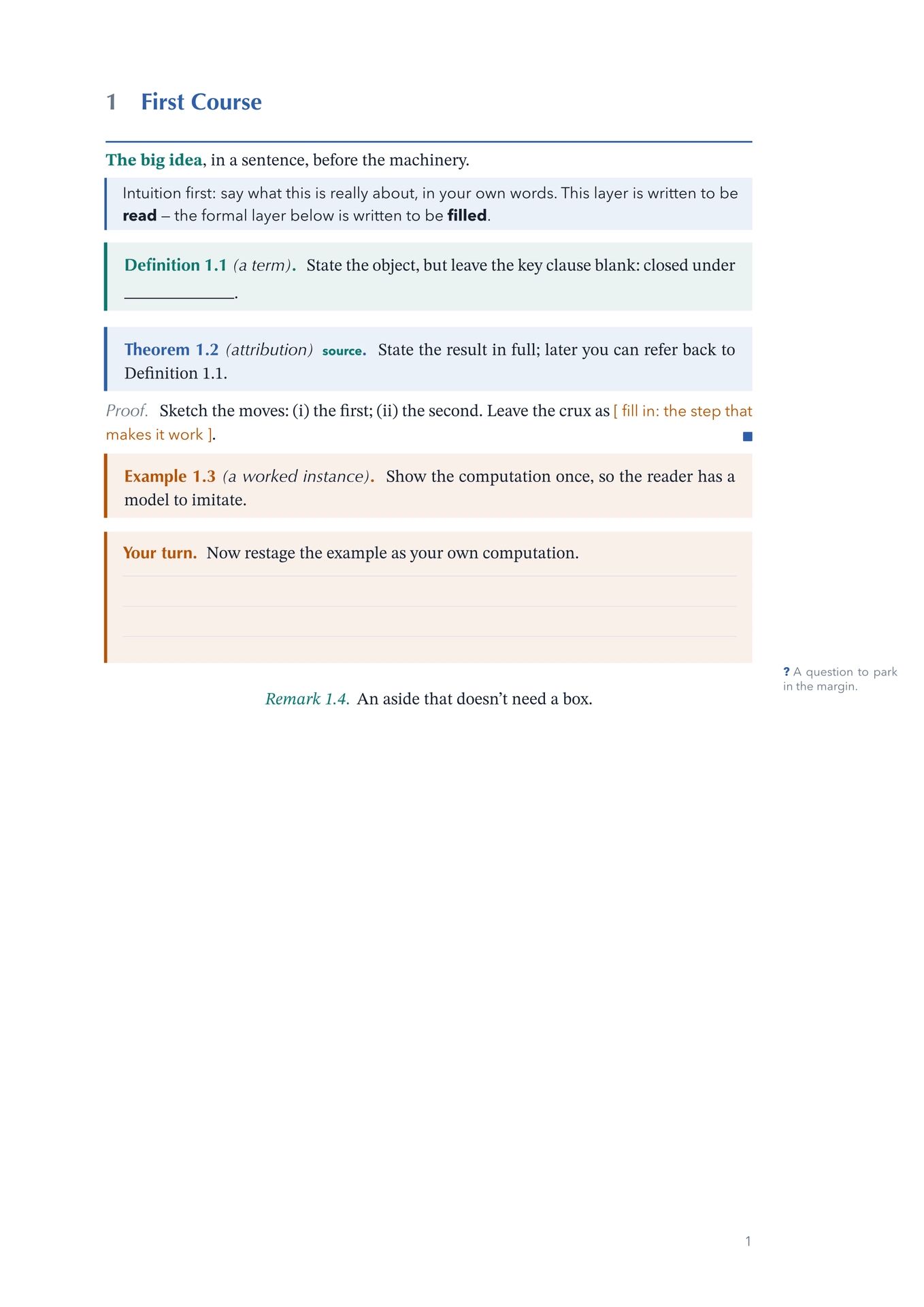
#note[The big idea, in your own words. The passive layer.]

#definition[a name][State the object, leave a clause blank: #fillin(width: 3cm).] <def:thing>

#theorem[attribution][State the result, then refer back to @def:thing.] <thm:main>
#proof[Skeleton: (i) … (ii) … #TODO[the step that makes it work]]

#yourturn[Restage it as your own computation. #workspace(n: 3)]
Knots are built on @preview/frame-it:
each is a figure, so they get native @label cross-references and shared,
section-tied numbering for free. The title is the first argument, the body the
last: #theorem[title][body] (omit the title with #theorem[body]). An optional
middle slot is a small tag — a source or claim-ID, styled by label-it:
#theorem[title][GSM 211, Thm 2.16][body].
Compile examples/example.typ to see every device in one
mini-chapter. It defaults to the light notes theme; uncomment the theme: "dark"
or prose: "book" line at the top to see the other modes.
The toolkit
| you want… | you write… |
|---|---|
| the cover | cover(title, subtitle: …, author: …, date: …, kicker: …) |
| a result (blue) | theorem[t][b] · lemma · proposition · corollary · conjecture · claim |
| a definition (teal) | definition[t][b] · axiom · assumption · notation |
| an example / remark (amber / plain) | example[t][b] · remark[b] |
| cross-reference a knot | label with <thm:x>, refer with @thm:x (native) |
| a source / claim-ID tag | a middle slot theorem[t][tag][b], or label-it[…] inline |
| the intuition voice | note[…] · whisper[…] · keyword[…] |
| a blank to fill | fillin(width: 2.2cm) |
| a proof gap | TODO[the missing step] |
| a do-it-yourself box | yourturn[…] + workspace(n: 3) |
| a margin note | sidenote[…] · recall[…] (the ? preset) |
Options (#show: scholia.with(…))
| option | values | effect |
|---|---|---|
theme |
"light" (default) · "dark" |
swaps the whole colour card — page, text, knots, accents (dark = slate) |
prose |
"notes" (default) · "book" |
notes = no indent + paragraph spacing; book = first-line indent + tight |
paper |
"a4" (default) · "us-letter" · … |
page size |
fonts |
dict overriding default-fonts |
e.g. (heading: ("Gill Sans",)) |
| Light | Dark |
|---|---|
 |
 |
Fonts
Every role is a fallback list — the nice face first, an embedded face last — so output never breaks and degrades gracefully when a font is missing:
| role | default list |
|---|---|
| body | ("STIX Two Text", "Libertinus Serif") |
| math | ("STIX Two Math", "New Computer Modern Math") |
| heading | ("Optima", "Libertinus Serif") |
| sans (intuition voice) | ("Avenir Next", "Libertinus Serif") |
| mono | ("Menlo", "DejaVu Sans Mono") |
A Typst package cannot ship fonts, so the universal baseline is Typst’s four
embedded faces (Libertinus Serif, New Computer Modern + Math, DejaVu Sans Mono).
For the intended look install STIX Two (Text + Math, free/OFL); on macOS, Optima
and Avenir Next are already present. Override any role via fonts:, or retune the
defaults in src/fonts.typ.
Known limitations
- Subsection / subsubsection are styled blocks, not true run-in headings.
- A
fonts:override reaches body / math / heading; thenotevoice and knot labels still readdefault-fontsdirectly (full theming is a later pass).
Internals
src/ is modular: colors.typ (palettes + theme state) ·
fonts.typ · visual.typ ·
theorems.typ (frame-it knots) ·
lib.typ (pedagogy, margins, cover, wrapper).
License & credits
MIT © Eric Yang. An independent Typst reimplementation, inspired by the design of the loom-notes XeLaTeX project (no source code reused). Example notes restate cited results for educational use; the mathematics belongs to its authors.