Published on Typst Universe as rasko-europass; the template function you
call is europass-cv. The development repository keeps the descriptive name
europass-cv.

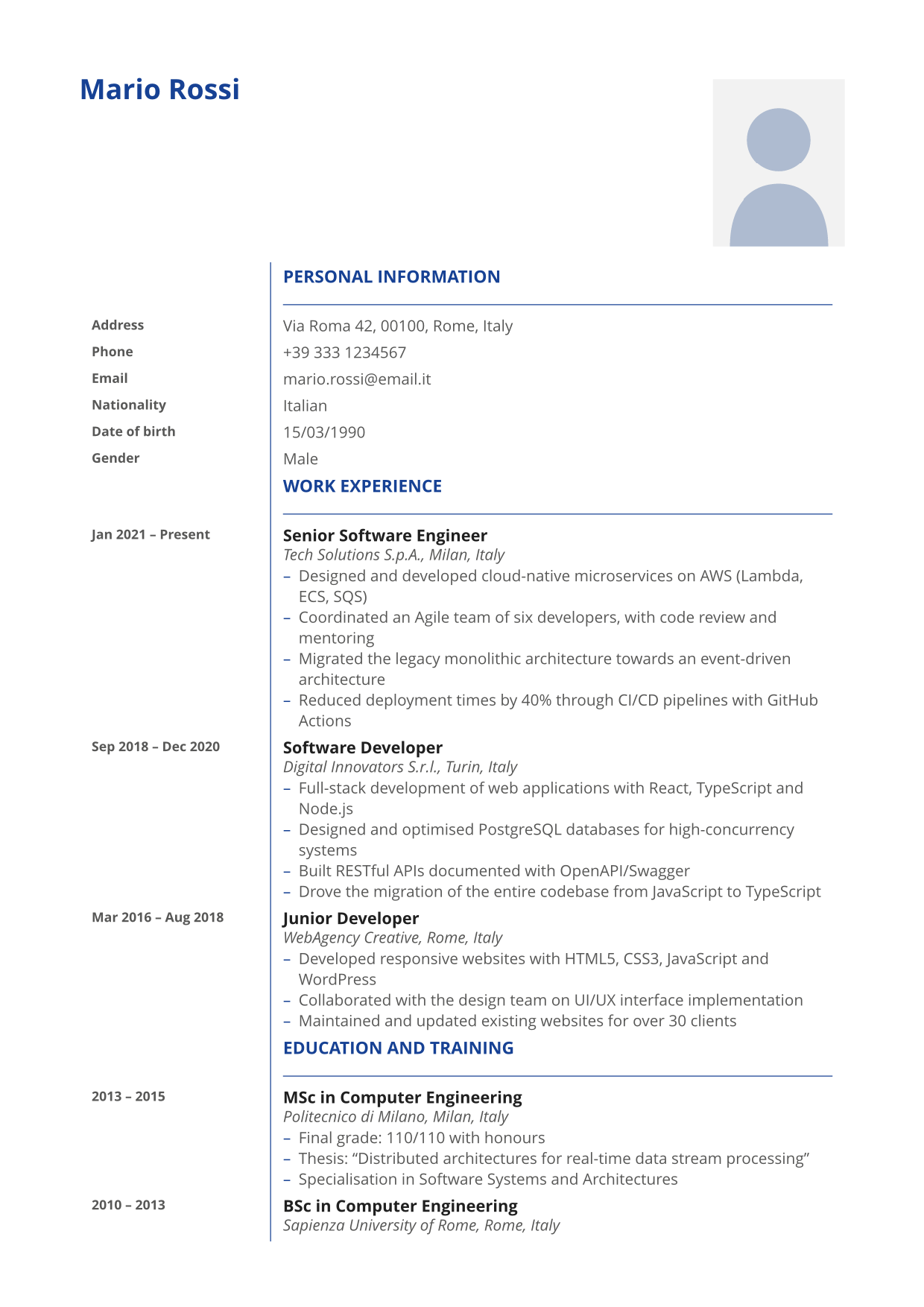
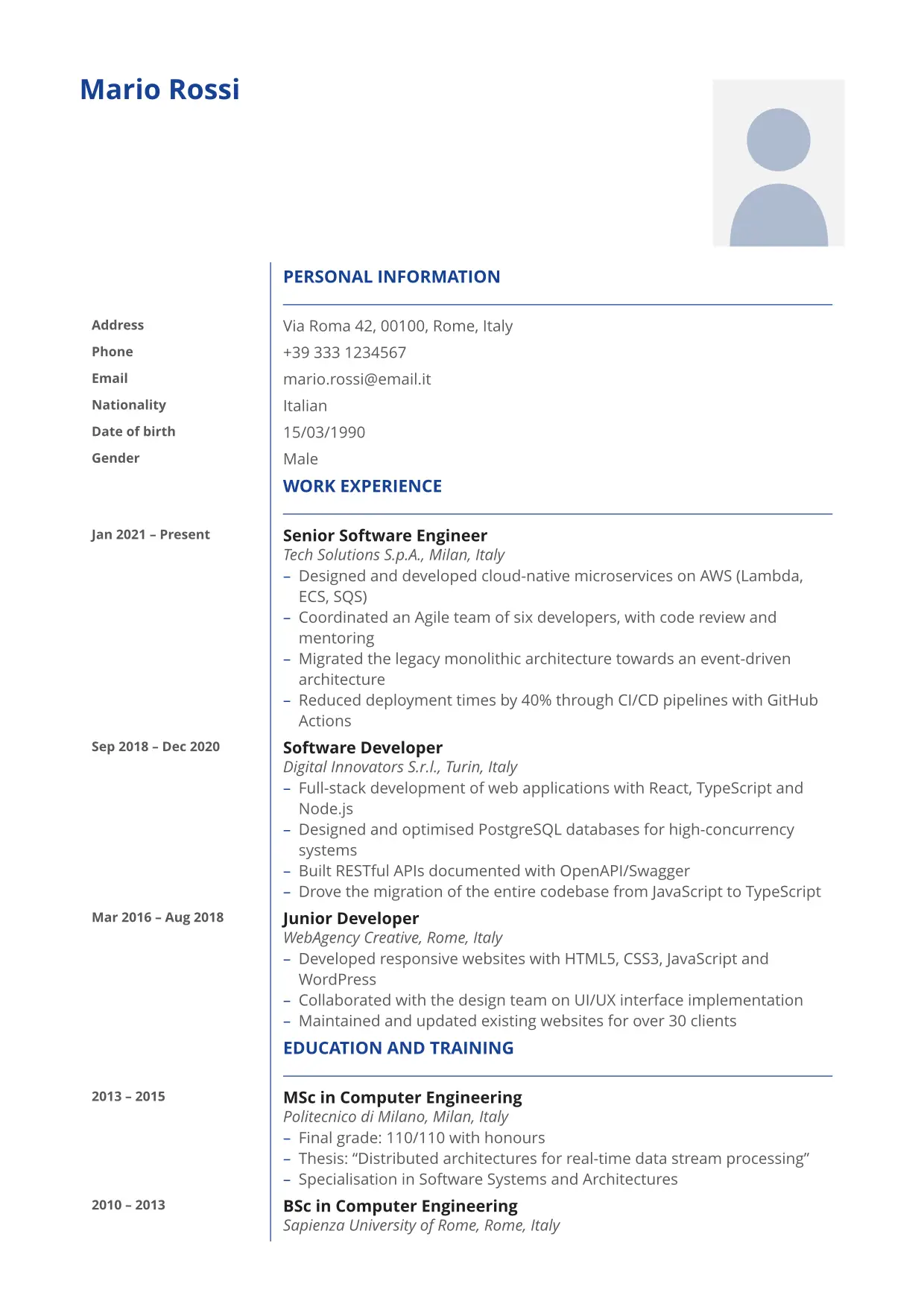
A faithful, accessible reproduction of the official European Union Europass CV format, built for Typst ≥ 0.15.
- Asymmetric two-column grid (~25 % dates / ~75 % content) with the iconic thin vertical blue rule running unbroken top-to-bottom.
- Official EU palette: blue
#164194, body grey#575756, highlight#F2F2F2. - CEFR language self-assessment table (A1–C2) with contrast-safe shading.
- GDPR / DPR 445 self-declaration clause, localised.
- Full i18n for all 24 official EU languages.
- PDF/UA-1 (ISO 14289-1) output — enforced at compile time in the
repository build (
--pdf-standard 1.7,ua-1) and covered by the automated accessibility checks inverify.sh. - Overridable typeface stack via the
font:parameter, because Typst Universe packages cannot bundle font binaries — see the note below.
Fonts — read this first
Typst Universe packages are not allowed to ship font binaries, so this package does not include Open Sans. Before compiling, either
- install Open Sans yourself — download it from fonts.google.com/specimen/Open+Sans, or install your distribution’s Open Sans package (the name varies:
fonts-open-sans,open-sans-fonts,ttf-open-sans, …);- or pass any family you already have via the
font:parameter — the only option in environments where you cannot install fonts, such as the Typst web app.If you do neither, Typst silently substitutes whatever it finds and the output will not match the official Europass typography. The development repository vendors the complete family in
fonts/so that its builds are hermetic and reproducible; see Fonts & reproducibility.
Quick start
From Typst Universe
Start a new CV from the template:
typst init @preview/rasko-europass:1.0.0 my-cv
cd my-cv
typst compile main.typ          # -> main.pdf
or import the package into a document you already have:
#import "@preview/rasko-europass:1.0.0": europass-cv, cv-entry

#show: europass-cv.with(lang: "en", name: "Your Name")
From the repository
The repository vendors the Open Sans family and ships the build and verification scripts, so its builds are hermetic and PDF/UA-1-validated. Clone it:
git clone https://github.com/Raskolny/europass-cv.git
cd europass-cv
./build.sh                 # hermetic, PDF/UA-1 build -> output.pdf
./build.sh my-cv.pdf       # custom output name
or fetch the released version as an archive instead of cloning:
curl -L -o europass-cv.tar.gz \
  https://github.com/Raskolny/europass-cv/archive/refs/tags/v1.0.0.tar.gz
tar xzf europass-cv.tar.gz
cd europass-cv-1.0.0 && ./build.sh
Repository-only files.
build.sh,build-examples.sh,verify.sh, the vendoredfonts/,examples/,social-preview.*and theCONTRIBUTING/ROADMAP/PUBLISHINGdocs live in the GitHub repository but are not part of the published Universe package. If you installed the package from Universe, disregard every reference to them further down this page and compile with plaintypst compileas usual.
build.sh is the canonical entry point. It compiles with:
typst compile --pdf-standard 1.7,ua-1 --ignore-system-fonts --font-path fonts main.typ output.pdf
and then runs verify.sh, which asserts accessibility and font embedding
(see Verification below). build.sh also materialises a local package
cache (.pkgcache/) so that main.typ’s @preview/rasko-europass:1.0.0
import resolves inside the clone; only build.sh guarantees the hermetic,
UA-1-validated result.
Writing your CV
Everything an end user touches lives in main.typ. You never edit the
layout. Fill in fields and go:
#import "@preview/rasko-europass:1.0.0": cv-entry, europass-cv

#show: europass-cv.with(
  lang: "it",
  name: "Mario Rossi",
  email: "mario.rossi@email.it",

  work-experience: (
    cv-entry(
      date-start: "Gen 2021", date-end: "Presente",
      title: "Senior Software Engineer",
      organization: "Tech Solutions S.p.A.",
      location: "Milano, Italia",
      description: [
        - Led a team of six engineers
        - Migrated a monolith to event-driven microservices
      ],
    ),
  ),

  other-languages: (
    (lang: "English", listening: "C1", reading: "C1",
     interaction: "B2", production: "B2", writing: "C1"),
  ),
)
Anything you write below the #show: line is appended as an extra section.
europass-cv(..) parameters
| Group | Parameters |
|---|---|
| Language / metadata | lang, title, author |
| Personal info | name, photo, photo-alt, address, postal-code, city, country, phone, email, website, nationality, date-of-birth, gender |
| Sections | work-experience, education (arrays of cv-entry) |
| Skills | mother-tongue, other-languages, digital-skills, comm-skills, org-skills, job-skills, other-skills, driving-licence |
| Declaration | declaration, signature-place, signature-date, signature-image (1.1.0, unreleased), signature-alt (1.1.0, unreleased) |
Every parameter has a default; supply only what you need.
cv-entry(..)
One row of Work Experience / Education. Fields: date-start, date-end,
title, organization, location, description. title is emitted as a
real H3 heading, so assistive technology can jump straight to a job.
language-grid(mother-tongue:, others:, lang:)
Renders the CEFR table. others is an array of dictionaries with keys
lang, listening, reading, interaction, production, writing, each a
CEFR code (A1–C2, case-insensitive). Levels are emitted as text with
a contrast-safe background shade — never colour-only, so the PDF stays
accessible.
Signature
Availability.
signature-image:/signature-alt:are part of the upcoming 1.1.0 release; they are not available from the published@preview/rasko-europass:1.0.0.
By default the declaration block ends with a thin rule, leaving space to sign
on paper after printing. To render an uploaded handwritten signature
instead, point signature-image: at it:
#show: europass-cv.with(
  lang: "it",
  signature-place: "Roma",
  signature-date: "15 settembre 2025",
  // Load your own file as BYTES — see the path-resolution note below.
  signature-image: read("signature.png", encoding: none),
  signature-alt: l("it").at("signature-alt"), // "Firma autografa"
)
Notes:
- Image paths resolve inside the package, not your project. Typst
resolves a relative path string where it is consumed (
lib.typ, inside the package), so a baresignature-image: "signature.png"would search the package directory and fail. Pass bytes instead —read("signature.png", encoding: none)resolves relative to your document. The same applies tophoto:. (Paths to files shipped with the package, e.g."assets/signature-sample.svg", work as plain strings.) - The image is fitted to a 40 mm × 16 mm box with
fit: "contain", so the aspect ratio is preserved and a tall scan can never overflow the 55 mm block or push the layout around. signature-alt:is required for PDF/UA-1 wheneversignature-image:is set — an untagged image fails the--pdf-standard 1.7,ua-1build. Use the localised string (l(lang).at("signature-alt")), which is translated for all 24 languages, exactly as forphoto-alt:.- The signature block only renders when
signature-place:orsignature-date:is non-empty. - All 24 examples use the shared anonymous placeholder
assets/signature-sample.svg, so no real person’s signature is depicted.
Internationalisation
Set lang: to any ISO 639-1 code; unknown codes fall back to English.
All 24 official EU languages are bundled:
bg cs da de el en es et fi fr ga hr hu it lt lv mt nl pl pt ro sk sl sv
Each provides the section headers, the personal-info labels, the CEFR grid labels, the A1–C2 proficiency descriptors, the gender values, the image alt-text, and the localised GDPR declaration.
Localisation data lives in lang.toml, not in code
Following the prevailing Typst Universe convention for multilingual packages
(cf. modern-cv), all translations are kept in a single external data file,
lang.toml, loaded by lib.typ with the built-in toml() function:
#let i18n = toml("lang.toml")
Why this rather than one file per language (or an inline dictionary)?
- Translator-friendly. Contributors edit plain TOML key/value pairs with zero risk of breaking Typst syntax.
- One reviewable diff. A new language or a wording fix touches one file.
- Keeps
lib.typpure logic. The entrypoint stays small and readable. - No import overhead. Per-language modules would each need an
#importand would all be compiled anyway; a single data file is simpler and is the established community pattern.
Gender (inclusive, localisable, omittable)
The gender parameter is deliberately flexible, localisable, and omittable:
| Value | Effect |
|---|---|
none / "" |
the row is omitted entirely (recommended default) |
"male", "female" |
localised label for the active language |
"other" / "non-binary" |
the EU third option (the “X” / German divers) |
"undeclared" / "prefer-not-to-say" |
an explicit “I prefer not to declare” |
| any other string | passed through verbatim, in the person’s own words |
All four semantic values are translated in lang.toml for every language.
Examples
Browse all 24 examples in the repository →
examples/
(only this README is displayed on Typst Universe, so the links point at
GitHub, pinned to this release’s tag).
Each examples/<code>.typ
is one complete CV in an EU language, with a persona of the matching
nationality — e.g.
examples/bg.typ
→ Георги Иванов, Българин. They double as the i18n regression suite:
./build-examples.sh # compiles all 24 to examples/pdf/ (PDF/UA-1)
Where a country’s convention includes a photo, the example uses the same
anonymous, gender-neutral placeholder portrait (assets/photo-placeholder.svg)
so no real person is depicted. Lean-CV countries (see the per-example comments
and discussion #3) omit it, keeping the parameter as a commented-out
instruction you can reinstate.
The flagship main.typ is written in English (the lingua franca of EU
mobility) but keeps an Italian persona — a common Europass combination for
EU/international applications.
Accessibility (PDF/UA-1)
The template is engineered for accessibility, not bolted on:
- Real semantic headings. The name is
H1, sections areH2, job/degree titles areH3. This produces a genuine PDF outline (bookmarks) — PDF/UA-1 rejects documents without one. - Layout vs. data. The presentational date/content grid uses Typst
grid, which is tagged as layoutDivs — screen readers never announce a bogus data table. Only the genuinely tabular CEFR grid usestablewithtable.header(), yielding properTable/THead/TH/TDtags. - Text, not colour. CEFR levels are always real text.
- Links. Email/website become real
Linkannotations. - Lists. Bullet skills are tagged
L/LI/Lbl/LBody. - Document metadata.
title,author, and the documentlangare set, and/DisplayDocTitleis enabled. - Alt text.
photo-altis mandatory for the portrait image.
Typst enforces PDF/UA-1 at compile time via --pdf-standard 1.7,ua-1: the
build fails if the document would not be accessible.
Fonts & reproducibility
fonts/ vendors the complete Open Sans family (Apache-2.0). The build uses
--ignore-system-fonts --font-path fonts, so no glyph is ever resolved from
the host machine, and the PDF embeds subsetted Open Sans with a Unicode
CMap (emb=yes sub=yes uni=yes) — there is no fallback to local/Base-14 PDF
fonts. See fonts/README.md.
Typst Universe note. Universe policy forbids shipping font binaries
inside a package, so the published bundle does not include fonts/.
Universe users should install Open Sans (e.g. from
fonts.google.com/specimen/Open+Sans
or their distribution’s open-sans package); alternatively they may pass any
family available to them via the font: parameter, which is also the escape
hatch for environments where fonts cannot be installed (such as the Typst web
app). The vendored copy remains in this repository so that repository builds
stay hermetic and reproducible.
Verification
verify.sh asserts, on the rendered PDF:
- every font embedded and subsetted;
- no Base-14 / non-embedded font referenced;
/MarkInfo Marked true,/StructTreeRoot, document/Lang, XMP metadata;- a non-empty PDF outline (H1 root + H2 sections);
H1/H2/Table/THead/TH/TD/L/LItags present;- the layout grid tagged
Div(not a data table).
Repository layout
The development repository (github.com/Raskolny/europass-cv) holds more than the published package: the vendored fonts, the build and verification scripts, CI and the contributor docs are all repository-only.
lib.typ               template library (layout + public API; loads lang.toml)
lang.toml             localisation data — all 24 official EU languages
main.typ              end-user entry point — fill this in
assets/               anonymous placeholder portrait + signature sample (SVG)
examples/             one CV per language/nationality (+ pdf/ build output)
fonts/                vendored Open Sans family + Apache-2.0 license
build.sh              canonical hermetic PDF/UA-1 build (main.typ)
build-examples.sh     compiles all 24 examples (PDF/UA-1)
verify.sh             accessibility + font-embedding assertions
typst.toml            Typst Universe package manifest
License
- Template code, examples, docs and scripts: MIT (see
LICENSE). - Bundled Open Sans fonts: Apache-2.0 (see
fonts/LICENSE-OpenSans-Apache2.txt). - Combined licensing statement: see
NOTICE.md.
Author
Massimiliano Milani (rasko–)
- GitHub: @Raskolny
- LinkedIn: maxmilani
- Email: raskolny@gmail.com