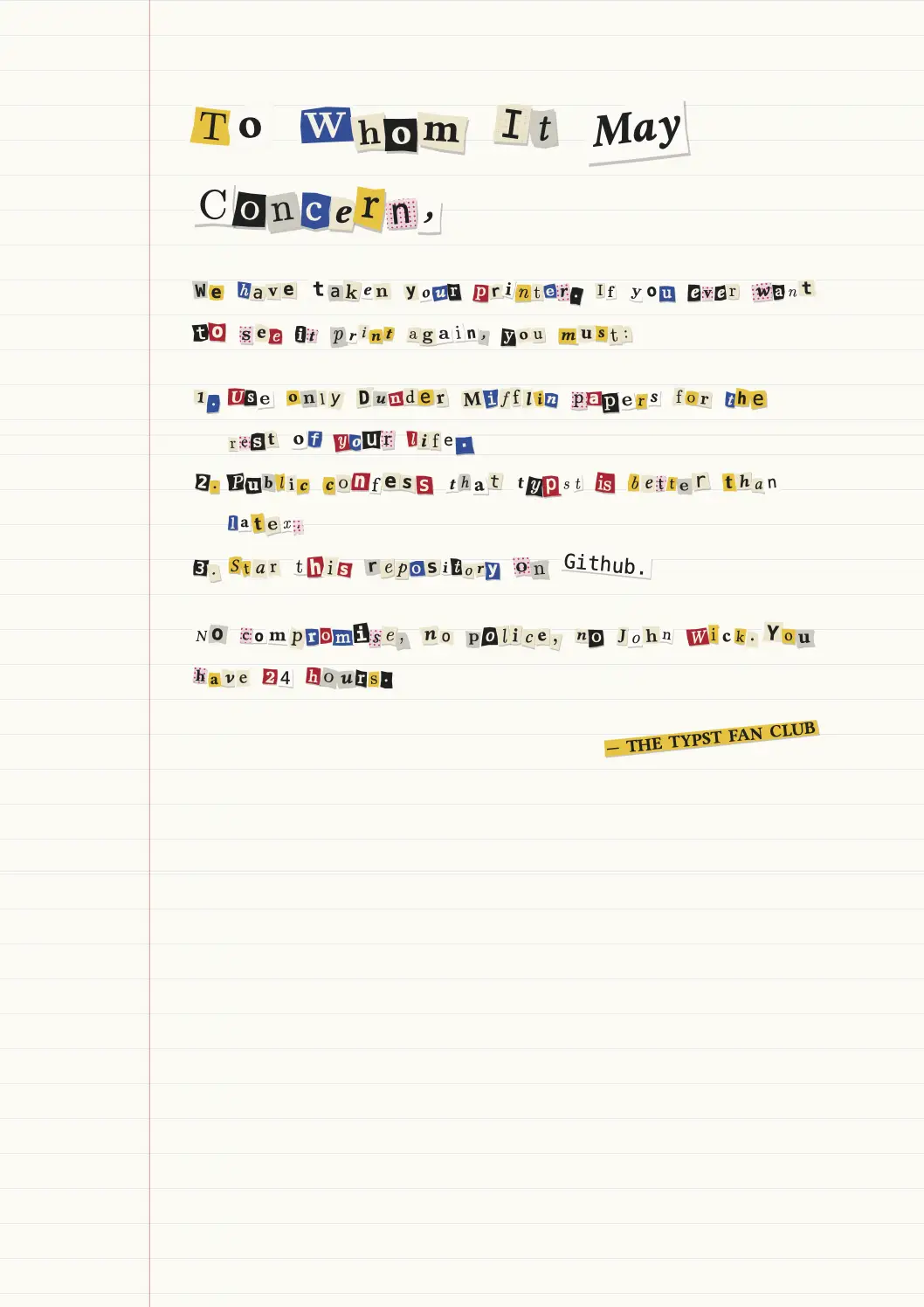
Cut-out ransom-note letters for Typst. Every letter comes from a different scrap of paper, in a different typeface, at a slightly different angle, with ragged scissor-cut edges and a faint shadow.
Write ordinary Typst; get a ransom letter.
Quick start
Start off from the template:
typst init @preview/ransom
or, to use it in an existing document:
#import "@preview/ransom:0.1.0": *

#show: ransom-note.with(title: "A Polite Demand", seed: 7)

= We have your thesis

Leave one espresso under the third bench. Tell *no one*.
Headings, lists, tables, links, footnotes and inline code are all cut out. Heading text comes out larger because the letters follow the size of the text around them.
Cutting letters yourself
Prefer to keep your document normal and cut only a few words? Turn the
document-wide behaviour off, and call ransom where you want it:
#show: ransom-note.with(cut-text: false, surface: "none")

Plain text stays plain. #ransom(size: 2.4em, seed: 3)[Except this.]
ransom also works with no template at all:
#import "@preview/ransom:0.1.0": ransom

#ransom(palette: "noir", tilt: 12deg)[Meet me at midnight.]
Typst’s strong text (*...*) and emphasized text (_..._) are cut out as
single pieces, while the rest is cut letter by letter:
ransom options
| Option | Default | Meaning |
|---|---|---|
seed |
1 |
Any int or string. Same seed, same arrangement, every compile. |
size |
1.0em |
Base letter size. em follows the surrounding text. |
palette |
"classic" |
"classic", "noir", "candy", "vintage", or an array of scraps. |
faces |
"embedded" |
"embedded", "expressive", or an array of faces. |
case |
"mixed" |
"mixed", "upper", "lower" or "keep". |
tilt |
8deg |
Largest rotation of one letter. |
sway |
12% |
Largest vertical wobble, as a share of size. |
scale |
(90%, 120%) |
Smallest and largest letter size, as shares of size. |
cut-words |
10% |
Share of short words cut out whole, as one headline. |
backing |
25% |
Share of letters that keep a white paper margin. |
ragged |
7% |
How uneven the scissor cuts are. |
shadow |
true |
Whether scraps cast a faint shadow. |
tracking |
4% |
Gap between letters, as a share of size. |
word-gap |
80% |
Gap between words, as a share of size. |
ransom-note options
| Option | Default | Meaning |
|---|---|---|
title |
none |
Document title for the PDF metadata. |
seed |
1 |
Reshuffles every letter when changed. |
surface |
"lined" |
"plain", "lined", "grid", "kraft" or "none". |
folds |
true |
Show the creases of a letter folded in thirds. |
cut-text |
true |
false leaves text alone; cut only where you call ransom. |
paper |
"a4" |
Page size. |
margin |
auto |
auto is 2.4 cm, with extra room left of lined paper’s margin line. |
size |
1.0em |
Base letter size relative to the 11 pt text. |
Any other named argument (palette, faces, tilt …) is passed on to ransom.
Your own paper and type
#import "@preview/ransom-note:0.1.0": *

#show: ransom-note.with(
  palette: (
    scrap(rgb("#ff5d8f"), white, weight: 3),      // fill, ink, how often
    scrap(rgb("#ffe066"), black),
    scrap(tiling(size: (4pt, 4pt))[#square(size: 2pt)], black),
  ),
  faces: (
    face("Libertinus Serif", weight: "bold"),
    face("DejaVu Sans Mono", weight: "bold"),
    // System fonts work too, with fallbacks: face(("Impact", "DejaVu Sans Mono"))
  ),
)
A scrap fill can be any Typst paint, including gradients and tilings.
Good to know
- Fonts. The default
"embedded"face set only uses fonts that ship with Typst, so the result is identical everywhere."expressive"prefers common system fonts (Impact, Georgia, Courier New …) and falls back to embedded ones, but Typst prints a warning for every family it cannot find. - Stable edits. Each paragraph, line and word gets its own random state
derived from its position, so fixing a typo does not reshuffle the rest of
the page. Change
seedto reshuffle everything on purpose. - Formatting is dropped. Strong and emphasized chunks are cut out whole; other formatting is discarded. Equations and images are left as they are.
- Long words wrap. Words longer than ten letters, such as URLs, are split into chunks that Typst may break between.
- Quotes. Apostrophes and quotation marks are cut out too, always as straight quotes.
- Line spacing. Scraps are taller than ordinary text. When using
ransomon its own, a generousset par(leading: 1em)keeps lines apart.
How it works
Typst has no random-number function and documents must compile identically
every time, so the package carries a tiny seeded generator. Each letter is
measured, drawn onto a jittered eight-point polygon, and rotated without
reflow so neighbouring scraps overlap like glued paper. The document template
works by matching ordinary text with a show rule; the letters it produces
are marked with overhang: false, which is what keeps the rule from matching
its own output.