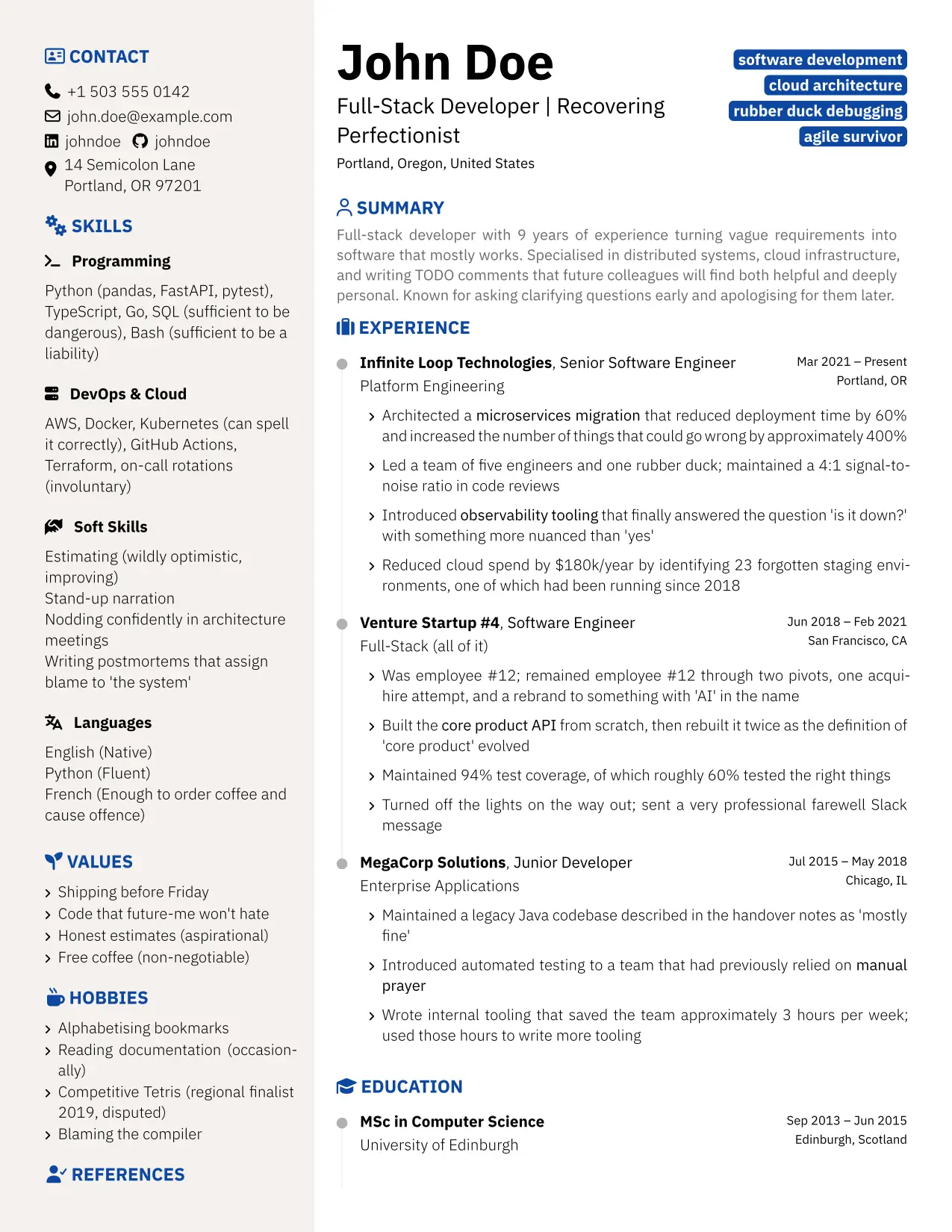
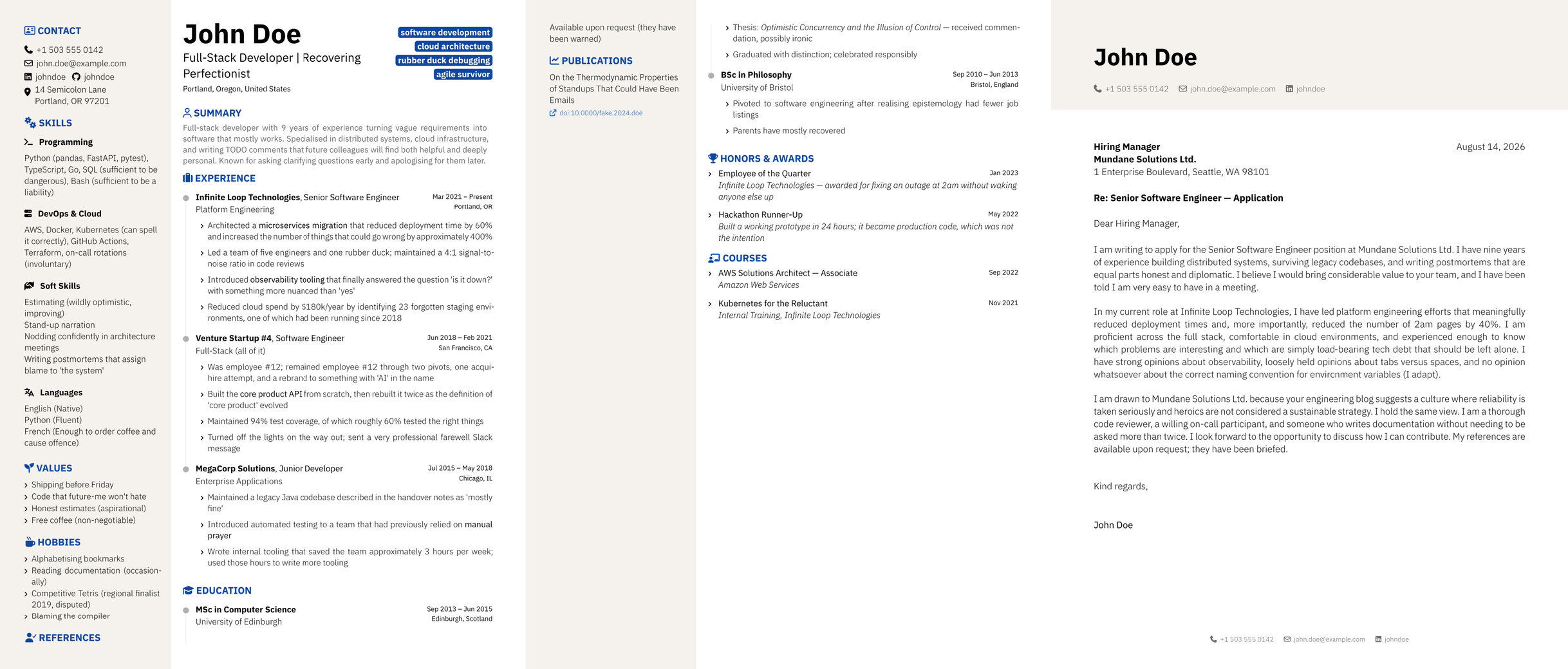
A Typst package for not-a-boring CV - data-driven, fully configurable, two-column layout


A data-driven CV and cover letter package for Typst. You write your resume in a .yml (or .toml) data file - the template reads it and renders the PDF. Layout, language, section order, icons and per-company variants are all driven from the data, so day to day you only edit data. The cv.typ / letter.typ files in your project are entrypoints you compile; you can also edit them for advanced options (colours, fonts, social-network mapping), but you never touch the package itself (src/).
Features
- Data-driven - your whole CV lives in
cv.yml/letter.yml; no source edits - YAML or TOML - pick either, identical output
- Configurable from the data - layout, locale, section order, titles and icons all set in a
meta:block - ATS-friendly layouts - a single-column
ats-splitand a full-width header band, plus tagged PDF/UA-1 output - Per-company variants - a file
inherit:s a base and overrides only what changes - Schema-backed - editor autocomplete/validation,
make validate, and a generated field reference
Prerequisites
-
Typst CLI - follow the official instructions.
-
Fonts - polycv requires two font families installed as system fonts:
IBM Plex Sans
# Debian/Ubuntu (Bookworm+)
sudo apt install fonts-ibm-plex

# Manual (all platforms)
mkdir -p ~/.local/share/fonts/ibm-plex
curl -L https://github.com/IBM/plex/releases/latest/download/OpenType.zip \
  | unzip -j - "ibm-plex-sans/fonts/complete/ttf/*.ttf" -d ~/.local/share/fonts/ibm-plex/
fc-cache -f
Font Awesome 7 Free
Download the Free for Desktop package from fontawesome.com/download, then:
mkdir -p ~/.local/share/fonts/font-awesome-7
# extract the downloaded archive, then:
cp path/to/fontawesome-free-*-desktop/otfs/*.otf ~/.local/share/fonts/font-awesome-7/
fc-cache -f
Quick start
1. Create your project
typst init @preview/polycv:0.2.0
This creates a polycv/ folder containing your data files (cv.yml, letter.yml, and their .toml equivalents) and the template entrypoints (cv.typ, letter.typ, application.typ). You edit the data files; the .typ files you only compile.
Tip - editor validation. The data files carry a
$schemaheader, so an editor with the YAML (Red Hat) or Tombi (TOML) extension autocompletes and validates every field as you type.
2. Fill in your data
Edit cv.yml:
cv:
  name: "Jane Smith"
  headline: "Software Engineer"
  email: "jane@example.com"
  phone: "+1 555 000 0000"
  summary: "Brief professional summary."
  profiles:
    - network: LinkedIn
      username: janesmith
  experience:
    - company: "Acme Corp"
      position: "Senior Engineer"
      start_date: "2021-03"
      end_date: "present"
      highlights:
        - "Built thing"
        - "Improved other thing"
Prefer TOML? Edit cv.toml instead (same fields) and add --input fmt=toml when you compile. Edit letter.yml similarly for your cover letter. FIELDS.md lists every available field with its type and a one-line description.
3. Build
typst compile cv.typ
typst compile letter.typ
typst compile application.typ        # CV + letter in one PDF
Your data is validated as it compiles - an invalid field stops the build and names it (e.g. /meta/locale), everywhere including the web app. An optional Makefile is available for local use (make builds incrementally, make watch live-previews); FIELDS.md lists every field. Bilingual CV? It’s just two files - the prefix before the first - picks the template, so name them cv-en.yml and cv-fr.yml (set locale in each, see below); both build automatically. Same for letters (letter-en.yml, …).
Configure from your data (meta:)
Presentation is controlled by an optional meta: block at the top of your data file - layout, language, section order, titles and icons. No .typ editing.
meta:
  photo: photo.jpg     # path to your photo (relative to the data file)
  locale: fr           # section titles + month names in French
  layout: header-band  # basic | ats-split | header-band (see below)
cv:
  name: "Jane Smith"
  # ...
Pick a layout
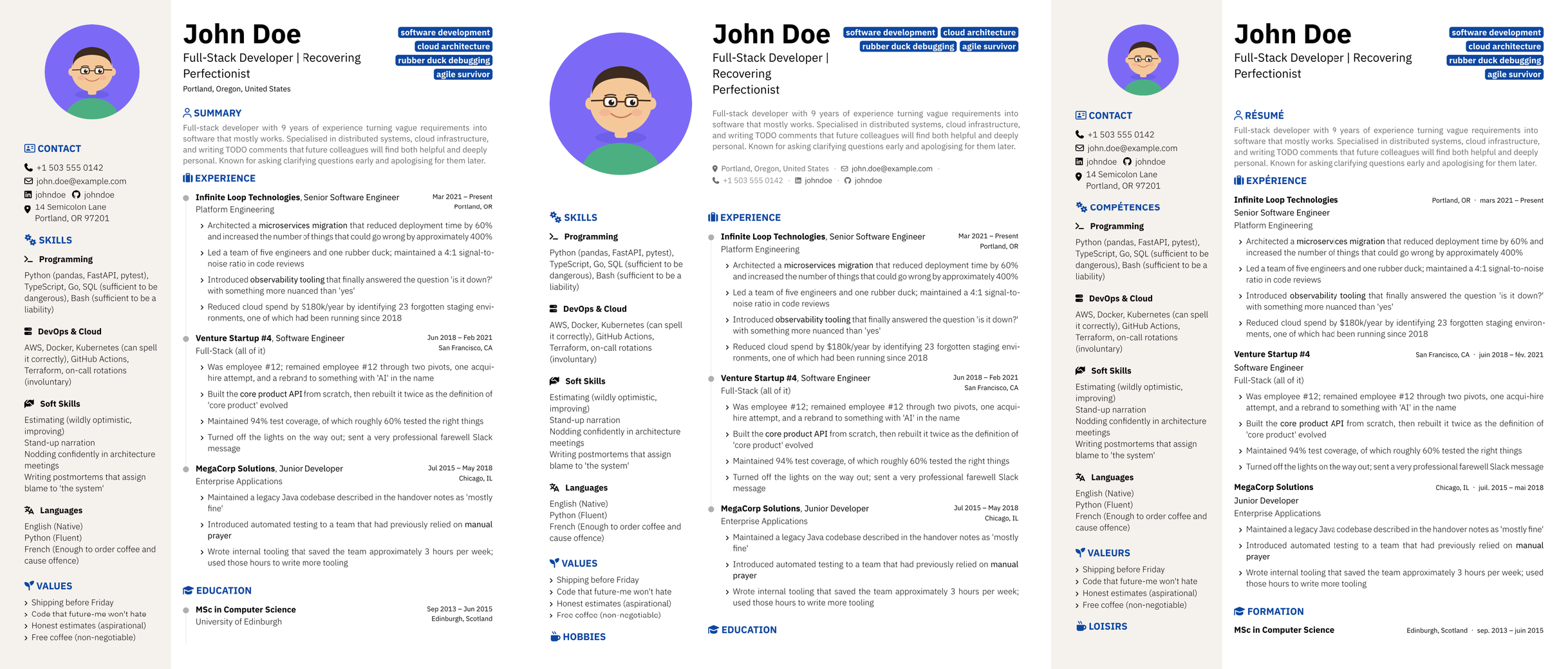
Left to right, all from the same data: Standard | Header band with the summary inside the band | ATS split rendered in French with inline entry dates and no timeline.
| Layout | meta: value |
Description |
|---|---|---|
| Basic | layout: basic (default) |
Name and headline atop the main column; photo and contact in the tinted sidebar |
| Header band | layout: header-band |
Full-width header: round photo, name, headline and a one-line contact row; no sidebar tint |
| ATS split | layout: ats-split |
Two-column header (photo left, name/headline right), sidebar keeps its tint; friendliest to ATS parsers |
Tune the header further (all work in any layout): summary-in-header: true moves the summary into the header; contact-in-header: true moves the contact line into the header instead of the sidebar; photo-size: 95 sets the photo diameter (percent of sidebar width); keywords-lines: 3 spreads keyword badges over 3 lines (0 = one per line).
Language
locale: fr translates the section titles and month names to French (en is the default). Other languages: keep your own titles via section-titles, or set month-names in the template (see Advanced).
Sections: order, placement, titles, icons
Every section can be reordered, moved between the two columns, retitled, or given a different icon - all from meta::
meta:
  # Order and column placement. Omit a section to hide it. A section listed in
  # sidebar-sections renders as a compact block instead of the wide timeline.
  sidebar-sections: ["photo", "contact", "education", "skills", "hobbies"]
  main-sections:    ["summary", "experience", "awards", "volunteering", "courses"]
  # Rename / re-icon any section (icons are FontAwesome 7 names):
  section-titles:
    awards: "PRIZES & RECOGNITION"
  section-icons:
    awards: medal
    hobbies: person-running
Skill groups
Skill groups live under cv.skills, keyed by a stable name. The heading and icon travel with the group, so they stay put across languages (no name-keyed icon map to translate). meta.skill-order picks which groups show, and in what order - omit a key to hide it; drop skill-order entirely to show them all in data order.
cv:
  skills:
    programming: { title: Programming, icon: terminal, items: "Python, Go, SQL" }
    languages:   { title: Languages,   icon: language, items: ["English", "French"] }
meta:
  skill-order: [languages, programming]
The key is the identifier (used by skill-order and inheritance); title is the display heading (defaults to the key). Because groups are keyed, a variant can rename a group or change its icon by name, and you can add new groups on the fly.
Customize for a company
A tailored CV is just another data file that inherits a base and overrides only what differs. Add cv-acme.yml:
inherit: cv.yml                                     # or cv-fr.yml - path relative to this file
cv:
  headline: "Backend Engineer - Distributed Systems"
  keywords: ["Go", "Kubernetes", "observability"]   # replaces the base list
  experience:
    - highlights:
        - ~                                          # keep base highlight 0
        - "Rephrased for Acme"                       # replace highlight 1
make builds it to cv-acme.pdf like any other file - no special command. The parent is deep-merged: dictionaries by key, arrays by index, other values replaced, and ~ (null) at an array position keeps the base item. Inheritance can chain (cv-acme.yml -> cv-fr.yml -> cv.yml), and editing a base rebuilds only the files that inherit it. Cover letters work the same way (letter-acme.yml with inherit: letter.yml).
All meta: keys
photo, photo-size, locale (en/fr), layout (basic/ats-split/header-band), summary-in-header, contact-in-header, keywords-lines, entry-inline-meta (company + location/dates on the title line), show-timeline (dots/line on experience & education), sidebar-sections, main-sections, section-titles, section-icons, skill-order. Any of these can also be passed on the command line, e.g. typst compile cv.typ --input layout=header-band (command-line inputs win over meta:).
Advanced: template parameters
A few knobs aren’t exposed through meta:: colours, social-network mapping, non-French locales, fonts and per-icon overrides. Set them as arguments to the cv(...) / letter(...) call in your project’s cv.typ / letter.typ - the entrypoints you already have. You still never edit the package under src/.
#show: cv.with(
  // ... keep your existing arguments ...
  theme: (secondary: rgb("#B71C1C"), sidebar-bg: rgb("#FFF8F8")),
  profiles-config: (
    LinkedIn:  (icon: "linkedin", url-base: "https://linkedin.com/in/"),
    GitHub:    (icon: "github",   url-base: "https://github.com/"),
    Portfolio: (icon: "globe",    url-base: "https://"),
  ),
)
The
meta:keys above (layouts, sections, titles, icons…) are themselvescv()parameters, so they can equally be set here - but for those, prefermeta:in the data file.
Theme / colours
#show: cv.with(theme: (secondary: rgb("#B71C1C"), sidebar-bg: rgb("#FFF8F8")))
| Key | Default | Description |
|---|---|---|
primary |
#000000 |
Main text colour |
secondary |
#0D47A1 |
Section titles and keyword badges |
accent |
#000000 |
Dates, entry summaries, headline |
links |
#1565C0 |
Hyperlinks |
sidebar-bg |
#F5F1ED |
Sidebar tint (standard and ats-split layouts) |
summary |
#6B6B6B |
Summary text and header contact line |
header-bg |
white |
Header band background (none = transparent) |
header-rule |
none |
Horizontal rule under the header band |
sidebar-rule |
none |
Vertical rule between the columns (header-band layouts) |
Header-band layouts drop the sidebar tint; set header-rule and/or sidebar-rule to a colour (e.g. rgb("#D5D5D5")) to draw separators instead.
Locale (other languages)
locale: fr in meta: covers French. For another language, set the month names and date separator directly:
#show: cv.with(
  // ... keep your existing arguments ...
  month-names:    ("jan.", "fév.", "mars", "avr.", "mai", "juin",
                   "juil.", "août", "sep.", "oct.", "nov.", "déc."),
  date-separator: " – ",
)
Other CV parameters
| Parameter | Default | Description |
|---|---|---|
photo-size |
70% |
Photo diameter as a fraction of sidebar width (ignored by the header band) |
bullet-icon |
"angle-right" |
Icon for all list bullets |
address-icon |
"location-dot" |
Icon for the address field |
doi-icon |
"external-link" |
Icon on publication DOI links |
justify-sidebar |
false |
Justify text in the sidebar |
skill-icons |
(defaults) | Map skill-group names to icons |
text-size |
(defaults) | Override any font size by key |
font-weight |
(defaults) | Override any font weight by key |
Letter parameters
| Parameter | Default | Description |
|---|---|---|
footer-items |
("phone", "email", "linkedin") |
Fields shown in the page footer |
contact-icons |
(defaults) | Icon names for contact fields |
contact-url-bases |
(defaults) | URL prefixes for email/linkedin/github |
Project files
typst init gives you these. Edit the data files; compile (but don’t rewrite) the .typ entrypoints.
| File | Role |
|---|---|
cv.yml / cv.toml |
Your CV data (personal info, experience, education, meta:…) |
letter.yml / letter.toml |
Your cover-letter data (sender, recipient, body) |
cv.typ |
Entrypoint: renders the CV via #show: cv.with(...) |
letter.typ |
Entrypoint: renders the cover letter |
application.typ |
Entrypoint: CV followed by the letter in one PDF |
Developing polycv
For contributing to the package itself (not needed to use it).
git clone https://github.com/bbinet/polycv
cd polycv
make build          # compile every content/ file (incremental)
make watch          # live-preview all content/ files + re-validate on change (WATCH=one file)
make build-examples # compile the shipped sample data only
make build-layouts  # compile the header layout variants side by side
make validate       # validate data files against schema.cue (cue vet)
make yaml-reference # print an annotated reference of every CV field
Personal data files go in content/ (gitignored). The prefix before the first - selects the template: cv-<slug>.yml -> cv.typ, letter-<slug>.yml -> letter.typ. make build compiles every such file and validates it against the schema first (resolving any inherit: chain, so a customized file is checked as the complete CV it produces).
Dependencies
| Tool | Purpose |
|---|---|
typst |
Compiler |
make |
Build orchestration |
cue |
Schema authoring + data validation (make schema, make validate) |
jq |
Schema key ordering (make schema) |
python3 |
Inherit resolver for validation + field reference (make validate, make yaml-reference) |
bump-my-version |
Version bumping (make bump-patch) |
cspell |
Spell checking (make spell) |
imagemagick |
Pixel-diffing the YAML vs TOML output (make test-yaml) - optional |
A shell.nix is provided for a reproducible environment with all tools and font paths pre-configured.
Claude Code (nono sandbox)
If you use Claude Code with the nono sandbox, a ready-made profile is included at .claude/nono-profile-claude-typst.json. It grants the sandbox access to the Typst package cache and system fonts.
cp .claude/nono-profile-claude-typst.json ~/.config/nono/profiles/claude-typst.json
nono run --profile claude-typst -- claude
Inspirations
- brilliant-CV - a well-crafted Typst CV package that inspired the overall structure and development workflow of this project
- hipster-cv - a LaTeX CV template that inspired the two-column sidebar design
- acadennial-cv - a Typst academic CV template
Credits
polycv began as a fork of nabcv (not-a-boring CV) by xrsl, and keeps its clean two-column, data-driven foundation. The main additions since:
- YAML as well as TOML for the data files, with identical output
- A
metablock to configure the layout from data alone - locale (incl. a French preset), section order and placement, per-section titles and icons - ATS-friendly layouts - an
ats-splitsingle-column mode and a horizontal header band (photo / summary / contact variants) for better text extraction - Tagged PDF/UA-1 output for accessibility and reliable ATS parsing
- A
volunteeringsection, inline entry metadata, and a toggleable timeline - A schema (CUE -> JSON Schema) driving editor autocomplete,
make validate, andmake yaml-reference(a generated, annotated list of every field) - Per-company customization via
inherit:- a variant file overrides only what changes and deep-merges over its parent - Incremental Makefiles, including an optional one for your own project, that rebuild only what changed (and, on a parent edit, only its inheritors)