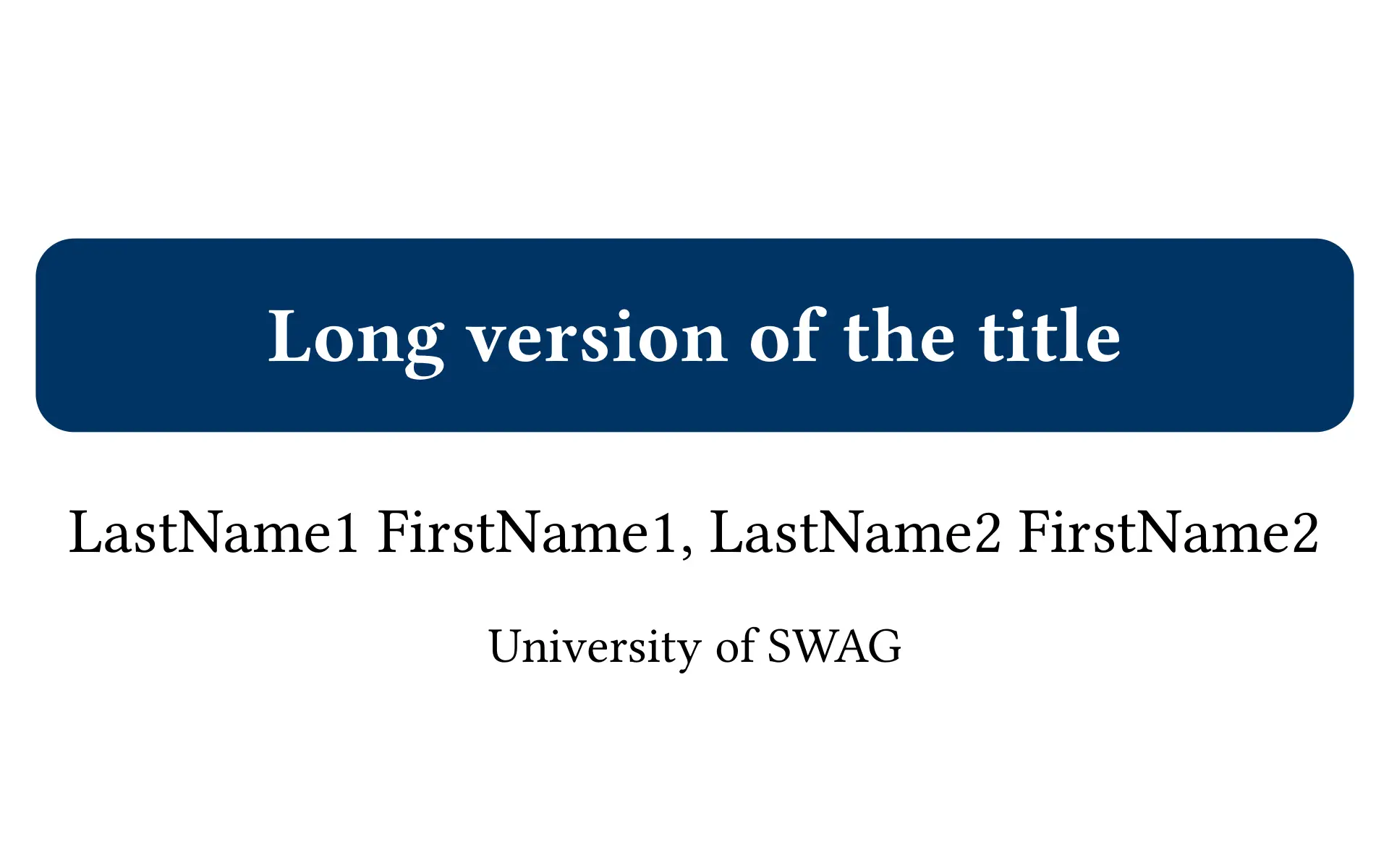
Simple slides for your university presentations
Pepentation is a Typst template designed for clean, academic presentations.
Features:
- 🎨 Comprehensive Theming: Extensive theme system with preset themes and easy customization.
- 🧭 Navigation: Header with bullet-point progress tracker and interactive table of contents (Beamer-inspired). The header always occupies a bounded amount of space, no matter how long your deck is: section titles are fitted into at most two lines, and trackers are capped at three rows of dots.
- 🔢 Smart Layout: Automatic footer with 3-column layout (Authors, Title, Date/Page).
- 🧱 Rich Content Blocks: 9 styled block types for definitions, warnings, remarks, hints, info, examples, quotes, success, and failure messages.
- 🌈 Theme Presets: Multiple beautiful themes including light and dark variants.
| Title Slide | Table of Contents | Section Slide | Main Slide |
|---|---|---|---|
 |
 |
 |
 |
Setup
Using the Published Package
Simply import the package in your .typ file:
#import "@preview/pepentation:0.3.0": *
The package will be automatically downloaded on first use.
Local Installation (Development)
If you want to install the package locally or modify it:
-
Clone or Download this repository.
-
Place it in your local Typst package directory:
{data-dir}/typst/packages/local/pepentation/0.3.0Where
{data-dir}is:- Linux:
$XDG_DATA_HOMEor~/.local/share - macOS:
~/Library/Application Support - Windows:
%APPDATA%
- Linux:
-
Import it in your
.typfile:#import "@local/pepentation:0.3.0": *
Quick Start
Don’t want to configure everything from scratch?
Check the template/ folder in this repository. It contains a fully configured main.typ file. You can copy this file to your project folder and start editing immediately.
Usage
Initialize the template at the top of your file using the setup-presentation rule:
#import "@preview/pepentation:0.3.0": *

#show: setup-presentation.with(
  title-slide: (
    enable: true,
    title: "Presentation Title",
    authors: ("Author One", "Author Two"),
    institute: "University of Typst",
  ),
  footer: (
    enable: true,
    title: "Short Title",
    institute: "Short Inst.",
    authors: ("A. One", "A. Two"),
  ),
  table-of-contents: "detailed", // Interactive: click to jump to section
  header: true,
  locale: "EN"
)

// Your content goes here...
Structure
Use standard markdown-like headings to structure your slides:
= Section(Level 1): Creates a dedicated Section Title Slide.== Slide Title(Level 2): Creates a new Main Slide.==(Empty Level 2): Creates a new slide without a title (excluded from ToC).=== Subsection(Level 3): Creates a new slide with a title, but excluded from the Table of Contents.
= Introduction

== Motivation
This is the first slide of the introduction.

==
This slide has no title.

=== Detail View
This slide has a title, but won't appear in the outline.
A section heading can also carry metadata, which never shows up as text:
metadata("…") sets the subtitle of the section slide, and
metadata((header: "…")) additionally sets a shorter label for the header
(see Header Behavior). The header, subtitle and
section-slide keys are read from such a dictionary; any other key is ignored.
The section slide and the table of contents use the full title, falling back to
the header label for a section that has no visible title.
= Cargo и компилятор #metadata((header: "Cargo", subtitle: "17 минут"))
A section that should be part of the header and the table of contents without
taking a slide of its own opts out with section-slide: false. Leaving the title
out of the heading keeps the visible title empty, so the header label is all the
reader sees:
= #metadata((header: "Владение", section-slide: false))
== Слайды раздела
Table of Contents Styles
Pepentation offers two different styles for the table of contents:
-
"detailed"(default): A compact 3-column layout that includes both section titles and subsections. This style displays level 1 headings with slide numbers and includes level 2 subheadings in a multi-column format for efficient space usage. -
"simple": A clean 2-column grid layout displaying only section titles (level 1 headings) in styled boxes. This provides a simpler, more spacious overview of your presentation structure. -
"none": Disables the table of contents entirely.
Header Behavior
The header is a navigation aid, not a content area, so it never grows past a fixed budget. This keeps your slide body in the same place on every page:
- Section titles are typeset at the full header size and shrunk (down to
9pt) until the title fits on at most two lines. Longer titles are truncated with an ellipsis, so a verbose section name never pushes the slide body down. - Progress trackers show one dot per slide in the section, filled row by row up to three rows per section. A section that overflows those three rows is compacted: while at most a quarter of its slides are dropped, the shown dots are kept and a trailing
…marks the remainder; beyond that, the slides are bucketed evenly, so each dot covers roughly the same number of slides. - Section titles are left-aligned, one column per section, separated by a small gap, so the header reads as a single list from the left margin onwards.
A section can also replace the text the header shows for it, which is useful when the real title is too long to fit the column:
= Владение и ссылки #metadata((header: "Владение"))
Footer Behavior
The footer is a band of three blocks of unequal width, and it never cuts information. Every label it is given is typeset in full: if the text does not fit, the band grows instead of clipping, and if even a grown band is not enough the build fails rather than silently dropping text.
+---------------------------------------------------------------------------+
| Плотников                 |    Что такое Rust     |  СПбГУ  September 2026  3/12 |
+---------------------------------------------------------------------------+
  40% of the page width      title, 9pt            institute, date and page, 7.5pt
  names left, institute right
- The left block is the widest. It carries two labels instead of one, so it
takes
40%of the page width; the title block takes35%and the date and number block25%. - Names and institute share the left block. The authors sit at its left edge and the institute is flush right, each in a column measured to its own text, so neither can squeeze the other out. Both may use two rows: a spelled out institute that is wider than the block wraps beside the names, ragged left, instead of dropping below them.
- Two size tiers. The names and the title are set at
text-size(9pt), the institute, the date and the page number atsecondary-size(7.5pt), so the band does not read as one undifferentiated strip. - Text shrinks before it wraps. Both tiers shrink in half-point steps down to
min-text-size(7pt) while their labels fit, and only then may a label wrap, so a slightly too long title still gets a single tidy line. - The band grows with the rows it needs. One row is
line-height(13pt) plus2ptof padding above and below, so a single-row footer is a17ptband and a two-row footer30pt. - The page reserves the worst case. Typst cannot measure text when it
computes a page margin, so the bottom margin always reserves room for
max-lines(2) rows. Every slide therefore keeps its content above the footer, whether this particular slide needs one row or two; on slides that use fewer rows the unused reservation simply shows as page background. - Overflowing
max-linesis an error, not a truncation. Compilation stops with a message naming the authors, title and date that did not fit and the three knobs to turn.
All of it is configurable per deck:
footer: (
  enable: true,
  text-size: 10pt,
  secondary-size: 8pt,
  min-text-size: 7pt,
  line-height: 14pt,
  max-lines: 3,
)
Decks whose footer always fits on one row can halve the reservation and get the
body height back with max-lines: 1; each row costs line-height of slide
height on every page.
Content Blocks
The template provides 9 styled blocks for highlighting specific content:
#definition[content](Gray) - Definitions, theorems, important concepts#warning[content](Red) - Warnings, cautions, important notices#remark[content](Orange) - Remarks, notes, additional observations#hint[content](Green) - Hints, tips, helpful suggestions#info[content](Blue) - Informational content, facts, details#example[content](Purple) - Examples, demonstrations, sample code#quote[content](Neutral Gray) - Quotations, citations, referenced text#success[content](Green) - Success messages, achievements, positive results#failure[content](Red) - Failure messages, errors, issues
Example:
#definition[
  *Euclid's Algorithm*
  An efficient method for computing the GCD.
]

#info[
  *Information – Time Complexity*
  The algorithm runs in `O(n log n)` time.
]

#example[
  *Example – Usage*
  ```python
  result = gcd(48, 18)
  # Returns: 6
  ```
]

#success[
  *Success – Implementation Complete*
  All test cases pass!
]
Theming System
Pepentation features a comprehensive theming system that allows you to customize colors for all elements, including blocks and inline code.
Using Theme Presets
Import the themes module and use a preset theme:
#import "@preview/pepentation:0.3.0": *

#show: setup-presentation.with(
  theme: themes.theme-azure-breeze,
  // ... other options
)
Available Theme Presets
theme-azure-breeze/theme-azure-breeze-dark- Light blue theme with fresh, airy feeltheme-crimson-dawn/theme-crimson-dawn-dark- Red-based theme with warm, energetic tonestheme-forest-canopy/theme-forest-canopy-dark- Green-based theme with natural, calming tonestheme-deep-ocean/theme-deep-ocean-dark- Blue-based theme (enhanced default)theme-twilight-violet/theme-twilight-violet-dark- Purple-based theme with elegant, mysterious tonestheme-golden-hour/theme-golden-hour-dark- Warm, sunset-inspired theme with golden and amber tonestheme-emerald-glow/theme-emerald-glow-dark- Vibrant green theme with emerald accents
Customizing Themes
You can easily customize any theme by merging it with your own values:
#import "@preview/pepentation:0.3.0": *

#show: setup-presentation.with(
  theme: (
    ..themes.theme-azure-breeze,
    primary: rgb("#FF0000"),  // Override primary color
    blocks: (
      ..themes.theme-azure-breeze.blocks,
      definition-color: rgb("#888888"),  // Override block color
    ),
  ),
)
Creating Custom Themes
You can create your own theme by defining a dictionary with all theme properties:
#import "@preview/pepentation:0.3.0": *

#let my-custom-theme = (
  primary: rgb("#003365"),
  secondary: rgb("#00649F"),
  background: rgb("#FFFFFF"),
  main-text: rgb("#000000"),
  sub-text: rgb("#FFFFFF"),
  sub-text-dimmed: rgb("#FFFFFF"),
  code-background: luma(240),
  code-text: none,
  blocks: (
    definition-color: gray,
    warning-color: red,
    remark-color: orange,
    hint-color: green,
    info-color: blue,
    example-color: purple,
    quote-color: luma(200),
    success-color: rgb("#22c55e"),
    failure-color: rgb("#ef4444"),
  ),
)

#show: setup-presentation.with(
  theme: my-custom-theme,
)
Configuration Options
These are the parameters available in the setup-presentation function:
| Keyword | Description | Default |
|---|---|---|
title-slide |
Dictionary configuration for the title slide | (enable: false) |
title-slide.enable |
Whether to show title slide | false |
title-slide.title |
Full title displayed on title page | none |
title-slide.authors |
Array of author names | () |
title-slide.institute |
Institute name | none |
footer |
Dictionary configuration for the footer | (enable: false) |
footer.enable |
Whether to show footer | false |
footer.title |
Short title displayed in center of footer | none |
footer.authors |
Array of short author names (left side) | () |
footer.institute |
Short institute name (left side) | none |
footer.date |
Date displayed (right side) | Today |
footer.text-size |
Font size of the names and the title | 9pt |
footer.secondary-size |
Font size of the institute, date and page number | 7.5pt |
footer.min-text-size |
Smallest size the text is shrunk to before it wraps | 7pt |
footer.line-height |
Height of one footer row | 13pt |
footer.max-lines |
Rows the footer may use before the build fails (and the room reserved for it) | 2 |
theme |
Dictionary for colors | (See Theme System above) |
theme.primary |
Primary brand color (Header/Footer/Title) | rgb("#003365") |
theme.secondary |
Secondary accents | rgb("#00649F") |
theme.background |
Slide background color | rgb("#FFFFFF") |
theme.main-text |
Body text color | rgb("#000000") |
theme.sub-text |
Text color on dark backgrounds (headers) | rgb("#FFFFFF") |
theme.sub-text-dimmed |
Dimmed text color | rgb("#FFFFFF") |
theme.code-background |
Background color for inline code | luma(240) |
theme.code-text |
Text color for inline code (optional) | none |
theme.blocks |
Dictionary of block colors | (See default-theme) |
theme.blocks.definition-color |
Color for definition blocks | gray |
theme.blocks.warning-color |
Color for warning blocks | red |
theme.blocks.remark-color |
Color for remark blocks | orange |
theme.blocks.hint-color |
Color for hint blocks | green |
theme.blocks.info-color |
Color for info blocks | blue |
theme.blocks.example-color |
Color for example blocks | purple |
theme.blocks.quote-color |
Color for quote blocks | luma(200) |
theme.blocks.success-color |
Color for success blocks | rgb("#22c55e") |
theme.blocks.failure-color |
Color for failure blocks | rgb("#ef4444") |
table-of-contents |
Style for the table of contents ("none", "detailed", "simple") |
"detailed" |
header |
Show the navigation header | true |
locale |
Language (“EN” or “RU”) | "EN" |
height |
Slide height (aspect ratio fixed at 16:10) | 12cm |