
Palimpsest turns one annotated manuscript into everything a peer-review response needs: the clean manuscript, a tracked-changes version showing every edit, and a response letter that cites the manuscript’s own real page and figure numbers — automatically, and always in sync.
You mark changes once, inline, in the manuscript itself. Two typst compile commands then produce all of it.

The problem
Responding to peer review normally means maintaining four things by hand: the revised manuscript, a version showing what changed, a letter citing modified passages and page numbers, and the certainty that no comment went unanswered. These drift apart the moment a last-minute fix lands — a page number in the letter goes stale, a quoted passage no longer matches the manuscript, a comment is quietly forgotten.
Palimpsest makes the second, third, and fourth of those derivable from the first. You write the manuscript and your responses; everything else — tracked changes, page numbers, quoted excerpts, cross-references — is generated at compile time.
This works because Typst 0.15’s experimental bundle export lets a single compilation produce several documents that share one introspection space: the response letter can query() the manuscript and know its real page numbers, because they are, quite literally, part of the same compilation. A LaTeX assembly of changes + latexdiff + a letter class cannot do this — there, the letter and the manuscript are two unrelated compilations that happen to sit next to each other.
Palimpsest is not a diff tool (marking what changed is explicit), not a template (your manuscript keeps your journal’s own template), and not a project manager (no database, no state outside your source files).
Key features
- Mark once, get up to four documents.
add,del,repinline in your manuscript; two compiles produce the clean manuscript and the tracked-changes manuscript — plus, if you’ve written responses to reviewer comments, a clean and a tracked response letter alongside them. - Real cross-references, not copy-pasted page numbers.
pinpoint(<anchor>)reports the manuscript’s actual, current page —xref/xcommentresolve figures, tables, and other comments the same way. Nothing to update by hand after a last-minute edit. - Quote the manuscript verbatim in the letter.
pinpoint(<anchor>, excerpt: true)re-emits the real passage — clean or tracked style, your choice — so the letter can never drift from what the manuscript actually says. - Reviewers, editor, and co-authors, all colored and tracked.
<r1-2>(reviewer 1, comment 2),<e1>(editor), or<bob-3>(co-author) — each anchor kind gets its own color and its own letter section, automatically. - Figure/table/equation/heading numbering that survives tracking. A deleted element keeps its own real number, struck through, instead of leaking a shifted one onto everything after it — the tracked manuscript and the clean one always agree on “Figure 3” (or “2.1”, for a section).
- A built-in checklist.
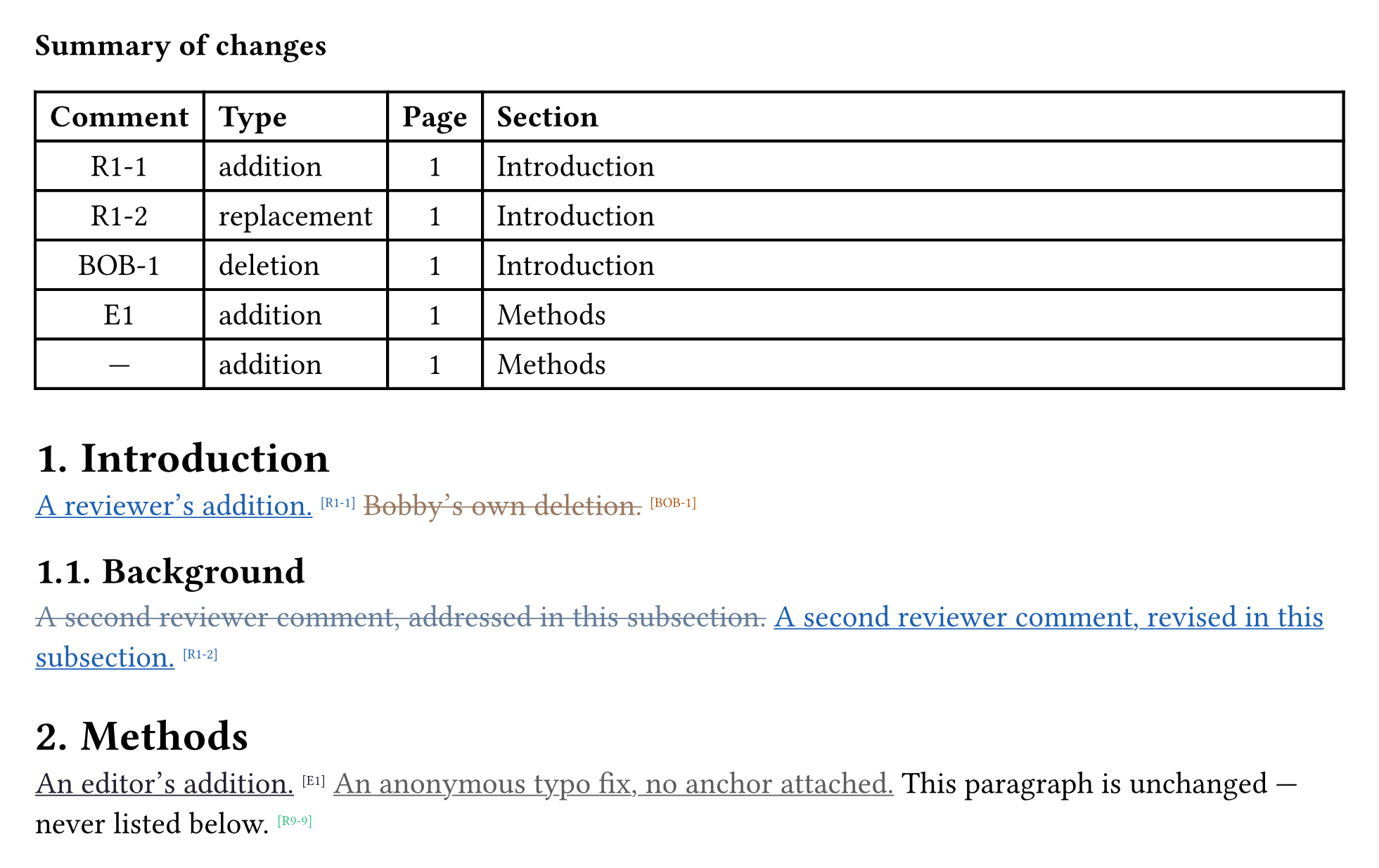
change-list()renders a table of every marked passage (comment, type of change, page, section) in the tracked manuscript — tick it off against the response letter. - Diagnostics. Orphan comments, duplicate exchanges, unanswered anchors, empty responses — flagged visibly in the tracked manuscript, or turned into hard compile errors with
contexture.bundle(strict: true, ...)so a broken bundle can’t slip through unnoticed. - Works with any journal template.
template:accepts anycontent -> contentfunction — swap in your actual Typst Universe template, palimpsest asks nothing more of it.
Installation
Import the package, plus contexture — the small, package-agnostic dependency that actually assembles the bundle compile (palimpsest itself never calls Typst’s own document(...)):
#import "@preview/palimpsest:0.1.0": *
#import "@preview/contexture:0.1.0": bundle
Requires Typst 0.15 or later, specifically its --features bundle export (still experimental — Typst prints a warning about this on every compile, which is expected).
Quick start
A palimpsest project is normally three files, plus whatever bibliographies your manuscript and letter use:
manuscript.typ    the manuscript, annotated with passage()/add()/del()/...
responses.typ     the exchanges with reviewers
main.typ          the pilot (a handful of lines)
manuscript.typ — mark changes inline, anchored to the comment they answer:
#import "@preview/palimpsest:0.1.0": *

#passage(<r1-2>)[
  Propensity scores were estimated by logistic regression
  and their overlap #add[assessed graphically].
]
responses.typ — write the reply, and let pinpoint cite the manuscript for you:
#import "@preview/palimpsest:0.1.0": *

#reviewer(1)[
  #exchange(<r1-2>)[
    Please also assess the overlap in propensity scores.
  ][
    Done. #pinpoint(<r1-2>, excerpt: true)
  ]
]
main.typ — wire the manuscript to your journal’s template and the responses to a letter. letter(...) only describes the response letter; contexture.bundle (a small, package-agnostic dependency shared with @preview/checkitoff) is the one place that actually assembles the compile — this is also what lets a second package’s own satellite (e.g. a reporting-guideline checklist) sit in the same documents: list with no conflict:
#import "@preview/palimpsest:0.1.0": *
#import "@preview/contexture:0.1.0": bundle

#show: bundle.with(
  template: my-journal-template.with(title: [...], authors: ("...",)),
  documents: (letter(exchanges: include "responses.typ"),),
)

#include "manuscript.typ"
Two compiles produce everything:
typst compile --features bundle --format bundle main.typ
typst compile --features bundle --format bundle --input variant=tracked main.typ
| Command | Produces |
|---|---|
First (variant defaults to clean) |
manuscript.pdf — what you submit, no marks visible at all — and response.pdf, citing this manuscript’s own pagination |
Second (--input variant=tracked) |
manuscript-tracked.pdf — every change visible, colored by reviewer, anchor-tagged — and response-tracked.pdf, the same letter citing that manuscript’s pagination instead |
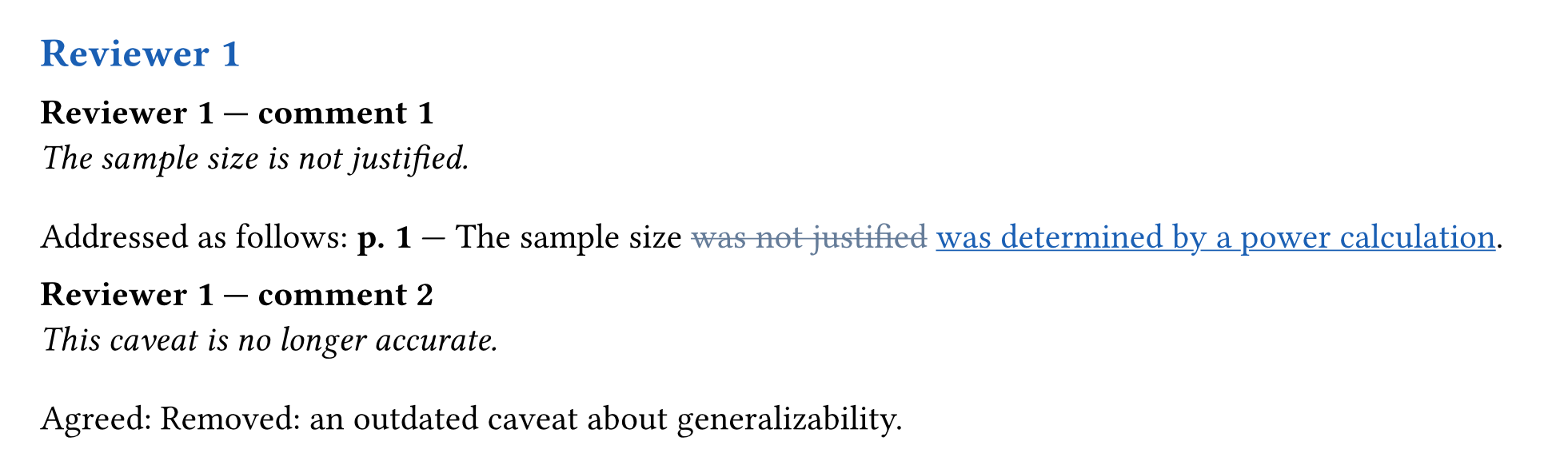
A letter comes out of both compiles automatically, as soon as exchanges: is set — no separate flag to remember, and a citation always follows whichever mode it’s actually compiled under. Take the same marked passage — a replacement and a deletion, both anchored to a reviewer comment — through both compiles.
The first compile accepts both marks: manuscript.pdf carries no trace of either, and its letter quotes the accepted wording only:
↓ manuscript.pdf --- the passage, accepted, no marks

↓ cited verbatim in the letter, real page number included
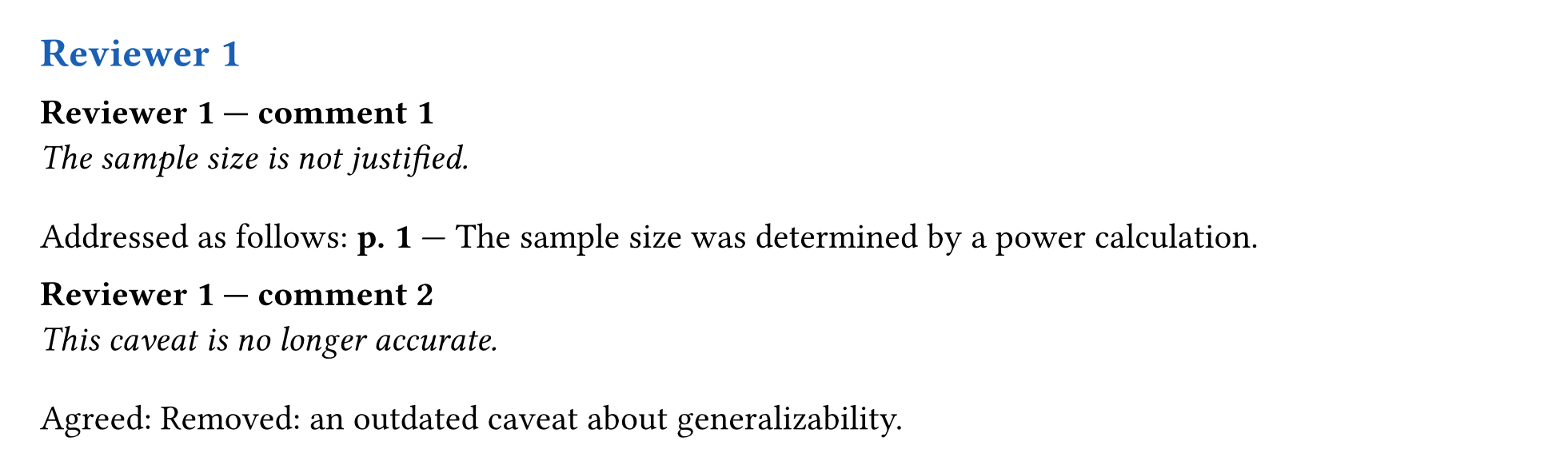
The second compile shows every change instead: manuscript-tracked.pdf keeps both marks visible, anchor-tagged, and its letter quotes that same tracked wording, struck and underlined:
↓ manuscript-tracked.pdf --- every change visible, anchor-tagged

↓ cited verbatim in the letter, tracked wording and page included
Don’t want a letter for a particular run — a fast, manuscript-only preview while drafting? --input only= (nothing after the =) skips it on either compile, without touching main.typ — contexture.bundle’s own generic mechanism, shared by any other satellite listed under documents: too.
A gallery of what’s built in
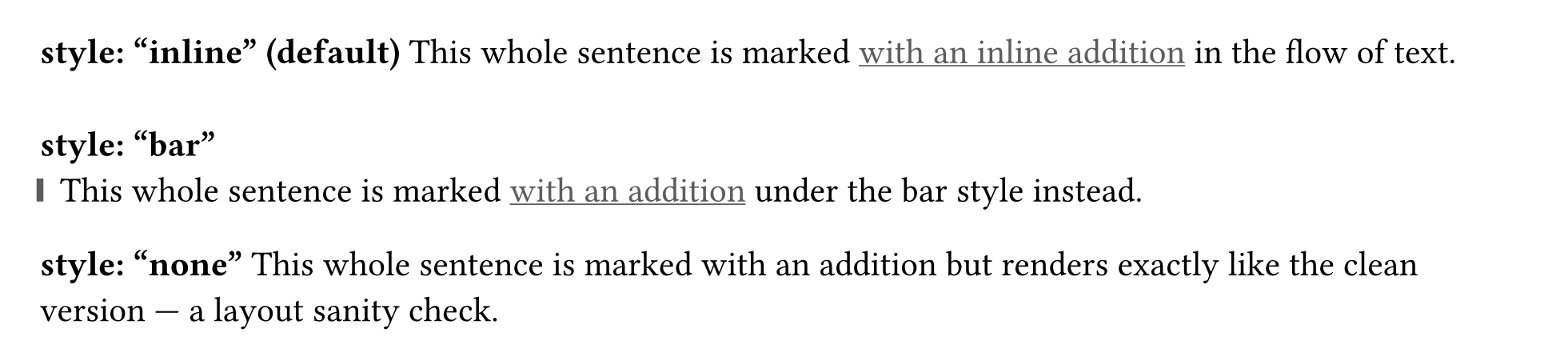
Three ways to mark a change — style: "inline" (underline/strike in the flow of text, the default), style: "bar" (a colored change-bar), or style: "none" (a layout sanity check — renders exactly like the clean version even when tracked):
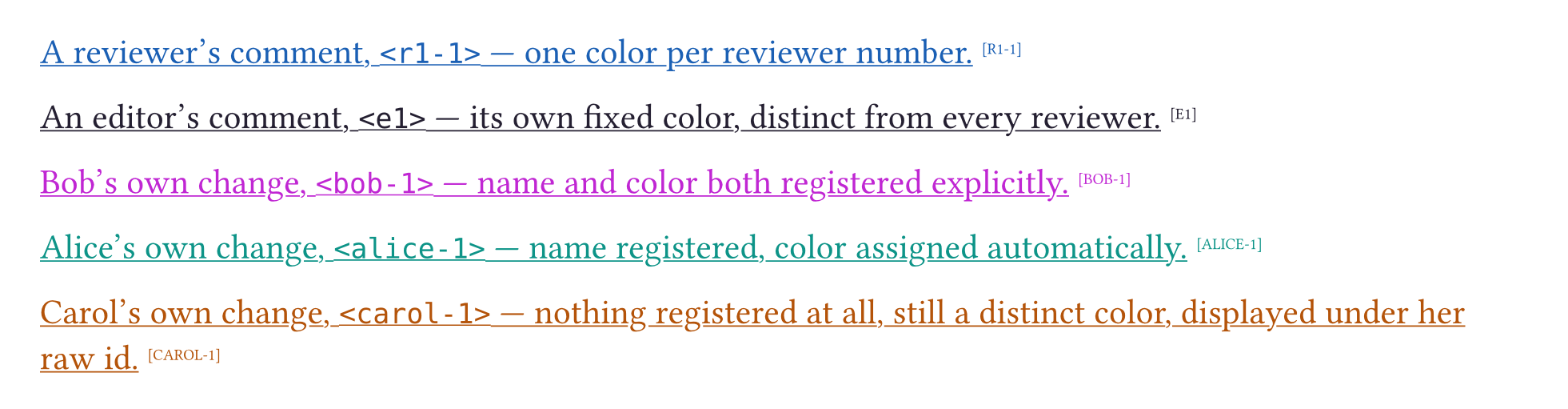
Reviewers, editor, and co-authors, colored automatically — a project doesn’t have to be reviewer-only: co-authors can mark their own edits on a shared draft the same way, with their own color and their own section in the letter:
A checklist that writes itself — change-list(), placed once near the top of the manuscript, tabulates every marked passage in the tracked manuscript only (never in what you submit):
Beyond the basics
suppress/suppressed— replace a deletion with a short note instead of the struck-through original, for whenever showing the real thing again isn’t useful — a long passage, say.xref/xcomment—xref(<label>)cites a manuscript figure/table/equation by its real number and page;xcomment(<anchor>)links to another comment in the letter itself (“as already discussed in comment R1-2”).letter-bibliography— a second, independently-numbered bibliography for citations the letter makes on its own, alongside the manuscript’s normal one.pinpoint(mode: "tracked" | "clean")— quote the tracked wording in an otherwise-clean letter (or vice versa), for “look, we removed exactly what you objected to.”contexture.bundle(strict: true, ...)— turn every diagnostic (orphan comment, duplicate exchange, unanswered anchor, empty response…) into a hard compile error, so nothing gets forgotten right before submission — one shared switch, covering any othercontexture-based package listed alongsideletter(...)too.
Documentation
- The palimpsest guide — the full user guide, one function (and every one of its options) at a time, with a real compiled screenshot for each.
Examples
Four complete, working projects live under examples/:
pilot/— the smallest complete three-file project. Copy it as a starting point. (⇒ pdf: manuscript, tracked, response, response-tracked)fridge-study/(⇒ pdf: manuscript, tracked, response, response-tracked) andemoji-email/(⇒ pdf: manuscript, tracked, response, response-tracked) — two full, deliberately over-the-top mock studies (multi-page manuscripts built on real Typst Universe templates,@preview/unequivocal-amsand@preview/charged-ieee, with real figures via@preview/lilaq) exercising essentially every feature at once: two reviewers and an editor, co-authors leaving their own notes alongside them,change-list(),pinpointboth as a page reference and as a verbatim excerpt, cross-references, and a letter-only bibliography.coauthors-simple/(⇒ pdf: manuscript, tracked) — the no-reviewer, no-letter, no-bundle shape: justadd/del/change-listin a single file, for co-authors tracking their own edits with nothing else attached.
Each ships its own compile.sh.
License
MIT