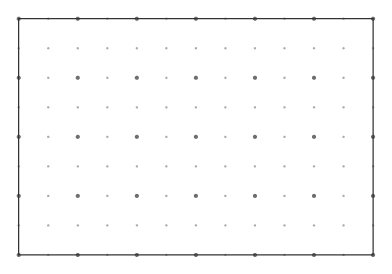
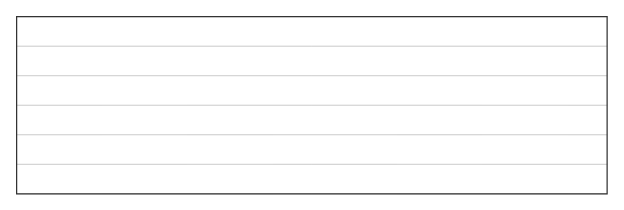
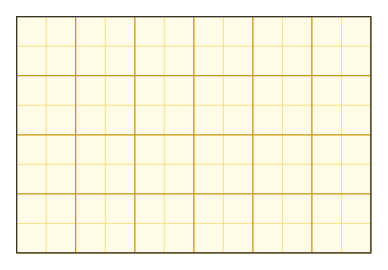
Configurable grid backgrounds for printable worksheets, in Typst, drawn with CeTZ. Square grid, ruled paper (horizontal or vertical lines only) or dot grid, with an optional darker “major” line/dot every N steps — the classic look of engineering/milimetrado paper.
Usage
#import "@preview/meshpad:0.1.2": grid-paper

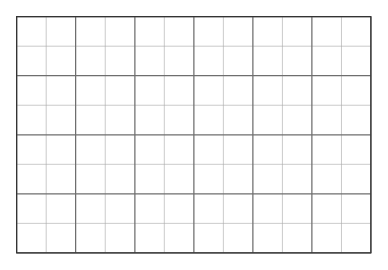
#grid-paper(size: (6, 4), kind: "square", step: 0.5, major-every: 2)
This is exactly the first image in the gallery above. Use it standalone, wrapped
in a box/place behind other content, or as a whole-page background —
meshpad doesn’t need to know about pages, Typst already handles that:
#set page(background: grid-paper(size: (21, 29.7), step: 0.5, major-every: 2))
Parameters
| Parameter | Default | Meaning |
|---|---|---|
size |
(10, 10) |
(width, height). Plain numbers are CeTZ units (cm by convention), but you can pass explicit Typst lengths instead — (5cm, 3cm), (4in, 3in), etc. |
kind |
"square" |
"square" (lines) or "dot" (dot grid). |
lines |
"both" |
"both", "horizontal" or "vertical" — only meaningful for kind: "square"; "horizontal" gives ruled/pautado paper. |
step |
0.5 |
Spacing between minor lines/dots. Same rule as size: a plain number is cm, or pass an explicit length like 5mm. |
major-every |
none |
Every Nth line/dot is drawn as “major” (thicker/darker). none disables it. |
background |
none |
Fill color behind the pattern. none is transparent. |
color |
gray |
Color of minor lines/dots. |
major-color |
none |
Color of major lines/dots. none defaults to a darker shade of color. |
frame |
true |
Draw a border around the rectangle. |
Sizes that aren’t a multiple of the step
size and step are independent, and neither is silently rounded: the grid draws
every full cell that fits and leaves the remainder as a narrower strip against the
frame. It never overflows.
#grid-paper(size: (7, 3), step: 0.6, major-every: 3)
Here 7 ÷ 0.6 = 11.67, so you get 11 columns of 0.6 (6.6 wide in total) and a 0.4
strip left over on the right; the height divides exactly (3 ÷ 0.6 = 5), so there is
no strip at the top. That is the same thing real graph paper does at the edge of the
page. For a flush fit, pick a size that is a whole multiple of step — (7.2, 3)
in this example.
What is rejected, and why
size, step and major-every are checked before anything is drawn, so a typo
gives you a meshpad: message instead of an error from inside CeTZ:
| You pass | You get |
|---|---|
step: 0 or a negative step |
meshpad: step must be positive (got 0) |
size: (0, 0), or any negative side |
meshpad: size must be positive (got (0, 0)) |
major-every: 0, -2 or 2.5 |
meshpad: major-every must be a positive whole number or none (got 2.5) |
size: (5cm, 3cm) with step: 0.5 |
meshpad: size and step must be all plain numbers or all Typst lengths, not a mix (…) |
An unknown kind or lines |
meshpad: unknown kind "isometric" (expected "square" or "dot") |
That last mix is the easy one to hit: plain numbers and Typst lengths cannot be
combined, so pick one and use it for both. Integers and floats do mix freely, so
size: (6, 4) with step: 0.5 is fine.
Compatibility
- Typst
>= 0.14.0 - CeTZ
0.5.2
Known limitations
See ROADMAP.md for
the current limits and the improvements on the list.
License
MIT.