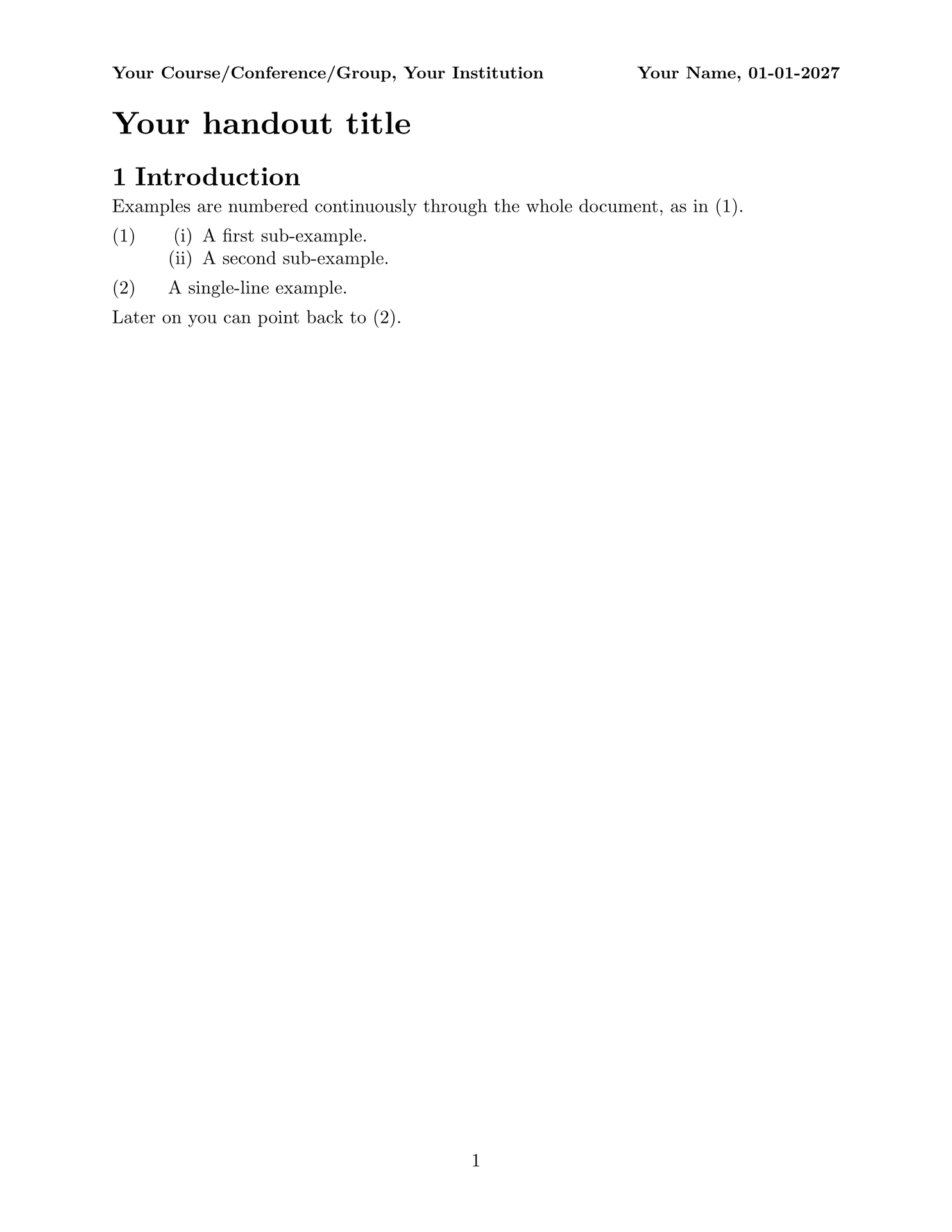
A Typst template for linguistics handouts. Examples are numbered (1), (2), … continuously across the whole document. Sub-lists inside an example are numbered (i), (ii), … And references to examples render as (n) with a link back to the example.
Quick start
Start a new project from the template:
typst init @preview/ling-handout:0.1.0
Or import it into an existing document:
#import "@preview/ling-handout:0.1.0": ling-handout, ex

#show: ling-handout.with(
  handout-title: [Your Title],
  handout-author: "Your Name",
  handout-date: datetime.today(),
  group: "Your Group",
  location: "Your Institution",
)

= Introduction

#ex[
  + If Oswald didn't shoot Kennedy, someone else did.
  + If Oswald hadn't shot Kennedy, someone else would have.
] <ex-conditionals>

Referencing examples from anywhere in the document, like @ex-conditionals, is easy.
Examples: the ex function
ex creates a numbered example. Numbering runs continuously through the whole document, independent of headings, as is customary in linguistics.
ex only displays correctly inside a document wrapped with #show: ling-handout.with(..), which supplies the layout and reference styling.
Single examples
#ex[Every linguist who knows about donkey sentences loves them.]
renders as
(1) Every linguist who knows about donkey sentences loves them.
Examples with sub-items
Use a numbered list (+) inside the example. Sub-items are numbered (i), (ii), …
#ex[
  + John left.
  + \*Left John.
]
renders as
(2)  (i)  John left.
     (ii) *Left John.
Note that * starts bold text in Typst, so write \* for an ungrammaticality star. The same goes for #, _, and @.
Referring to examples
Put a label directly after the closing bracket of ex, then reference it with @ and the label name:
#ex[The present King of France is bald.] <ex-russell>

As @ex-russell shows, *the* requires a unique referent that exists (or at some point existed) in the evaluation world.
The reference renders as (3) (whatever the example’s number is) and links to the example. The label’s angle brackets are only used where it’s defined, not in the reference.
Current limitations
- Only whole examples can be referenced. Individual sub-items like (3.i) can’t be labeled yet, so write the suffix manually in plain text.
- Sub-items always use (i), (ii), … numbering.
The example counter
Examples are figures of kind "example", so their counter can be accessed directly. For instance, to restart numbering at (1), e.g. for an appendix:
#counter(figure.where(kind: "example")).update(0)
Parameters
| Parameter | Default | Notes |
|---|---|---|
handout-title |
none |
string or content; also sets document.title; omit with none |
handout-author |
none |
string or content; also sets document.author; omit with none |
handout-date |
none |
string, content, or datetime; shown in the header only, does not set document.date; omit with none |
group |
none |
string or content; left side of the header; omit with none |
location |
none |
string or content; shown after group; omit with none |
paper |
"us-letter" |
passed to page.paper |
margin |
1in |
passed to page.margin |
font |
"New Computer Modern" |
passed to text.font |
font-size |
12pt |
passed to text.size |
leading |
0.52em |
passed to par.leading |
spacing |
0.9em |
passed to par.spacing |
Planned features
- Optional bibliography with the Unified Style Sheet for Linguistics
- IPA, Leipzig glossing, syntax trees, and phonological rules
- Referencing sub-items, e.g. (3.i)
- Configurable example and sub-item numbering
- Customizable header layout
License
MIT-0. See LICENSE.