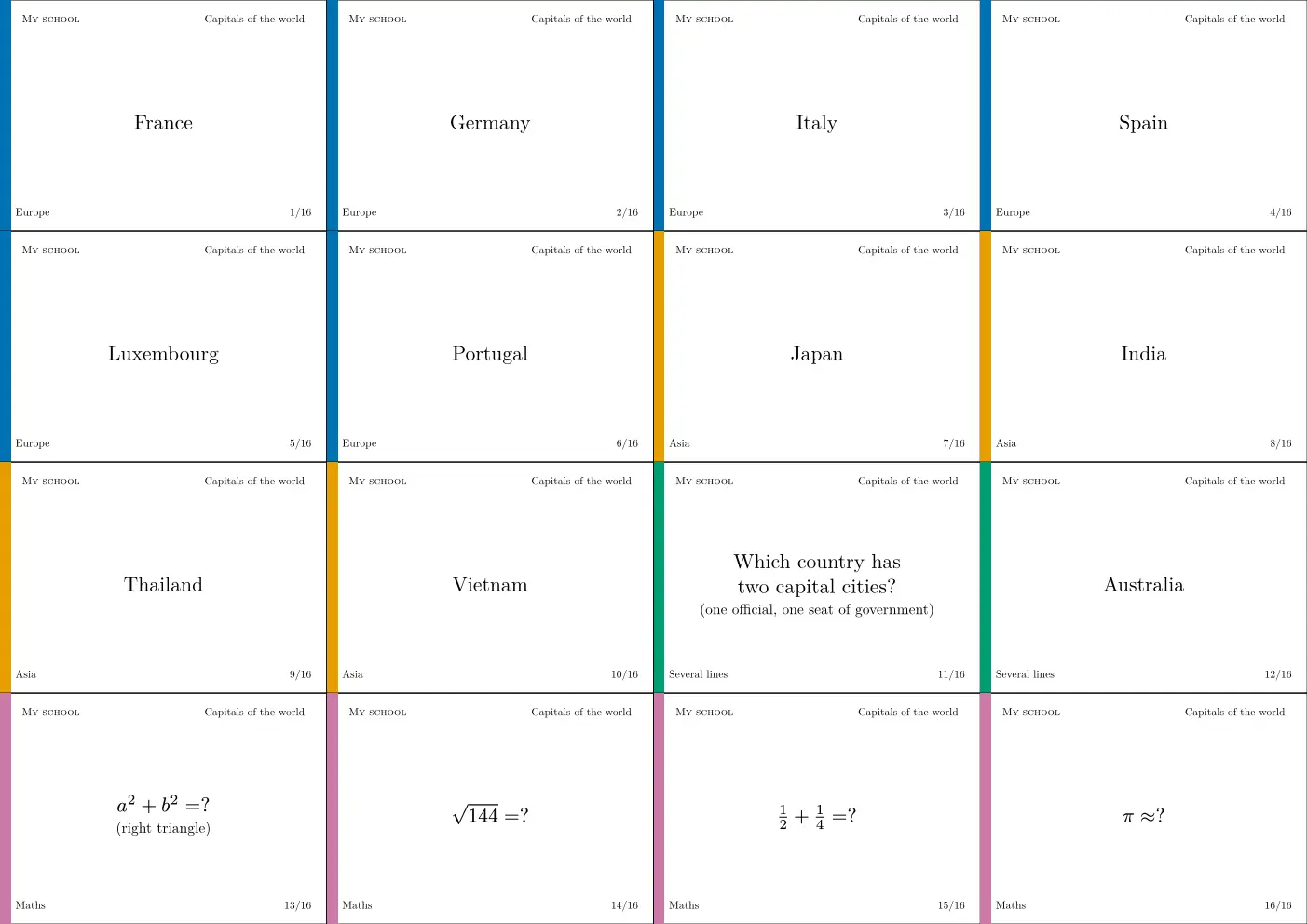
Double-sided flash cards that line up when printed. Write the questions and answers, print the PDF double-sided, cut along the lines: every card has its question on the front and its answer on the back.
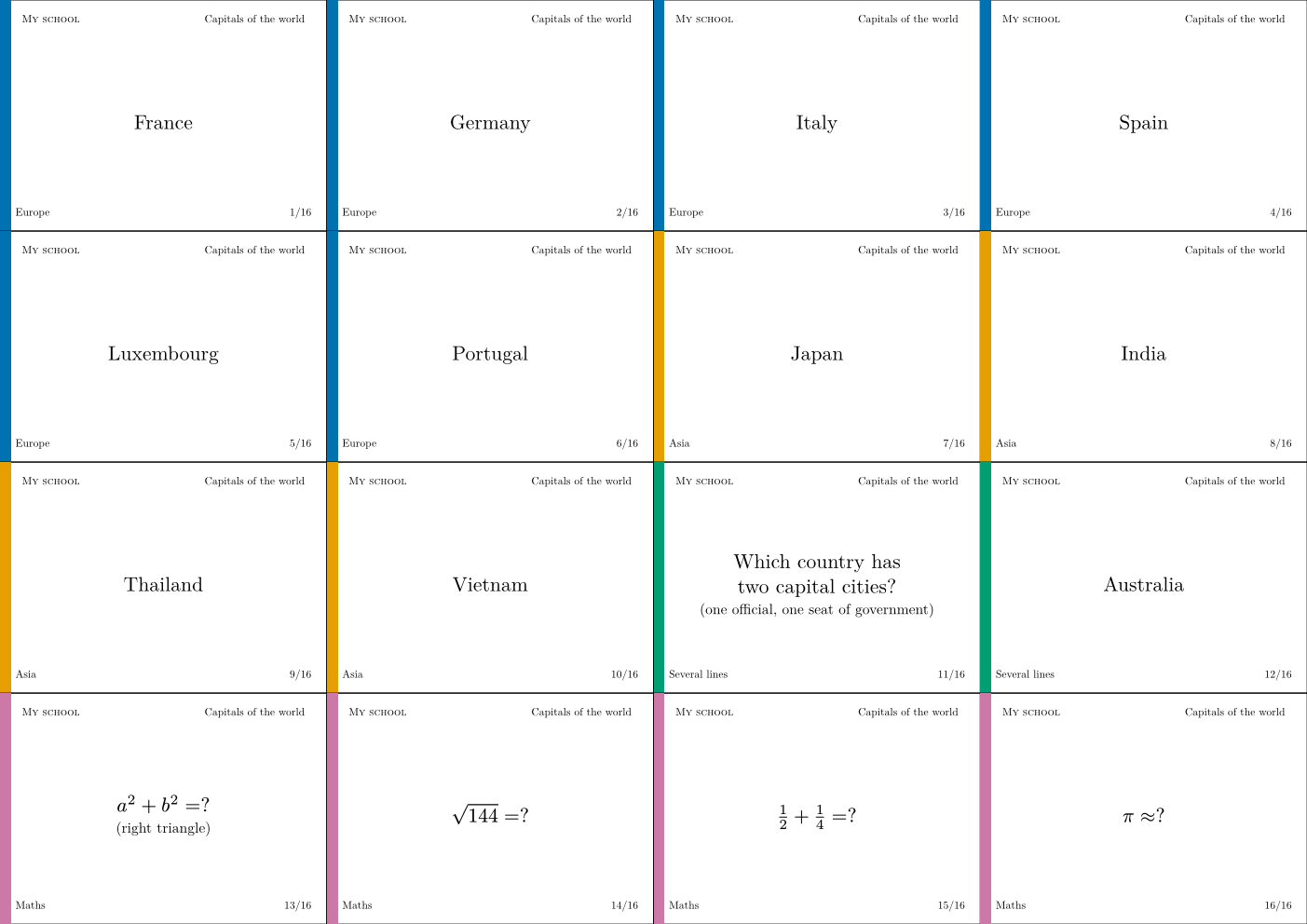
- Any card size: DIN A8, A7, A6, A5, US index cards (3×5, 4×6 in), business cards on perforated sheets, or your own size; A4 or Letter paper; landscape or upright cards.
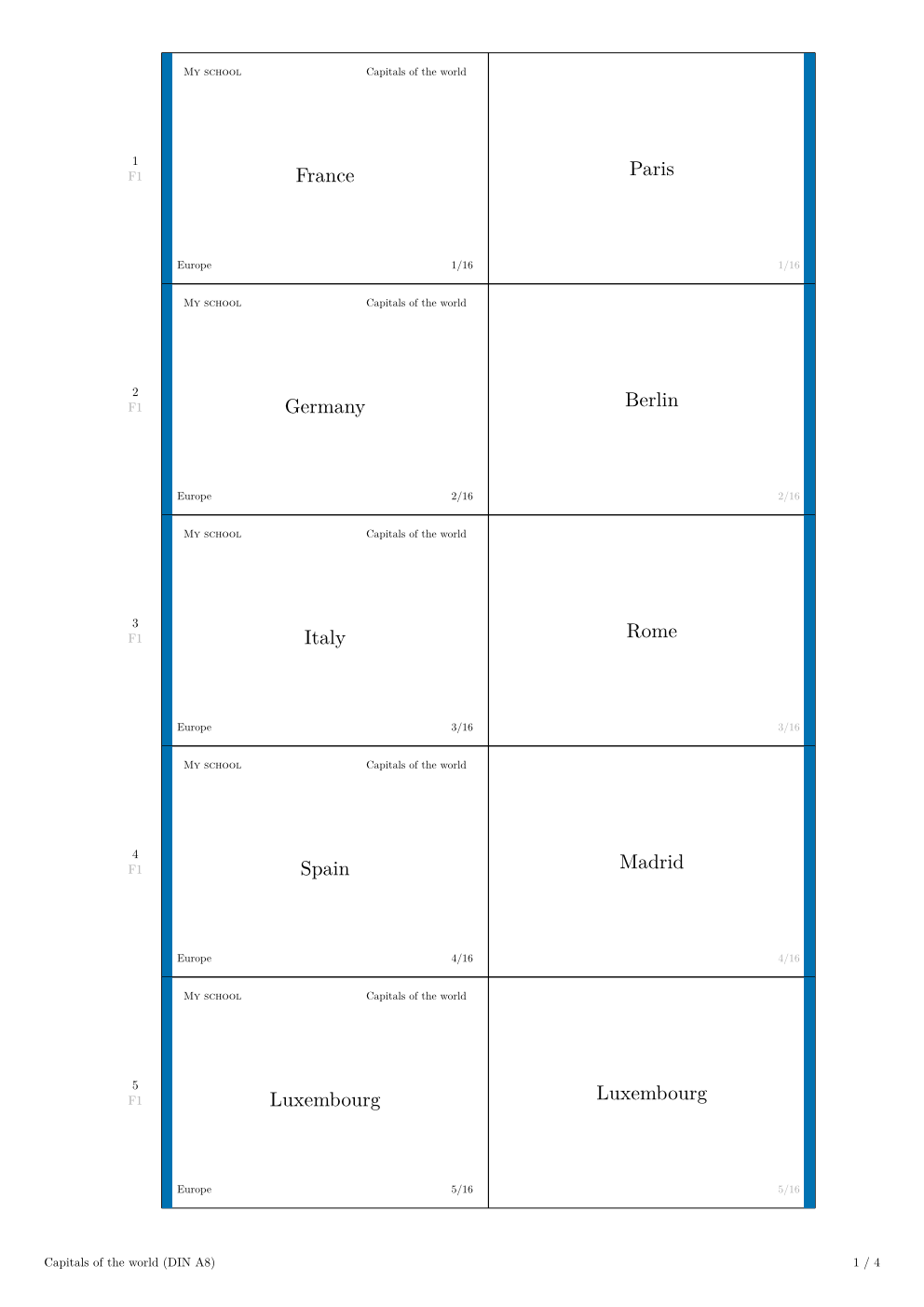
- A list to check the cards: every card on one row, question and answer side by side, exactly as printed.
- A calibration sheet to make up for printers that shift the back side.
- Cards from a CSV file, e.g. a word list from Excel.
- Header and footer with three slots each: logo, theme, card number, …
- Coloured stripes per theme, to sort the cut cards.
- Text that is too large is shrunk to fit, and marked in the list.
- Reprint single cards without the rest of the deck.
- Both directions (
dir: "both"), several items (all,any) and hints shown only as question or only as answer ([? …],[! …]), e.g. for vocabulary.
The manual (PDF, attached to each release) explains everything, with many examples.
Needs Typst 0.15.0 or newer.
Getting started
#import "@preview/flipside:0.2.1": *

#flipside((
  (q: [France], a: [Paris]),
  (q: [Germany], a: [Berlin]),
  (q: [Which country has \ two capital cities?], a: [Bolivia \ #small[(Sucre and La Paz)]]),
))
or start from the template:
typst init @preview/flipside:0.2.1 my-cards
Page 1 holds the questions with cutting lines, page 2 the answers, mirrored so that each answer lands behind its question. Print all pages double-sided at 100 %: flip on short edge for a landscape sheet, flip on long edge for a portrait sheet.
Checking the cards
typst compile --input layout=list cards.typ cards-list.pdf
Themes, header and footer
#let number(c) = if c.number != none [#c.number/#c.total]

#flipside(
  header: (left: image("logo.png", width: 19mm), right: [Geography · 7a]),
  footer: (left: c => c.theme, right: number),
  back-footer: (right: c => text(fill: gray, number(c))),
  stripe: auto,
  (
    (theme: "Europe"),          // no card: the theme of the cards below
    (q: [France], a: [Paris]),
    (theme: "Asia"),
    (q: [Japan], a: [Tokyo]),
  ),
)
A slot is content, or a function that gets the card (c.theme, c.number,
c.total, …). header/footer are the question side,
back-header/back-footer the answer side.
Cards from a CSV file
#flipside(lang: (q: "de", a: "fr"), csv("words.csv", row-type: dictionary))
q,a,theme
der Verkäufer,"le vendeur
la vendeuse",Berufe
der Sänger,le chanteur,
Columns q and a, any other column becomes a field; an empty cell keeps the
value above; a line break in a cell is a line break on the card.
Both directions, items and hints
#flipside(
  lang: (q: "de", a: "fr"),
  dir: "both",                                           // every card both ways
  (
    (q: [laut [? (m/f)]], a: [bruyant, bruyante]),
    (q: [der Lift, [? ein Lift]], a: [l'ascenseur, [! un ascenseur]]),
    (q: [der Kühlschrank], a: any[le réfrigérateur][le frigo]),
    (q: [die Möbel #q-note[Plural]], a: all[les meubles][le mobilier]),
  ),
)
[? …]is shown only when its side is asked,[! …]only when it is the answer (#q-only[…]/#a-only[…]for maths or bold).all[…][…]: as the question one card, as the answer all needed;any[…][…]: as the question one card per item, as the answer any one right.#note[…],#q-note[…],#a-note[…]: notes on a line of their own.
Card sizes
card: |
Card | Paper | Per sheet |
|---|---|---|---|
"DIN A8" (default) |
74 × 52 mm | A4 | 16 |
"DIN A7" |
105 × 74 mm | A4 | 8 |
"DIN A6" |
148 × 105 mm | A4 | 4 |
"DIN A5" |
210 × 148 mm | A4 | 2 |
"US 3x5" |
5 × 3 in | Letter | 4 |
"US 4x6" |
6 × 4 in | Letter | 2 |
"US business" |
3.5 × 2 in | Letter | 10 |
"EU business" |
85 × 54 mm | A4 | 10 |
(width: 90mm, height: 60mm) |
your own | A4 | as many as fit |
paper: "us-letter" (or "a4", "a3", "a5", "us-legal") changes the
paper, orientation: "portrait" makes the cards upright. Your own size can
also give cols, rows, gap and margin to match a perforated sheet.
Printing
- Back side shifted? Print the calibration sheet
(
--input layout=calibrate), hold it against the light, read the values on the rulers and setback-offset: (x: 0.8mm, y: -0.5mm). - Reprint lost cards:
--input only=5-12,17; the numbers stay those of the whole deck.
Everything that changes between printouts can be chosen when compiling, and
wins over the file: --input layout=…, card=…, paper=…,
orientation=…, only=…, back-offset=…, dir=….
Parameters
| Parameter | Default | |
|---|---|---|
cards |
— | (q: […], a: […]), entries with fields only, (q: [], a: []) for a blank card, CSV rows |
header, footer, back-header, back-footer |
(:) |
slots (left:, center:, right:) |
title |
none |
name of the deck, in the list’s footer |
lang |
"en" |
"fr" or (q: "de", a: "fr") |
font, size |
New Computer Modern, 13 pt | text of the cards |
slot-font, slot-size |
New Computer Modern, 7 pt | text of the slots |
back-borders |
false |
outline the answer cards too |
fit |
true |
shrink a side that is too large |
stripe, stripe-width |
none, 2.5 mm |
auto, ("Theme": colour) or c => colour |
markup |
false |
read CSV cells as Typst markup |
back-offset |
(x: 0mm, y: 0mm) |
shift of the answer pages |
only |
none |
"5-12,17", (3, 8) or c => bool |
layout |
"cards" |
"cards", "list", "calibrate", "report" (for the MyCards app) |
dir |
"forward" |
"reverse" or "both"; a card’s own dir wins |
count |
n => [(n)] |
shown on the question when more than 2 items are needed |
card, paper, orientation |
"A8", auto, "landscape" |
see Card sizes |
Helpers: small[…] (72 %), tiny[…] (60 %), block-left[…] (left-aligned,
justified).
Examples
The examples folder of the repository holds complete decks: a German–French vocabulary from CSV learnt both ways with hints, maths with formulas, chemical elements on business-card sheets, US index cards, upright cards of your own size.
Development
Tests, the manual’s sources and how a version is released: see CONTRIBUTING.md in the repository.
Author and license
Frank Fasbender, ffasbend@gmail.com · github.com/ffasbend/flipside (questions, ideas and bug reports: please open an issue).
MIT, © 2026 Frank Fasbender (LICENSE). The template (template/,
the files typst init copies into your project) is under MIT-0
(LICENSE-MIT-0): use and share your decks made from it
without any notice.