Full Documentation | Playground
A Typst package for writing exams, quizzes, and homework with automatically numbered questions, answer boxes, points accounting, smart cross-references, and solutions that can be toggled on and off. This package follows the spirit of the exam class for LaTeX.
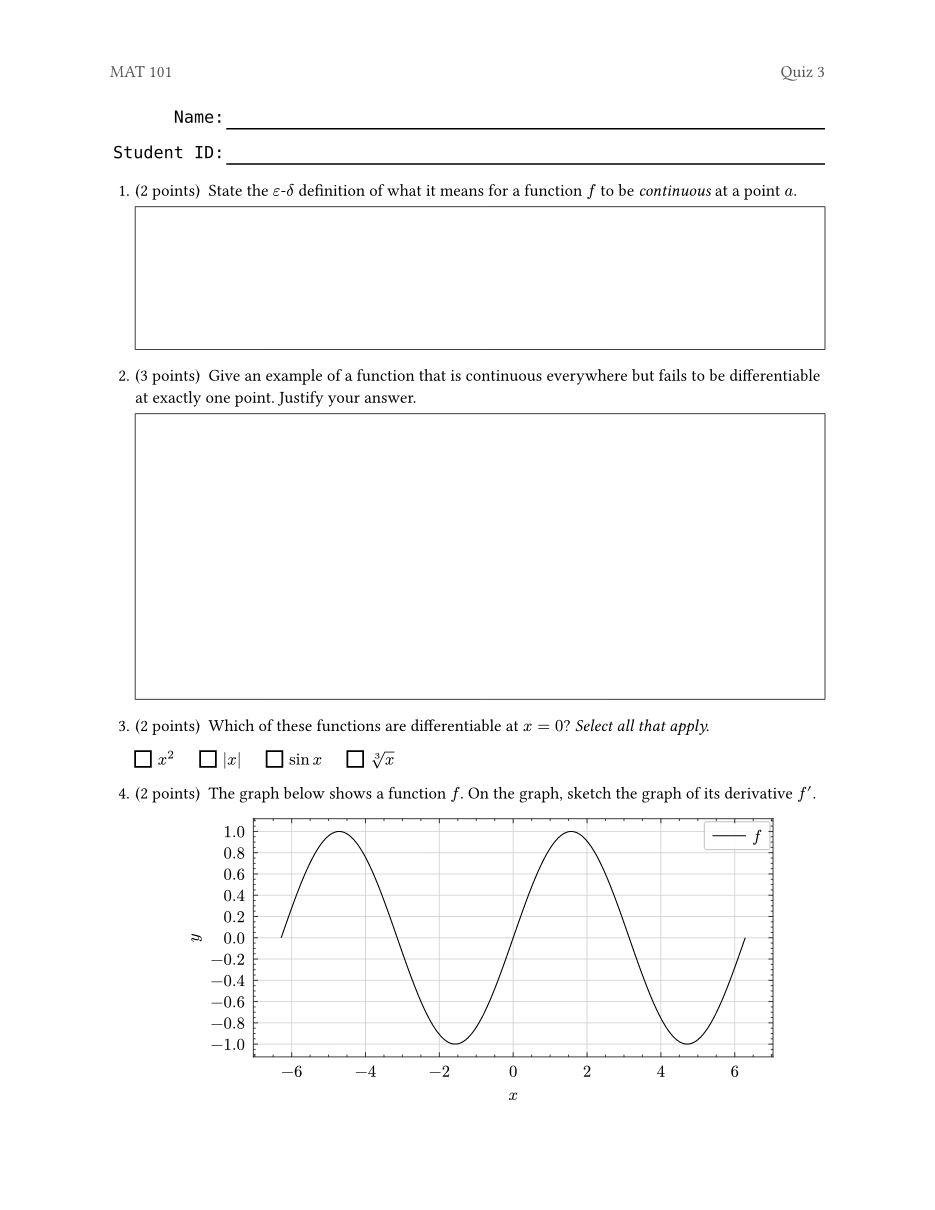
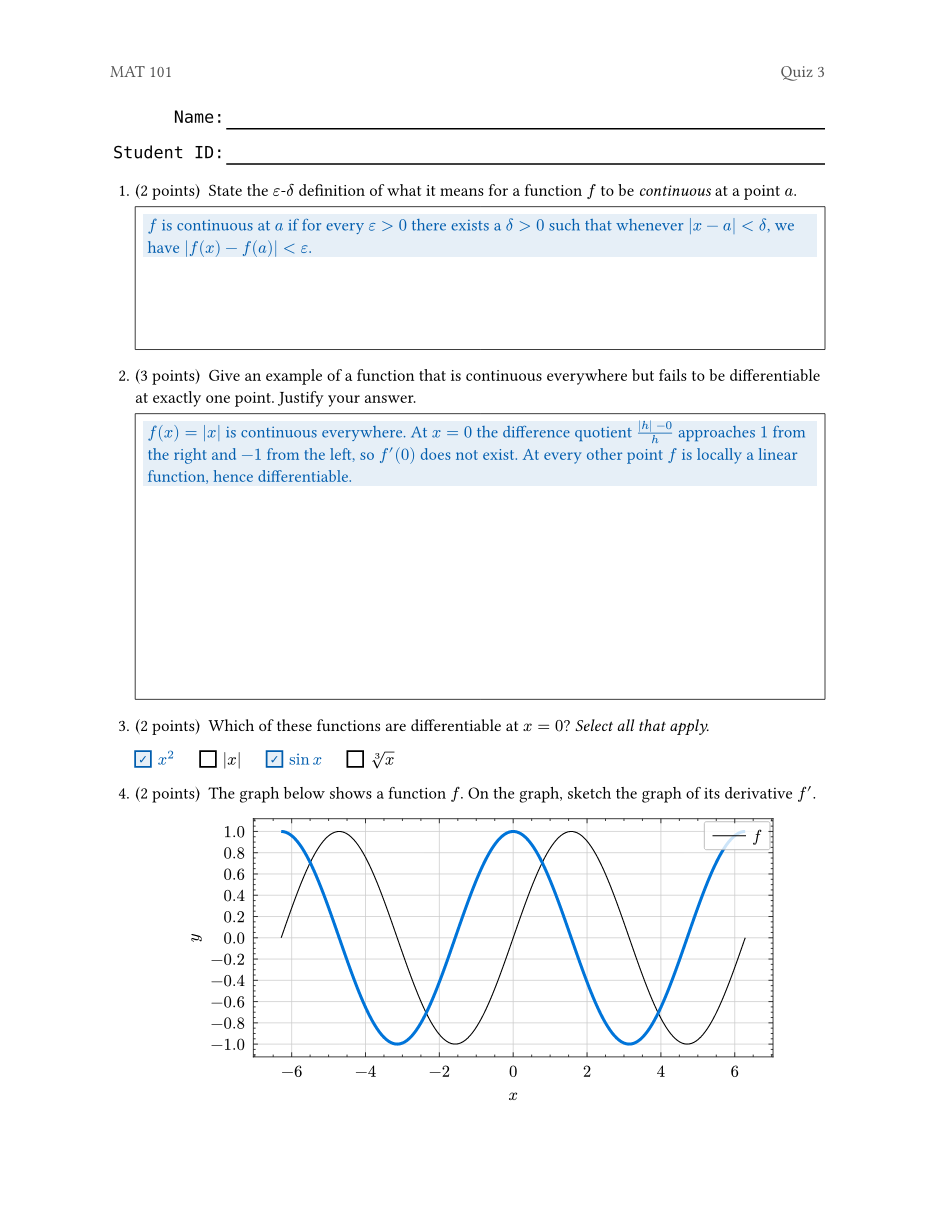
examples/quiz.typ, compiled without and with solutions.
Full documentation is available at the Examy website or downloadable as a PDF. See the examples/ folder for sample documents.
Quick start
A basic document looks like this:
#import "@preview/examy:1.0.0": *

#show: exam.with(show-solutions: false)

// A fill-in block (Name / Student ID) at the top of the page
#{
  set text(font: "DejaVu Sans Mono")
  name-block()
}

#question(points: 2)[
  State the definition of a _continuous function_.
  #answer-box(height: 1fr)[
    #solution[A function $f$ is continuous at $a$ if
      $lim_(x -> a) f(x) = f(a)$.]
  ]
]
#question(points: 3)[
  Give an example of a continuous function that is not
  differentiable.
  #answer-box(height: 2fr)[
    #solution[$f(x) = abs(x)$, at $x = 0$.]
  ]
]
A quick-start template is available by choosing examy under Start from template in the Typst web app or on the command line by running
typst init @preview/examy
Features
- Questions, parts, and subparts, numbered automatically.
- Points: points listed on a per-question basis as well as points tables and points per page displays.
- Answer boxes providing a student with space to write. These can have a fixed size or can use available space via fractional units (e.g.
height: 1fr). - Solutions: written solutions can be globally toggled as visible/invisible to make answer-key and blank versions of a test.
- Rubrics: annotate questions and solutions with grading rubrics (positive or negative points), exportable as JSON.
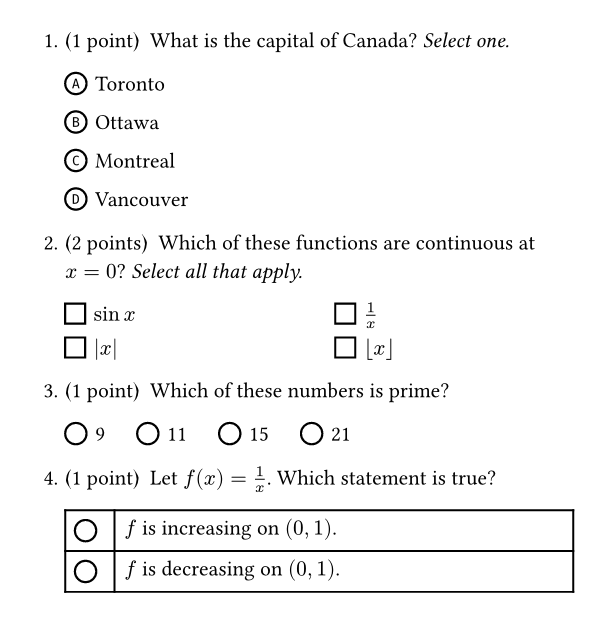
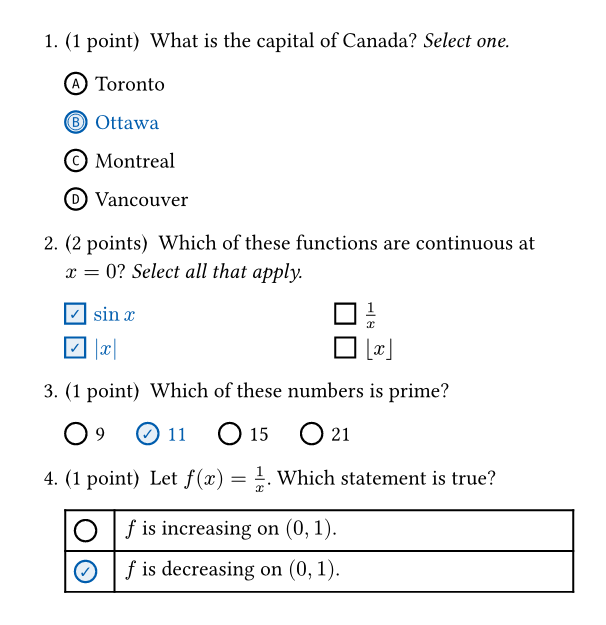
- Multiple choice with round or square bubbles, optionally enumerated.
- Smart cross-references:
a
@namereference to a question will show a minimal string that uniquely identifies the question/part/subpart. - Cover pages: basic commands for creating name/exam info areas.
Basic API Reference
All names below are exported by #import "@preview/examy:1.0.0": *. See the full reference for all arguments.
| Export | |
|---|---|
#answer-box[..] |
A box for students to write answers in. |
#choice[..] |
A round or square bubble (used for multiple-choice questions) followed by the choice it labels. |
#choices[..] |
An enumerate environment for multiple-choice answers. Every list item gets turned into a #choice, with a round/square bubble as its list marker. |
config |
Global configuration of package options. Give options to the exam, e.g. #show: exam.with(show-solutions: true), or set them with #show: e.set_(config, show-solutions: true). |
e |
A re-export of elembic, used mainly for e.set_. |
#exam[..] |
Lays out an exam. Start one with #show: exam (or #show: exam.with(..), with config options). |
#maketitle(..) |
The exam title block (in the spirit of LaTeX’s \maketitle). Exam information is read from the global config. |
#name-block(..) |
A block of fill-in rows for a student to write their name. |
#points-table(..), #num-points(..), #num-questions() |
A scoring table, and the exam’s points and number of questions as numbers, which need context (e.g. #context num-points()). |
#question[..], #part[..], #subpart[..] |
Declare a question, part, or subpart — numbered 1., (a), or i. respectively. |
#rubric[..], #rubric-list() |
Grading rubric items for a question, part, or subpart, drawn on the graders’ copy, and every rubric of the exam as a list. |
#solution[..] |
Declare a solution to a question, part, or subpart; this is only rendered if the config option to show solutions is enabled. |
License
MIT