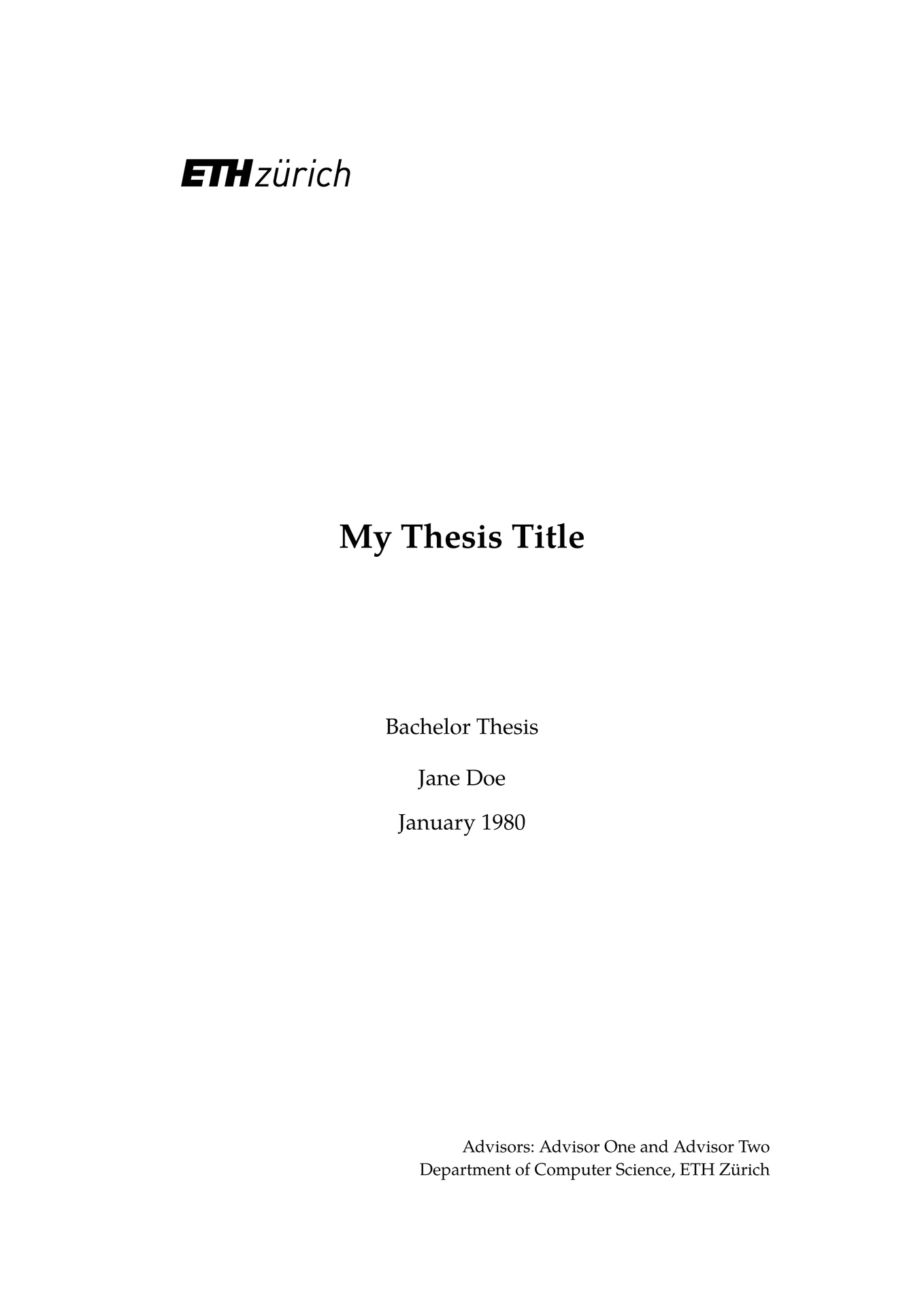
A template for writing a (bachelor’s) thesis at ETH Zürich.
It provides general styling and some useful helper functions.
It is an unofficial Typst adaptation of the CADMO LaTeX thesis template which is maintained by Kostas Lakis at CADMO (Center for Algorithms, Discrete Mathematics and Optimization), ETH Zürich. It is not affiliated with or endorsed by CADMO or ETH Zürich.
Usage
Start a new thesis from this template with:
typst init @preview/ethz-cadmo-inspired-thesis
or directly with:
#show: setup.with(
  "My Thesis Title", // title
  "Jane Doe", // author
  ("Advisor One", "Advisor Two"), // advisors
  thesis-type: "Bachelor Thesis",
  department: "Department of Computer Science",
  bib: bibliography("bib.bib", title: none),
)
Configuration
The template exports setup, applied as a show rule at the top of your
document:
| Parameter | Type | Default Value | Description / Note |
|---|---|---|---|
title |
content | str | Required | The title of the thesis |
author |
str | Required | The author’s name |
advisors |
array of str | Required | List of academic advisors |
department |
str | "Department of Computer Science" |
The academic department |
thesis-type |
str | "Bachelor Thesis" |
The degree level or type of thesis |
date |
datetime | datetime.today() |
Date of publication/submission |
bib |
bibliography | none | none |
Takes a Typst bibliography() element |
dev |
bool | false |
Force Work in Progress (WiP) mode |
doc |
content | Required | The rest of the document content |
Applied with #show: setup.with(...), it sets up the page and general structure needed for a thesis.
If bib is set, a References chapter with that bibliography is appended at the
very end. If you need the bibliography to appear before an appendix, leave bib: none and place the bibliography
yourself instead (see Bibliography and appendix).
Fonts
The template typesets in TeX Gyre Pagella. Typst cannot bundle a font into a package and load it automatically, so the font has to be available at compile time.
Download the OTF files from the official GUST e-foundry page and install them, or place them on your --font-path:
https://www.gust.org.pl/projects/e-foundry/tex-gyre/pagella
The font is distributed under the GUST Font License.
Document structure
| Helper | Purpose |
|---|---|
frontchapter(title) |
An unnumbered level-1 heading for front matter such as Abstract or Acknowledgments. |
#show: mainmatter |
Starts the numbered body: resets the page and chapter counters and switches to arabic page numbers. Apply once, after the front matter. |
#show: appendix |
Switches heading numbering to letters (A, A.1, A.2, …). Apply once, at the start of the appendix. |
Headings render as:
- Level 1: a centered
Chapter Nlabel above the title, framed by rules (the label is omitted for unnumbered chapters). - Level 2 / 3: bold section and subsection titles.
The running header shows Chapter N - N.M Section Title and is hidden on pages
that begin a new chapter.
Bibliography and appendix
To keep the references and appendix out of the word count, wrap them in a
<no-wc>-labelled block and set bib: none:
#[
  #set page(numbering: "1")
  #heading(level: 1, numbering: none)[References]
  #bibliography("bib.bib", title: none)

  #include "chapters/appendix.typ"
] <no-wc>
An appendix file then looks like:
#show: appendix
#frontchapter[Appendix]

== First Appendix Section   // numbered "A"
=== A Subsection            // numbered "A.1"
Theorem environments
All environments take a body and an optional name, and are numbered
chapter.n, resetting at every chapter:
#theorem(name: "Fermat")[
  There are no positive integers $a, b, c$ with $a^n + b^n = c^n$ for $n > 2$.
]

#proof[
  The margin is too small. #h(1fr)  // proof already appends a QED square
]
Available: theorem, lemma, corollary, proposition, definition,
example, remark, claim, and proof.
Code listings
code renders a single raw block with line numbers, in a rounded gray frame:
#code(
  ```rust
  fn main() {
      println!("hello");
  }
  ```,
  filename: "main.rs",     // optional file label in the header
  projectname: "my-crate", // optional right-aligned label
  start: 1,                // first line number
  breakable: false,        // allow the listing to split across pages
  highlight: none          // optional line to highlight
)
code-file embeds code read from a file, optionally limited to a line range.
The caller reads the file so Typst tracks it as a dependency:
#code-file(
  read("../src/lib.rs"),
  lang: "rust",
  from: 10, to: 25,        // inclusive, 1-indexed; line numbers stay aligned to the file
  filename: "lib.rs",
  highlight: none          // optional line to highlight
)
To keep parts of a file out of the listing (for example a test-harness preamble
that has to stay in the file to keep it runnable), wrap them between a line
containing <hide> and a line containing </hide>. Both marker lines and
everything between them are dropped from the display, and the remaining lines
are renumbered contiguously from start. Because the markers live in comments,
the source file still compiles and runs unchanged:
// <hide>
//@compile-flags: -Zmiri-tree-borrows
// </hide>
use std::io::Read; // shown as line 1
Hiding is meant for file-only preambles and is not combined with from/to.
multi-code shows several excerpts of the same listing separated by a dashed
“…” line, for skipping over irrelevant lines. It takes an array of
(raw, start-line) tuples:
#multi-code((
  (```rust
  fn first() {}
  ```, 1),
  (```rust
  fn later() {}
  ```, 42),
))
Inside any listing, the token <fakebreak> is replaced by a newline, which lets
you force a break within a single source line.
Utilities
breakable-id(n) returns a string with zero-width spaces inserted after every
- and _, so long identifiers (package names, crate names, symbol paths)
can break across lines without an explicit hyphen:
#raw(breakable-id("my-very-long-crate-name"))   // breaks at each `-`
#breakable-id("some_module::long_symbol")        // use in any content
display-pr(url) displays a GitHub or GitLab Pull Request in a shorter, more readable format.
Cross references
nameref(label) links to a labelled heading and prints its supplement, number
and title, e.g. #nameref(<sec-method>) → “Section 3.2: Method”. For unnumbered
headings it falls back to the heading text alone.
== Method <sec-method>
...
As shown in #nameref(<sec-method>), ...
TODOs and WiP mode
todo(body, inline: false) marks unfinished work:
#todo[rewrite this paragraph]           // block
Some text #todo(inline: true)[fix ref]. // inline
While any TODO is present (or dev: true is passed to setup), the document
is in work in progress mode: the title page shows a red Work in Progress
banner and every running header shows WIP · N words. Once the last TODO is
removed, both disappear automatically.
Colours
This template also exposes some colours. The official ETH colours can be found at eth. The custom colours used for some functions can be found at custom.
Exports
setup, mainmatter, appendix, frontchapter, display-pr, nameref, todo,
code, code-file, multi-code, breakable-id, theorem, lemma, corollary,
proposition, definition, example, remark, claim, proof, eth, custom.
Contribution
I’m always open to contributions / feedback. As the repo currently only tracked in typst packages, just send me an email with a diff / comment and I will integrate it: mail@dominik-schwaiger.ch
Full Example
A full example how the template can be used can be found here: https://gitlab.dominik-schwaiger.ch/quio/bachelor-thesis/-/tree/main/Thesis?ref_type=heads
Acknowledgments
This template is a Typst port of the CADMO LaTeX thesis template by Kostas Lakis (CADMO, ETH Zürich).
Many thanks to VirtCode, whose work the code-listing helpers are based on.
The body font is TeX Gyre Pagella by the GUST e-foundry, distributed under the GUST Font License.